



When Jeff Emch was hired at Poseidon Barge Corp., Berne, Ind., in 2009, he was the first degreed naval architect to join the organization. The owner, Donnie Fain, couldn’t tell him soon enough that the first project he wanted Emch to work on was a sectional jack-up barge.
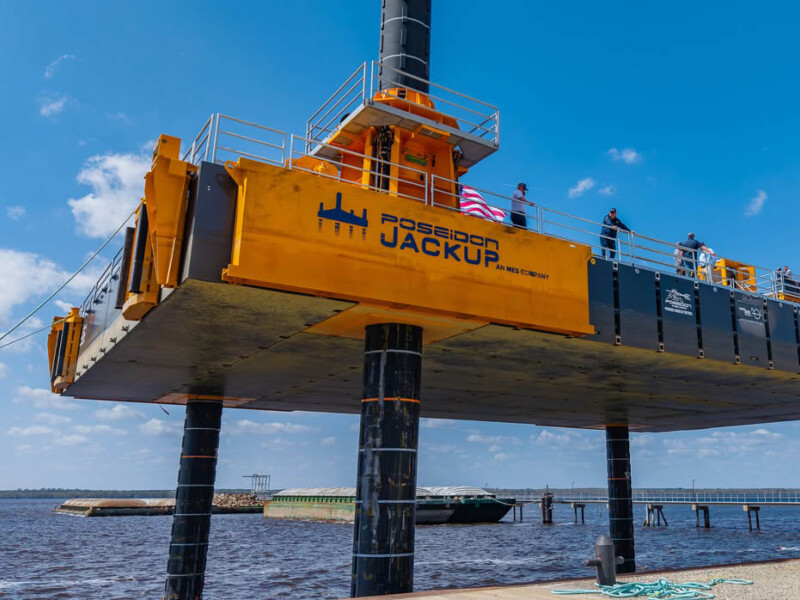
Fast forward to April 2026, and the collaborative effort known as Poseidon Jackup introduced the MES-C7, a 100'x60' self-elevating barge platform that can work in water depths exceeding 100’ and can carry a 440-ton deck load elevated by four oversized hydraulic cylinders. The combined and loaded platform can be lifted at a rate of 8" per minute.
“We had an impromptu christening ceremony where [Fain] brought three of his closest friends and a champagne bottle or two,” said Emch when the first MES-C7 was launched, a moment that was years in the making. “He grabbed me and our operations director, and we had our own personal moment of reflection.”
Poseidon Jackup was born from a collaboration between Poseidon Barge, a builder of sectional barges in Berne, Ind., and Combifloat Systems BV, a Dutch firm known for modular, floating, and self-elevating barges that wanted to make inroads in the North American market. Combifloat and Poseidon Barge formed a joint venture backed by Marine Equipment Solutions (MES), Seattle, a parent company of Poseidon Barge, Rasmussen Equipment Co., Seattle, Portadam, Williamstown, N.J., Pacific Gulf Wire Rope, Belle Chasse, La., and Humco Marine Products Inc., St. Louis.
Poseidon Jackup launched in September 2025 with the aim to introduce purpose-built, Jones Act-compliant jack-up barge systems designed for the North American market. For international accreditation, the platforms are RINA-classed.
“This jack-up application is the first of its kind,” said Emch. “While other sectional barge manufacturers in the United States have self-elevating systems, their capacities are not even half.”
The MES-C7 achieves its lifting capacity by integrating the legs into the internal structure rather than mounting them externally. “It’s definitely a key component,” Emch said of the legs. “Another key component is the design of the legs themselves.”
The steel legs each measure 48" in diameter with a 1½" wall thickness. Weighing more than 50 tons apiece, each leg is assembled from two 63' sections to reach its full 126' length.
The legs extend through the body of the steel platform, each supported by four hydraulic cylinders operating at more than 3,500 psi. From an elevated, climate-controlled central command station, all legs can be operated simultaneously, and platform systems can be monitored. For redundancy, each leg also has manual controls at its four jacking tower locations on deck, and a secondary hydraulic power circuit is kept on standby. All four corners of the platform are fitted with heavy-duty fenders, bitts, fairleads, and hydraulic mooring winches. An anchor boat typically runs out the lines and sets the grounding tackle, often with the assistance of a pushboat or a tugboat.
The platform will be leased for applications including precision long-term pile driving, waterfront construction, seawall and shoreline maintenance, bridge work, cable laying, offshore wind, and cable and communications infrastructure.
Jody Jordan, MES national sales director, couldn’t share lease rates due to non-disclosure agreements. “The rates are well in line of liftboats and crews or other single hull jack-up platforms,” said Jordan. “A huge benefit is in the fact that the jack-up, once elevated, is equal to working on land versus floating platforms. This lets customers avoid derating their cranes and work faster.”
The process begins with Poseidon Jackup engineers working alongside clients and their geotechnical teams to evaluate seabed soil properties at the proposed project location, confirming the site can support the platform and planned operations. Because the platform is modular, it can be transported by road in 33 truckloads. That modularity also allows deployment in inland rivers, lakes, reservoirs, and locations inaccessible to larger single-hull platforms.
When the platform sections arrive at a site, they are loaded into the water and assembled by a crew from MES in about a week. “There’s a distinct order and procedure to ensure the platform goes together as it should,” Emch said. “The assembly procedure is well-documented and can be accomplished with the same basic equipment that a standard floating sectional barge would require, with the addition of a manlift to assist with spud leg installation.”
Once assembled, cranes lift the leg sections and lower them into the structurally reinforced jacking towers integrated within the hull. Legs are installed diagonally in sequence to distribute weight evenly and prevent misalignment from list or trim. With the platform fully assembled and commissioned, it’s ready for a jacking captain. “We highly recommend a certified jacking captain,” Jordan said. “That person may be there for 15 to 30 days, depending on the mobility needs of the site and how frequent the lift and positioning is needed.”
For around-the-clock coverage, MES recommends two captains working rotating 12-hour shifts, using cameras and sensors to continuously monitor the platform’s position and instrumentation from the control house.
Looking ahead, MES plans to develop the MES-C9, a taller platform with a 1,200-ton deck load capacity, expanding a lineup that already includes the MES-C7 and MES-C5. All platforms are built at the company’s factory in Berne, where 111 of MES’s 254 staff members make up the Poseidon Jackup production team.
The MES-C7 made an immediate impression. After seeing the platform for the first time, a vice president at a major U.S. construction company told Jordan, “You have significantly outpaced your competition with this.”
Jordan reflected on what that response has meant for the company: “It drew attention not only to the Poseidon Jackup, but to everything else that MES has to offer. Our customers are becoming more reliant upon our skill set as a partner to who they are rather than just a supplier for what they need.”
