



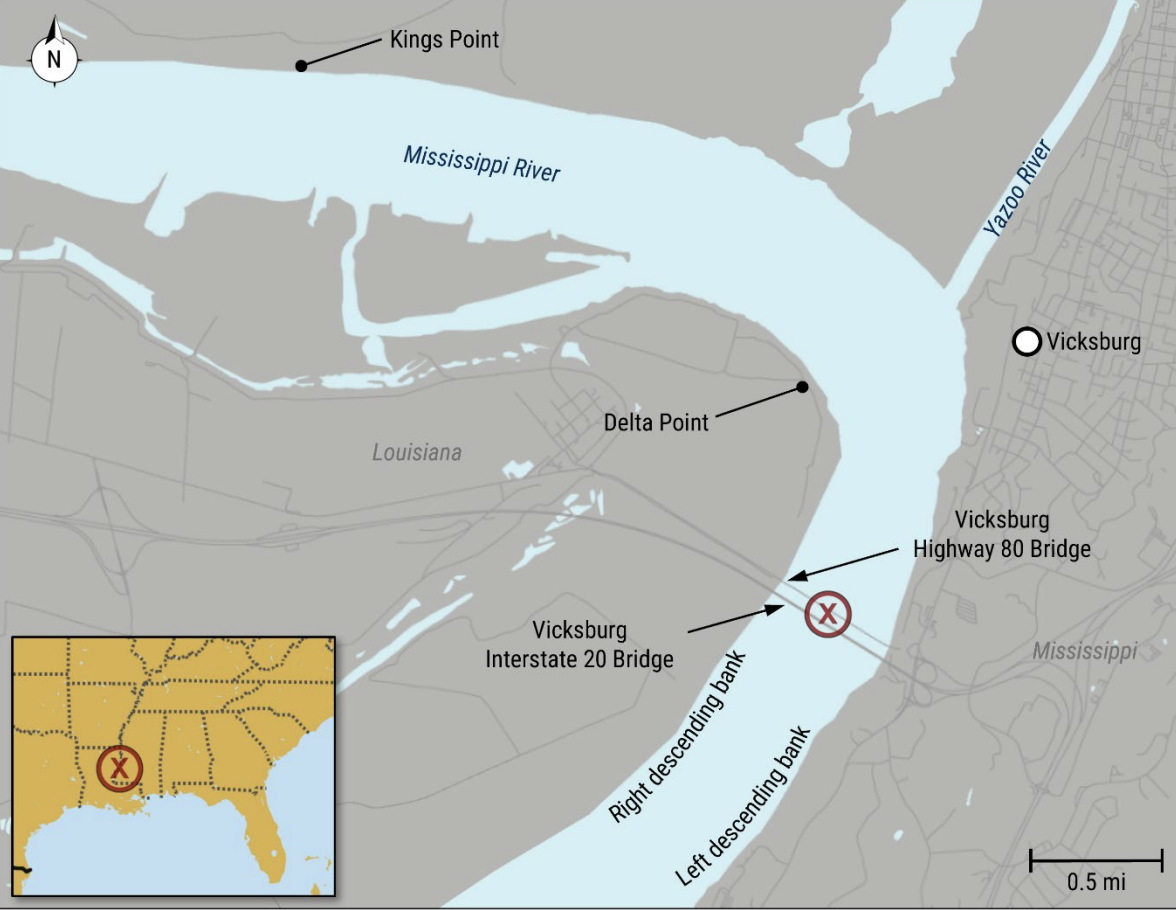
The National Transportation Safety Board (NTSB) has released a report on its investigation into a May 1, 2025, allision on the Lower Mississippi River near Vicksburg, Miss., involving the tow of the m/v Rickey Hughes and the Highway 80 Bridge.
At the time of the allision, the vessel, part of the fleet of American Commercial Barge Line (ACBL), was southbound, headed to New Orleans with 22 barges. The barges were arranged in five strings, four with five barges each and one with two barges. Cargos included potash, petroleum coke, corn, distillers grain pellets, lead concentrate, OSB-C, OSB-D, and soybeans, according to the NTSB. Due to the river stage at Vicksburg measuring 48.73 feet at the time, a shoreside captain came on board at Kings Point, Miss., to provide updated river conditions and guidance for transiting the Vicksburg bridges.
According to the NTSB, at the time the Rickey Hughes transited the Vicksburg harbor, the river was running at about 5 mph, and winds were blowing at 8 mph. Around 2:45 p.m., with the pilot, mate, and shoreside captain in the wheelhouse of the Rickey Hughes and the pilot at the helm, an alarm sounded in the wheelhouse, in the engineer’s cabin, at the engine control room booth, in the engine room, and in the rudder room. Upon checking the alarm, the pilot saw an “oil pressure” disclaimer for the flanking steering system.
The engineer, who was off watch and asleep, was awakened by the alarm and, upon finding alarms showing low flanking system voltage and low flanking system oil pressure, made his way to the rudder room to investigate. He discovered that the flanking steering pump was not running. The engineer began an emergency steering change over, but after switching the third valve and staring the auxiliary pump motor, hydraulic oil erupted from the flanking rudder system’s hydraulic reservoir tank, covering the engineer’s face and body.
“The engineer was wearing glasses, and they were also covered in oil,” the NTSB report stated. “The engineer told investigators that he had difficulty seeing the valve tags with the valve numbers.”
Meanwhile, in the wheelhouse, the pilot noticed the head of the tow falling to port in the current. At about 2:52 p.m., the pilot attempted to use the steering rudders to correct course, but he noticed there was no response. The pilot then “stated aloud that he had no steering and sounded the general alarm to muster the crew,” the NTSB report stated.
The vessel’s captain, in the wheelhouse for the bridge transit, went to the rudder room “to figure out why steering had been lost.”
“When he got to the rudder room, he met the engineer, who was covered in hydraulic oil,” the NTSB report stated. “The vessel’s captain looked into the rudder room and saw ‘oil everywhere.’”
Though the pilot attempted to slow the vessel’s forward speed by backing full astern, the Rickey Hughes’ two lead barges on the starboard string contacted the main bridge span’s pier on the right descending bank side of the river at about 9 mph. Seven of the barges broke free, and one of the barges sank.
The pilot was able to use thrust from the propellers to maneuver through the bridge span, and several other vessels in the area arrives a few minutes later to assist with gathering loose barges and pushing the Rickey Hughes to the bank.
The barge that sank was a covered hopper barge loaded with soybeans. According to the NTSB report, the barge was valued at $73,000, while the cargo was valued at $610,000. Total damage to four barges involved was estimated at about $1.9 million. Neither the Rickey Hughes nor the bridge sustained damage.
The NTSB determined that the probable cause of the allision was loss of all steering due to the engineer misaligning the flanking rudder system’s hydraulic valves as he responded to the low-pressure alarm. After the allision, ACBL initiated a “steering campaign,” according to the NTSB, to inspect every steering system on the company’s vessels. The port engineer also required each engineer on board the Rickey Hughes to practice changing the hydraulic systems to the auxiliary system for steering.
“On May 18, the engineer that had been aboard the Rickey Hughes during the Vicksburg Highway 80 Bridge strike completed the steering system swap and notified the port engineer,” NTSB stated.
