



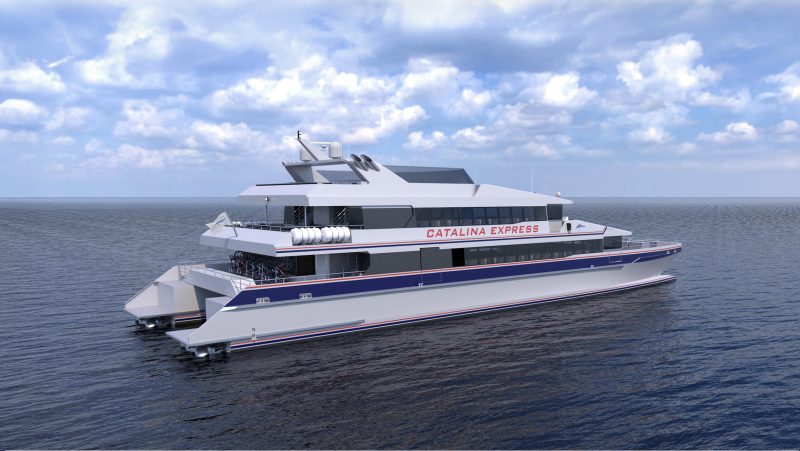
Marine Group Boat Works, Chula Vista, Calif., has been selected to build a 524-passenger, low-emissions ferry for Catalina Express under a $30 million contract announced July 20.
The 46-meter high-speed catamaran, designed by Incat Crowther, Lafayette, La., will be constructed at Marine Group’s Chula Vista shipyard. The vessel is expected to launch and begin sea trials in the third quarter of 2027.
The ferry will be equipped with four Tier 4 MTU 12V 4000M65L engines and a proposed diesel particulate filter once the system is certified by the Environmental Protection Agency, Coast Guard, and California Air Resources Board. The vessel is being developed to meet CARB’s Commercial Harbor Craft Regulation.
Earlier design details released in 2025 called for the ferry to operate on R-99 renewable diesel at speeds of up to 37 knots. It will serve Catalina Express routes between the Southern California mainland and Santa Catalina Island, including the roughly one-hour crossing from Long Beach.
The vessel is part of the Los Angeles Marine Emission Reduction project, or LA MER, a demonstration program involving CARB and the Port of Los Angeles. Catalina Express received a $15 million grant toward the ferry and committed another $15 million to the project.
The broader $31 million LA MER initiative is testing emissions-reduction technology aboard passenger ferries and excursion vessels. The program also calls for an evaluation of the technology’s feasibility, shoreside infrastructure needs, and workforce requirements for advanced engine and battery-electric systems.
Catalina Express plans to use the new ferry to replace three smaller vessels powered by a combined six Tier 2 and Tier 3 engines. The change is intended to reduce fleet emissions while maintaining the same passenger capacity within the Catalina Express fleet.
“For over 45 years, Catalina Express has been committed to environmentally conscious operations, consistently meeting or exceeding federal and state emissions standards,” Greg Bombard, president and CEO of Catalina Express, said. “We’re proud to be part of the LA MER program and grateful for the opportunity to collaborate with MGBW Shipyard on this next-generation vessel.”
Earlier design information called for indoor and outdoor seating, two passenger kiosks, protected luggage storage, space for 16 bicycles, café-style seating, and accessible restrooms. The design also included a resiliently mounted superstructure to reduce noise and vibration and a Naiad active ride-control system with T-foils and interceptors to help limit vessel motion.
Marine Group said the project is expected to support more than 100 full-time jobs during construction, including positions for shipyard craftsmen, engineers, production personnel, and support staff. The build will require more than 200,000 lbs. of locally sourced aluminum and more than 880' of piping materials.
Using Maritime Administration industry multipliers, Marine Group estimated the project will generate more than $54 million in total regional economic impact.
