


.jpg.medium.800x800.jpg)
MobileOps, Bellevue, Wash., and MM-SEAS, Virginia Beach, Va., have signed a memorandum of understanding (MOU) to connect their respective software platforms in an effort to automate sea service letters and streamline credential compliance.
Both companies say the partnership is rooted in their shared backgrounds as mariners and operators, and in a common goal of making administrative requirements less burdensome for working crews.
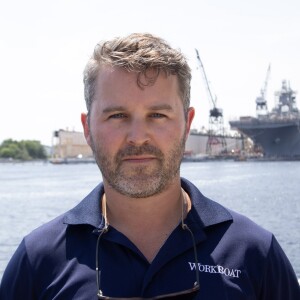
MobileOps founder and president David Hill said the partnership is intended to reduce manual back-office work and simplify routine credential tasks for mariners.
“We’re excited about the MM-SEAS MobileOps partnership,” Hill said. “We see a lot of synergies and a lot of advantages for our customers with what they’re doing, coupled with what we do,” noting the partnership is “a great union between two companies.”
Under the MOU, MobileOps’ timekeeping and vessel location data, already captured for daily operations and regulatory compliance, would feed directly into MM-SEAS’ credential-management platform to support automatic generation of sea service letters. In turn, MM-SEAS would share real-time credential data back to MobileOps so operators can view license, medical and document status while making crewing decisions.
“What they [MobileOps] have is they have the ability to track the crew in real time because they already have to by law, and the ability to track where the vessel is,” said Nate Gilman, founder and president of MM-SEAS. “We have all the compliance…someone’s actual credentials, someone’s TWIC, someone’s medical, their passport.”
Gilman said MM-SEAS “hit[s] the different databases to update it in real time and make sure it’s valid,” adding that integrating that information into operational systems can reduce the risk of credential gaps that sideline crew at the last minute.
For Hill, the partnership centers on usability and data integrity.
“The digital product of MobileOps is about finding a solution that provides the least amount of clicks, the best user interface and the best user experience that makes it easier for the mariner,” Hill said.
Both companies identified sea service letters as one of the most persistent administrative pain points in the industry.
“Sea service letters are the big pain that every operation has because they get requests and then it’s a manual process,” Hill said.
Gilman joked, “Service letters are the bane of my existence. They are the Wild West.”
MM-SEAS has been developing a standardized format designed to match U.S. Coast Guard expectations.
“When [mariners are] ready for upgrading, renewing, getting their first license, they click a button in our software and it creates the sea service letter automatically exactly how the Coast Guard wants it,” Gilman said. By contrast, he described the current process as “it can take four or five hours per person to scrub through payroll and logs just to ensure everything is 100% factual.”
Hill said MobileOps intends to offer the automated sea service-letter workflow across its customer base but noted it depends on operators using MobileOps’ timekeeping module as the source data.
“If there’s a customer that’s not using our timekeeping function, they will need to use our timekeeping function because that’s the data … which gets pushed over to MM-SEAS to produce that automated digital letter ready for digital signing,” Hill said.
Technical planning is already underway. “We’ve…got all the framework in place at a high-level MOU discussion level,” Hill said. “Now we’re getting down to, ‘OK, what’s the programming needs?’”
Gilman said the development timeline is measured more by rollout and polishing than core coding.
“We can have it done probably by the end of this quarter, middle of next quarter,” he said. “The technical lift isn’t that hard. It’s the polishing afterwards.”
MM-SEAS’ platform is typically paid for by employers as part of an established compliance program, Gilman said, and the integration is expected to be included for customers already using both systems.
Built by mariners
Both executives point to their time on and around vessels as the foundation for the partnership.
Hill’s career spans nearly 40 years in transportation including work in towage, shipping and logistics operations. He began in the 1980s handling vessels for what became China Ocean Shipping Company followed by the last 20 years at Foss Maritime and G&H Towing during which time MobileOps was formed.
"This was a great experience,” Hill said of his work at Foss and G&H Towing, where he worked across “harbor services, coastal and ocean towing, managing all aspects of it from operations to safety to commercial.”
He said MobileOps was founded in 2016 as operators prepared for Subchapter M and rising administrative demands.
“The burden of paper in the wheelhouse and paper shoreside, we needed digital products,” Hill said.
Gilman’s path began hawsepiping on Puget Sound before moving into shoreside roles that included issuing sea service letters. He later served as deputy chief of marine operations for NOAA’s Atlantic fleet, where he saw how credential gaps could halt operations and delay careers.
Those experiences, he said, demonstrated how an expired document or delayed letter can trigger a no-sail event.
Both leaders described the MOU as an effort to close the gap between shoreside administration and life on deck.
“There’s always that gap, that water between the pier and the rail, and you got to step over that,” Hill said. “We need to go to the water side. We need to step over and meet them on their ground and find solutions for them.”
Gilman said the focus remains on the end user. “The goal is to bring as much value to the mariners themselves,” he said.
