



The U.S. Navy has issued a request for proposals for a vessel construction manager (VCM) to oversee acquisition of the medium landing ship (LSM), signaling a shift in how the service plans to manage the new amphibious program.
The VCM will serve as the prime contractor, holding the primary contract with the Navy and issuing and managing subcontracts directly with shipbuilders. The award is anticipated in mid-2026.
For initial production, the Navy intends for the VCM to manage construction at Bollinger Shipyards and Fincantieri Marinette Marine. Bollinger was awarded a contract in September 2025 for long-lead-time material procurement and lead-ship design engineering. Fincantieri Marinette Marine is slated to build four ships under the base contract.
The VCM will also determine the contracting approach for three additional ships authorized under the base contract.
Under the structure outlined by the Navy, the VCM will maintain direct contractual control over shipyard performance. Navy officials said the model is intended to reduce cost and schedule risk by inserting a commercial-style program manager between the service and the builders, while relying on a mature, “build-to-print” design.
Rear Adm. Brian Metcalf, program executive officer for ships, said the approach is intended to accelerate timelines while broadening industrial base participation.
“The VCM approach not only accelerates construction timelines but also strengthens our industrial base by engaging multiple shipyards,” Metcalf said. “By providing a mature, ‘build-to-print’ design and empowering a VCM to manage production, we are streamlining oversight for this acquisition.”
The strategy departs from traditional Navy shipbuilding programs, where the service typically contracts directly with a prime shipbuilder and assigns larger government oversight teams. Under the VCM construct, production will be managed across multiple yards in parallel using commercial shipbuilding practices and with fewer Navy personnel assigned to the program.
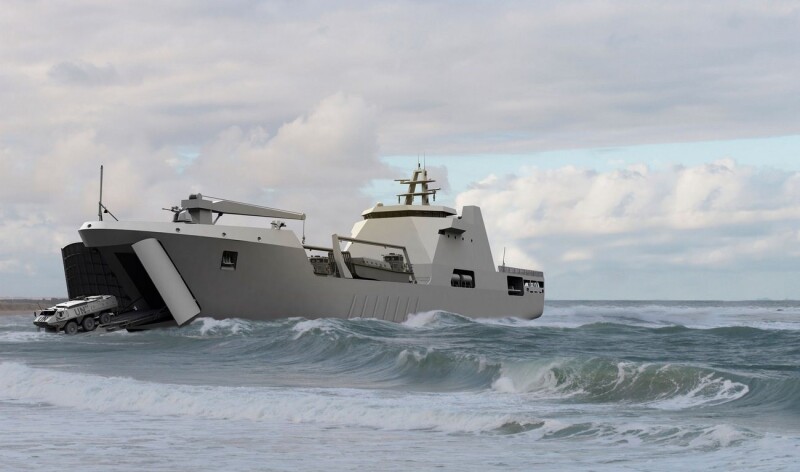
The Navy and U.S. Marine Corps in December 2025 selected Damen Naval’s LST 100 design as the baseline for the LSM. The design is described as non-developmental, a factor the service said will reduce technical risk and help accelerate fielding.
The Medium Landing Ship is intended to bridge the gap between smaller, short-range landing craft and the Navy’s larger amphibious warships. The program calls for a 35-ship fleet to support Marine Corps distributed operations and logistics in contested littoral environments, particularly in the Indo-Pacific.
