


As San Francisco Bay Ferry awaits the arrival of its zero-emission newbuilds, the agency is ensuring that the final diesel-powered vessels to be built for its fleet are the cleanest in the nation.
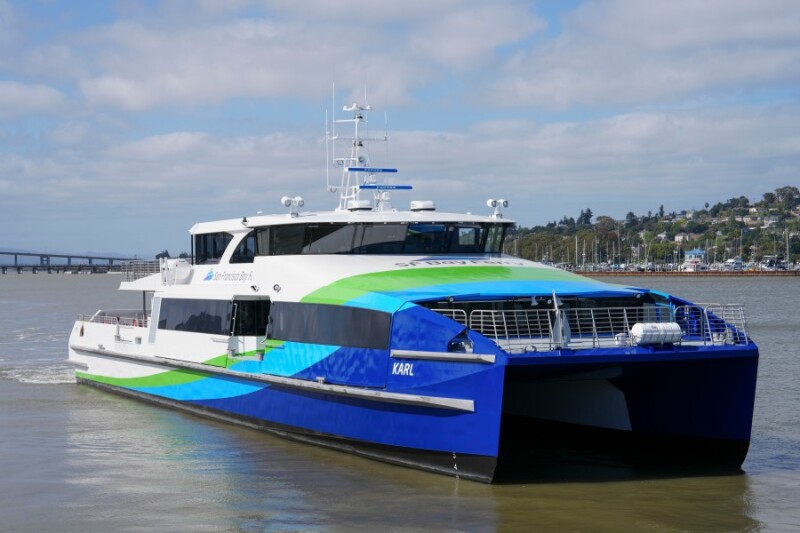
In April, SF Bay Ferry took delivery of the high-speed passenger vessel Karl, a 137'x36.45' aluminum catamaran designed by One2three Naval Architects, Pyrmont, Australia, and built by Mavrik Marine Inc., La Conner, Wash., with construction management services provided by Aurora Marine Design, San Diego.
The boat’s EPA Tier 4-compliant propulsion package includes quad MAN D2862LE48B diesels that produce 1,450 hp at 2,100 rpm to power four HamiltonJet HTX-52 waterjets through Reintjes WVS440 DR DL gears. The ferry, which has 2,000 gals. fuel capacity and runs on R99 renewable diesel, cruises at 40 knots.
Karl features selective catalytic reduction (SCR) systems to reduce nitrogen oxide emissions, and it is the first passenger ferry in the United States to be equipped with diesel particulate filters (DPF). The vessel’s four MAN DPF units — one for each engine — filter virtually all the soot particulate from engine exhaust, ensuring compliance with California Air Resources Board (CARB) harbor craft emissions regulations.
Karl is the third of four Dorado-class commuter ferries for SF Bay Ferry, following Dorado and Delphinus delivered in 2022 and 2024. However, it is the first to have DPF units on board. The series’ final vessel, Zalophus, which will have an engine and emissions package identical to Karl’s, including SCR and DPF units, is expected to arrive in the Bay Area at the end of the year.
This propulsion arrangement was chosen early in the build program to ensure the Dorado-class design could accommodate the SCR and DPF units once approved, a San Francisco Bay Ferry spokesperson told WorkBoat.
Industry groups such as the American Waterways Operators have advocated against the mandatory installation of DPFs, citing safety concerns and a lack of suitable marine-certified equipment. The Coast Guard has also expressed concerns about DPF’s fire safety. Nevertheless, CARB moved forward with its mandates, requiring DPFs beginning Dec. 31, 2024.
The new equipment brings updated training protocols for captains and crews, but SF Bay Ferry believes running the units will demand minimal operational adjustments. “The MAN DPFs are passive and regenerate (self-cleaning) at sufficiently high exhaust temperature,” the agency’s spokesperson said. “In Karl’s use case, the regeneration curve corresponds to full regeneration at a low rpm, theoretically allowing minimal maintenance requirements.”
SF Bay Ferry secured federal funding for DPF technology through U.S. Sen. Alex Padilla and U.S. Rep. John Garamendi, both Democrats of California. This included a $1.52 million congressionally directed spending request from Garamendi to purchase DPFs for Karl and Zalophus. The request covered 80% of the cost, with the remaining 20% funded by local bridge toll revenue and state transit assistance.
“We’re so proud of the work SF Bay Ferry has done along with CARB, the U.S. Coast Guard and other partners to advance clean maritime technology in the Bay Area,” Jim Wunderman, SF Bay Ferry board of directors chairman, said in a statement. “It’s exciting to see state-of-the-art innovation providing passengers with safe, reliable, and affordable transportation across all of the communities we serve.”
Manned by a crew of four, plus one bartender, the 46 CFR Subchapter K ferry has capacity for 320 passengers and 37 bicycles, with a fully enclosed upper deck area. It holds 500 gals. potable water and 500 gals. sewage.
Karl features HamiltonJet AVX controls, Furuno electronics, MTU NautIQ alarm and monitoring system, and a Humphree trim control system. Service power is provided by a pair of Northern Lights M99C13 gensets.
The new ferry, which began serving the operator’s Vallejo route in May, was named through a youth-led regional contest. High schooler Sean O. submitted the winning name, inspired by the Bay Area’s iconic fog, popularly known as “Karl the Fog.” It topped a public vote and was approved by the SF Bay Ferry Board.
The four Dorado-class vessels will be the final diesel ferries to join the SF Bay Ferry fleet. CARB recently approved the agency’s plan to accelerate the transition to zero-emission technology for new short-run and existing transbay routes. The first five battery-electric ferries are now under construction, with the first set to enter service in early 2027.
