



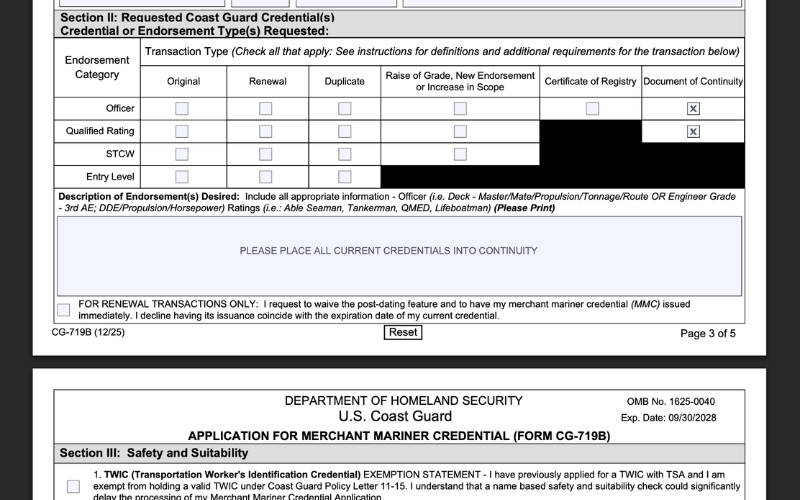
Of all the reforms in the White House Maritime Action Plan, one stands out as the single highest-impact change for bringing experienced mariners back to work: eliminating Documents of Continuity.
It sounds like a small administrative fix. It isn't. This one change could unlock thousands of credentialed mariners who left the industry years ago and want to come back. This is exactly the workforce we need as America scales up its maritime ambitions under Executive Order 14269, "Restoring America's Maritime Dominance."
Here's the problem. Right now, when a mariner's MMC expires, they have six years to either renew it or file a continuity application with the Coast Guard. The continuity application is a CG-719B form with a few boxes checked and is about 30 seconds of paperwork. File it in time and your qualifications are preserved. You can renew your MMC and return to work whenever you're ready.
If you miss that six-year window, you lose credit for every Coast Guard-approved training course and exam you ever passed. You're not required to prove sea time again, but you have to retake all of the underlying training and potentially the original exams to get back to the same USCG credentials you already earned. We're talking thousands of dollars and months of time to return to exactly where you already were.
Think about the AB tankerman who spent years working in the ATB fleet and left the industry when oil prices cratered a decade ago. With the maritime industry now expanding, that mariner is ready to come back. Under the current system, whether or not they can affordably return to work comes down entirely to whether they remembered to file a form most mariners don't even know exists. If they filed it, they follow the standard renewal process and get back to work. If they didn't, they're looking at a bill that may make re-entry not worth it.
That's not a safety standard. That's a trap.
The absurdity becomes obvious when you look at how STCW international endorsements are handled. STCW endorsements aren't subject to any continuity paperwork at all. A mariner holds their STCW endorsements for the rest of their life no matter how long their credential has been expired. When they're ready to come back, they follow the standard renewal process, no continuity application, no deadline, no cliff. It works exactly the way the whole system should work.
There's no logical reason domestic national endorsements should be treated any differently. The fix is simple: when your MMC expires, it expires. When you're ready to come back, you follow the standard renewal steps that every other renewing mariner follows. No continuity applications, no six-year deadline, no paperwork trap.
This change also directly helps the National Maritime Center dig out from the application backlog created by the recent government shutdowns. Every continuity application that staff process, every physical document they print and mail, is time and capacity that could be spent on that backlog instead. Eliminating continuity removes a category of work from the NMC entirely, freeing up resources for the applications that actually get mariners back on the water. And once the backlog is cleared, that same efficiency benefit carries forward permanently, helping the NMC process every future application faster.
The Maritime Action Plan specifically calls for the elimination of Documents of Continuity as part of its deregulatory push to remove barriers to re-entering the maritime workforce. Congress should lock that change in through legislation. We are trying to rebuild an entire industry, and the fastest way to do that is not just training new mariners but making it easy for experienced mariners who already did the work to come back.
Eliminating Documents of Continuity is the single most impactful thing Congress can do right now to make that happen.
