



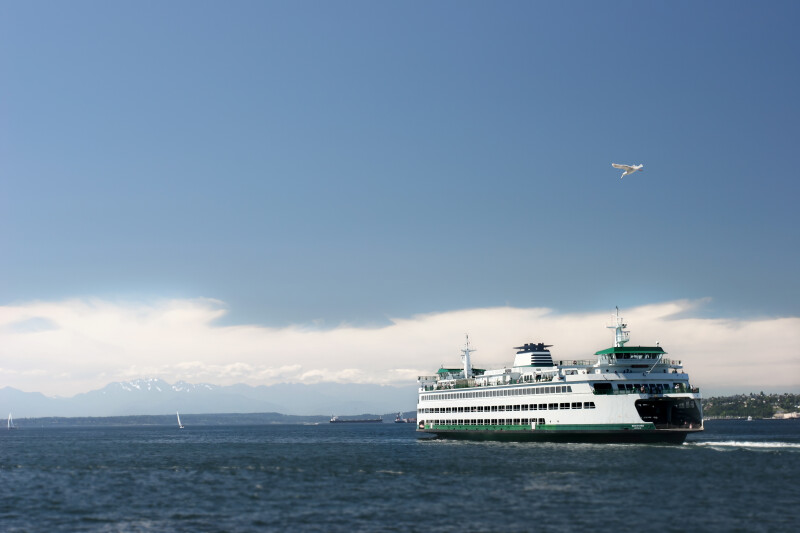
Washington State Ferries’ first plug-in hybrid-electric vessel, Wenatchee, has entered service after a challenging and longer-than-expected conversion process.
“We have a lot to learn from this experience and room for improvement moving forward,” said Stan Suchan, practical solutions manager at the Washington State Department of Transportation. “Modifying existing vessels for new technology is inherently challenging because you must work within as-built conditions. This is particularly challenging on the first conversion of a vessel in its class.”
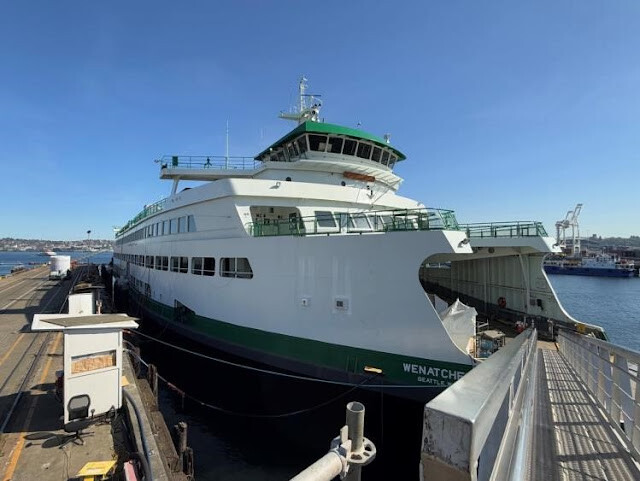
The 460'2"x90' Wenatchee, built at Todd Pacific Shipyards, Seattle, in 1998, is one of WSF’s three Jumbo Mark II-class vessels — the largest in its fleet, with capacity for 2,499 passengers and 202 vehicles. In 2023, as part of WSF’s $4 billion electrification plan, the Wenatchee entered Vigor Marine's Seattle shipyard to begin the process of being converted to hybrid-electric propulsion.
Design and integration of the new battery-hybrid system and propulsion controls were led by Siemens Energy, which hired naval architects Glosten for the preliminary, contract, and functional design work.
In the shipyard, two of the ferry’s four EMD L16-710G7A diesel generators were removed, and new battery rooms were constructed on both ends. Siemens Energy supplied 864 Blue Vault energy storage modules that deliver 5,702 kWh in total, a pair of energy storage switchboards, and a 12.47-kV NXPLUS C switchboard for charging. The vessel also received transformers from TMC as well as thousands of feet of electric and fiber optic cable.
OVERRUNS
WSF's original plan included the conversion of its other Jumbo Mark II-class ferries, Tacoma and Puyallup, but in March, Gov. Bob Ferguson announced those projects would be postponed due to systemwide reliability issues and delays in the Wenatchee conversion program, which extended well beyond its one-year timeline.
“This is our first vessel conversion,” said Suchan. “This is a program unlike anything our organization has previously delivered.”
WSF had to adapt quickly to meet the demands of the project, which ultimately proved to be larger than originally anticipated. “WSF rapidly resourced the project, including management, engineering, and oversight,” said Suchan. “Our ability to build organizational capacity and expertise lagged behind the conversion project, which led to issues like design and production engineering challenges.”
Vigor’s $100 million contract covered the conversion of two vessels, with a fixed-price option to convert a third. WSF now expects the cost to refit the Wenatchee alone to total around $133 million — $96 million for the hybrid-electric conversion and $37 million for technology and safety upgrades, along with miscellaneous improvements such as painting and upholstery repair, said Suchan.
“Inflation and labor shortages raised costs on many major construction projects, including shipbuilding. Design changes and production engineering challenges also contributed to delays and costs,” said Suchan.
BACK TO WORK
The ferry — now the largest hybrid-electric passenger vessel in the United States — began sea trials in May, marking the first test of its new propulsion system.
“This is a huge moment for us. It’s the first ferry in our system to run fully on battery power,” WSDOT Deputy Secretary Steve Nevey, head of WSF, said in a statement. “I went down into the engine room and watched as the crew started up the engines on diesel. Then, it seamlessly transitioned to full battery power. It was smooth and quiet. Seeing it work was one of the most exciting things I’ve been part of in a long time.”
After WSF accepted the vessel, crew training began while a final Coast Guard review was performed, and additional preparations were made at WSF’s Eagle Harbor Shipyard on Bainbridge Island.
The Wenatchee officially returned to service on July 18, running part-time in the evenings on the Seattle/Bainbridge route before returning to full-time service in the following few weeks.
“We don’t yet know whether or to what extent the new propulsion system will differ from previous performance, but Wenatchee will continue to operate within our standards for speed, maneuverability, and ability to stop,” said Suchan.
WSF said that terminal charging infrastructure is in the design phase and could be completed as early as 2029.
