



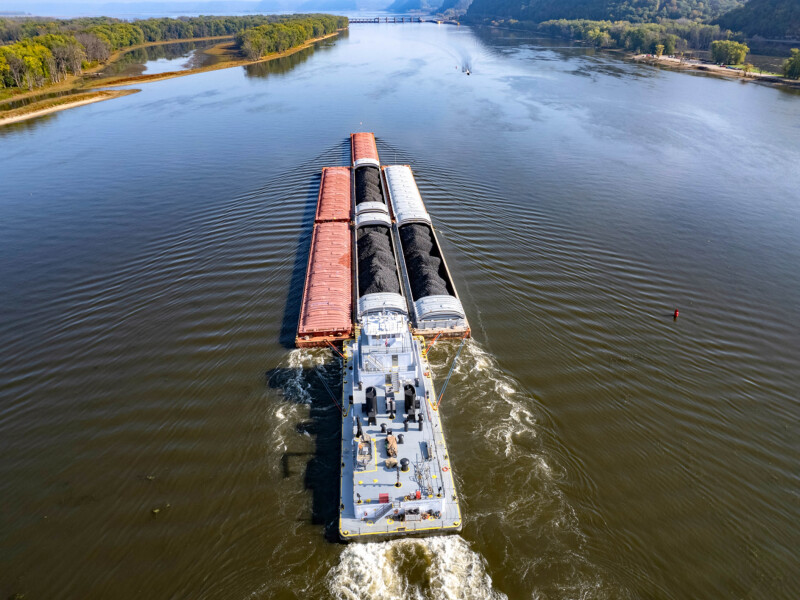
Inland freight has long been a market people learn by listening. Dispatchers call brokers. Traders call terminals. Operators compare notes. The picture forms through conversations more than measurements, a system understood through experience rather than visibility.
That works until the market moves faster than phone calls. By the time information travels from elevator to broker to fleet, conditions may already be changing somewhere else on the system. The industry has always had knowledge, just rarely at the same time.
Susan Olson, founder of the data, software, and artificial intelligence firm Action Intel, Louisville, Ky., said that uncertainty is what pushed her company toward forecasting freight from the river itself. “A lot of the request came from commercial participants moving grain,” Olson said. “They would ask, ‘Is there a way to get a look ahead of where freight is going?’”
That question became the starting point for Barge Flows, a new dataset within the company’s BargeAI platform, which subscribers access through a dedicated web application. Action Intel also offers API services that allow customers to connect BargeAI data directly into their own internal systems, tools, and planning models.
Instead of relying on past freight prices, Barge Flows tracks the physical behavior of barges across the Mississippi River system and uses those patterns to estimate freight conditions weeks in advance. The premise is intuitive and elemental. Freight rates are not the cause of market changes, but the result of supply and demand forces moving through the system.
“If you think about freight as a commodity,” Olson said, “there’s a supply of available barges and a demand to move cargo. What we’re trying to provide is a window into the fundamentals driving that push and pull.”
WATCHING THE SYSTEM
Traditional freight signals arrive after decisions have already been made. Grain programs, vessel arrivals, and logistics planning often occur months ahead, meaning capacity starts adjusting before market reports reflect it.
Olson believes that timing explains why reported rates trail physical movements. “You’ve got a vessel arriving in New Orleans in 90 days,” she said. “You need barges in the pipeline to fill it. So the supply chain starts adjusting ahead of that. The best information people have today informs what they’re willing to buy and sell freight for in the future.”
Barge Flows measures those adjustments directly. Rather than tracking price history, the system counts barges moving through defined regions — St. Louis; Cairo, Ill.; the Illinois River; New Orleans — and observes how equipment accumulates or disperses.
“What does watching equipment move tell you?” Olson asked. “It shows the overall supply-and-demand dynamics, not just a bilateral transaction. You see what the whole system is doing outside your organization.”
That distinction separates a reported rate from a physical signal. One records what happened, the other anticipates what is developing.

FLOWS, BALANCES, AND A CLOSED SYSTEM
Action Intel breaks cargo behavior into two related measures: flow and balance. Flow is simply movement past a point — the number of barges passing Baton Rouge, La., entering Cairo, or moving into St. Louis over a period of time. Balance looks at where those barges accumulate.
“A barge is a unit entity,” Olson said. “You can’t have a partial barge. If you start in Minnesota and end in New Orleans, everything has to add up. You’re seeing how those flows build and accumulate.”
When barges begin stacking up in a region faster than they are picked up, capacity shifts. Those shifts often precede freight changes. That can mean empty equipment sitting longer in one region while another area waits on capacity. The imbalance doesn’t immediately change rates, but it changes how participants position equipment and commitments. By the time the market reports respond, operators often have been repositioning boats and adjusting plans for weeks.
The first evidence appeared when Action Intel overlaid freight curves with movement patterns. “We started to see signals that looked similar, but they were leading,” Olson said. “Freight changes came after the big changes in those signals.”
The correlation was strongest not at short horizons, but farther out. “The surprising thing was the model could be worse three weeks ahead than 12 weeks ahead,” she said. “That’s because the market trades forward.”
TOWBOAT DATA
The foundation of the system comes from towboats’ AIS transmissions. Many vessels report tow length and width, allowing Action Intel to estimate the number of barges in a tow.
From there the work becomes less straightforward. “Not everyone updates those fields immediately,” Olson said. “You might pick up a barge and the field doesn’t change for miles. You have to be diligent about data quality.”
Action Intel cleans and corrects those signals, accounts for missing information, and organizes them into regions where drops and pickups occur.
The goal, Olson said, is transparency rather than a black box. “We try to be very transparent about how we’re doing things,” she said. “We don’t want the numbers to just appear without understanding what’s behind them.”

RIVER BEHAVIOR
Current patterns suggest a system behaving differently than in recent years. “We’re seeing less volume moving out of the Upper Mississippi downstream,” Olson said. “At the same time there’s a strong push of barges upstream from New Orleans that’s been slow to move farther north.”
Seasonal demand still plays a role, but export dynamics have shifted. “Soybean exports in the fall were slow to materialize,” she said. “Corn was strong, but it didn’t fully offset it.”
Instead of the sharp harvest spike typical of recent low-water seasons, freight patterns have been more flat. Signals looking into spring show volatility rather than a steady slide toward lower rates.
The result is a market still adjusting to its own physical balance.

PREDICTION MEETS EXPERIENCE
The model does not eliminate uncertainty. Olson stressed it adds context rather than certainty. “This isn’t the whole picture,” she said. “It’s a piece of information people didn’t have before.”
Large freight swings tend to appear clearly in the signals, while smaller week-to-week changes may still diverge from market sentiment. Weather, river conditions, and trading behavior continue to shape the outcome.
But the timing changes. Conditions that later show up in spot freight rates often appear first as shifts in accumulation and movement. Olson pointed to a recent freight increase tied to low water and ice that had been visible weeks earlier in the underlying data.
That does not replace experience, though. Rather, it changes how experience is applied.
Many of the people interpreting the signals began their careers on deck or in dispatch offices, Olson said, and, thus, combine operational knowledge with analysis. “It’s a marriage between information and experience,” Olson said. “One without the other is missing a crucial element.”
DATA INFORMS STRATEGY
More visibility does not necessarily erase competitive advantage. Participants still interpret signals differently based on contracts, geography, and risk tolerance. The data does not standardize strategy, but it changes how early those strategies take shape.
Olson believes decisions will still vary even when information is shared. “If everyone has the same information, they won’t make the same decision,” she said. “But more information helps people make better decisions.”
Over time, the data itself may shape behavior. Barge Flow users planning further ahead could change how freight cycles form. “If you’re basing tomorrow’s decision on the best information you have today and you have better information now to make tomorrow’s decision,” Olson said. “Then it can have some impact on how that market looks in the future.”
