



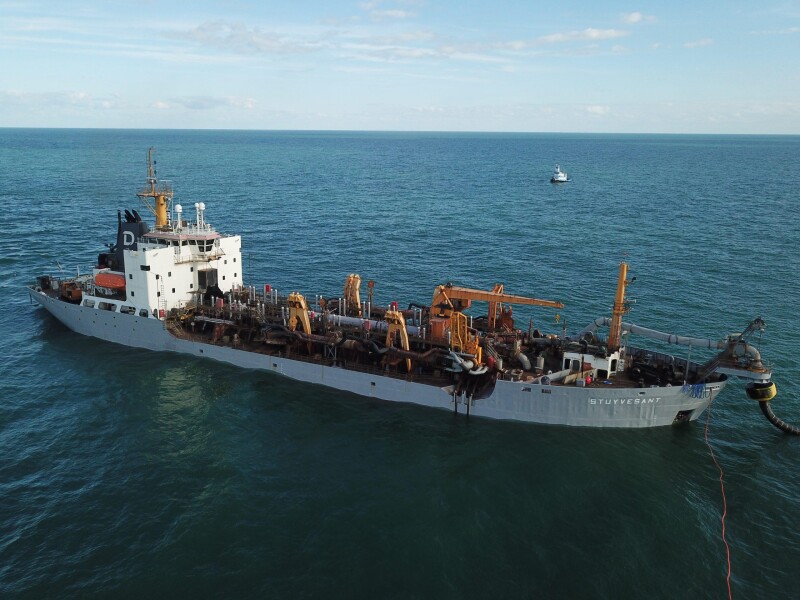
A fatal engine room fire aboard the trailing suction hopper dredge Stuyvesant was sparked by lube oil spraying from an auxiliary diesel generator and igniting off a nearby running engine, according to the National Transportation Safety Board (NTSB).
The incident, which occurred Nov. 2, 2024, on the St. Johns River near Jacksonville, Fla., resulted in one crewmember’s death and an estimated $18 million in damage; no pollution was reported.
An NTSB report on the incident noted the Stuyvesant — owned and operated by The Dutra Group, San Rafael, Calif. — was under contract with the US Army Corps of Engineers, Jacksonville District, at the time of the incident. At approximately 1435 local time, a fire broke out while the 392.7' dredge was holding station. Of the 22 crewmembers on board, two were in the machinery control room when the fire ignited. One managed to escape on his own, while the other was rescued by the onboard emergency squad and later pronounced dead at a local hospital.
After crews reported no active flames, they confirmed the engine room was sealed and discharged the vessel’s fixed-gas fire suppression system.
Investigators determined the fire originated when engine room personnel failed to reinstall a plug on the port auxiliary diesel generator following routine maintenance. Without the plug in place, lube oil sprayed from the engine and came into contact with an adjacent running diesel engine, causing ignition. The National Transportation Safety Board found that the maintenance work was not conducted in accordance with the engine manufacturer’s instructions and that the generator was not thoroughly inspected prior to startup.
The NTSB highlighted several lessons learned, emphasizing that crew should start engines locally after maintenance, rather than from a remote control station. Local startup allows operators to immediately check for leaks, abnormal noise, vibration, or other signs that equipment should be shut down before being placed into service.
“Diligent inspection of the machinery is critical to ensure it functions as expected and that all components have been properly reinstalled,” investigators noted.
The Stuyvesant fire adds to a series of recent casualty reports citing maintenance lapses as a leading factor in engine room incidents across the commercial fleet, the NTSB report said.
