



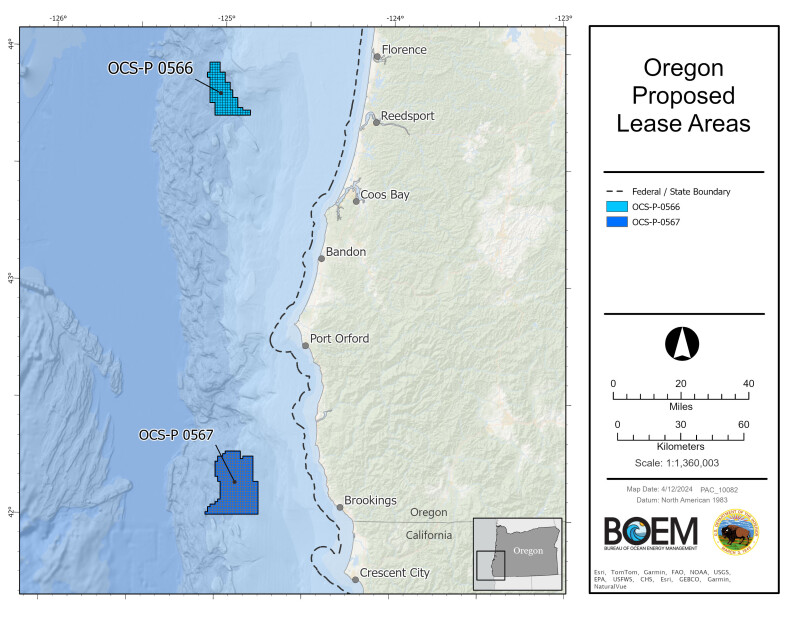
After plans for Oregon offshore wind energy were blocked, state officials have published a new “roadmap” for how a future consensus might be developed.
Opposition to offshore wind development led Gov. Tina Kotek in September 2024 to pull Oregon from a wind energy leasing agreement with the federal Bureau of Ocean Energy Management. Months of pressure from skeptical Oregon leaders, commercial fishing groups and Native tribal advocates led to that impasse, and in July 2025 the Trump administration rescinded all BOEM wind energy planning areas.
Developed with coastal communities and interests from November 2024 to June 2026, the roadmap “does not recommend whether offshore wind energy should be built off Oregon’s coast, according to the document’s preamble.
“Instead, it outlines the conditions, processes, and standards from which it could proceed responsibly while protecting the interests of coastal communities, federally recognized tribes in Oregon (tribes), fisheries, and ecosystems while advancing Oregon’s clean energy and climate goals. Achieving this will require balancing several, sometimes competing, objectives. This work demands care, attention, and continued learning.”
The options now outlined by the Oregon planning document run the gamut:
– No offshore wind energy: Oregon does not participate in offshore wind energy in any way and reserves the ocean and coast for other beneficial uses.
– Economic participation only: Oregon participates in economic activities related to offshore wind energy such as the supply chain, portside services, research and development, and other services, but does not host projects off its coast.
– Pilot wind project: Oregon pursues a pilot-scale offshore wind energy project.
– Gigawatt to more than 3 Gigawatts — Oregon develops a full-scale offshore wind industry, either with major port development or without.
The roadmap calls to “develop and fund an offshore wind energy research agenda to secure reliable and trustworthy data to inform future energy development. Before Oregon is ready to advance offshore wind energy, more needs to be known about the effects of development on ecosystems and to communities of place and practice on the coast, given important community, tribal, ecosystem, and fishery values.”
The state should “establish and fund an offshore wind energy science collaborative that involves a broad spectrum of interests and potentially affected communities,” organizers wrote. “The purpose of the collaborative would be to build a shared understanding of the science related to offshore wind energy’s effects on ecosystems and communities.”
“Oregon should also participate in the West Coast Science Collaborative, currently being established by California, to share lessons learned and look for opportunities to coordinate research regionally.”
