



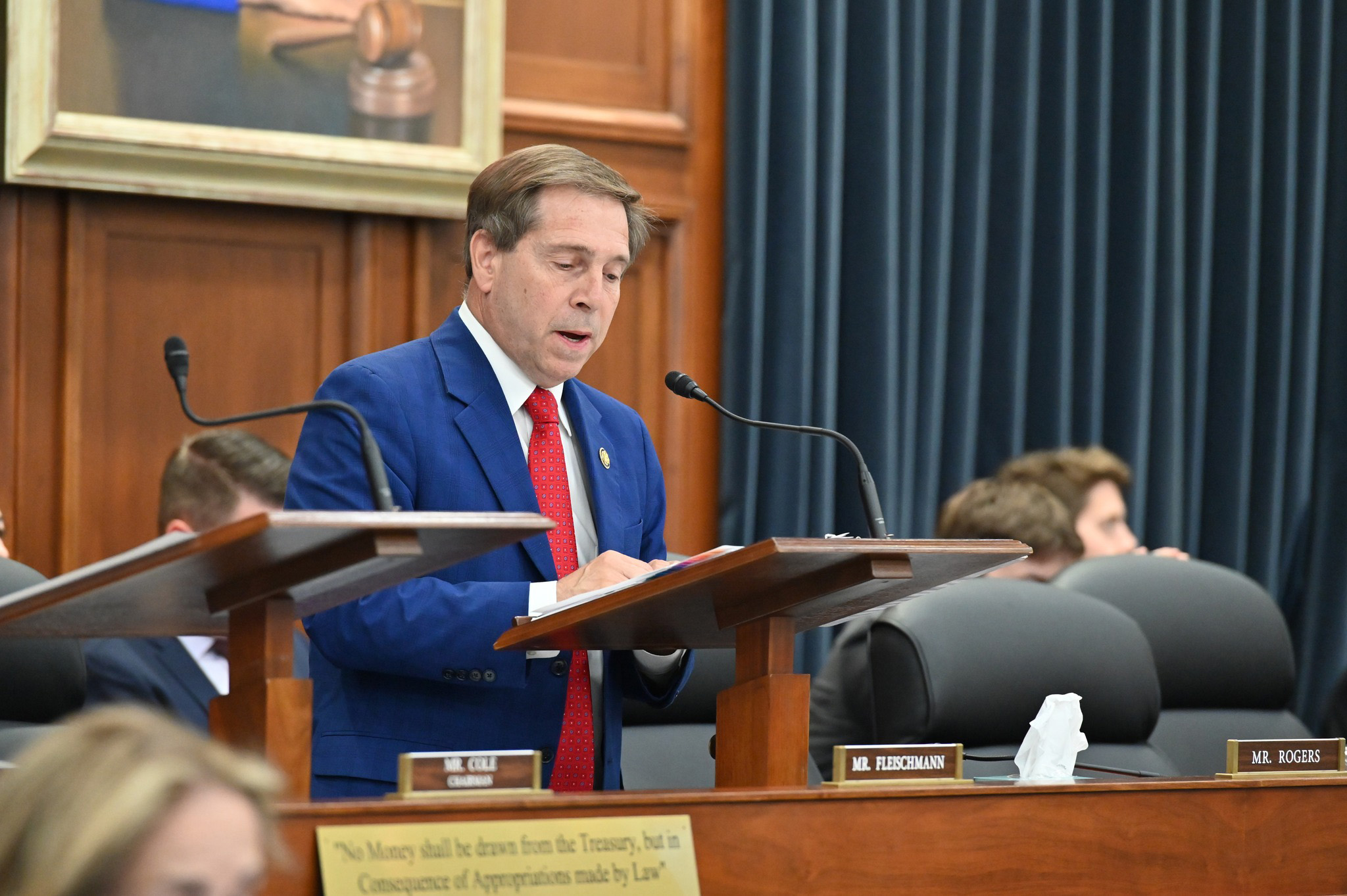
The House Appropriations Committee on May 20 passed the Fiscal Year 2027 Energy and Water Development and Related Agencies (E&WD) Appropriations Act, a key source of funding for the U.S. Army Corps of Engineers. The bill, approved by a committee vote of 34 to 25, includes about $9.8 billion for the Corps of Engineers’ civil works mission and, for the first time since FY23, funding for inland waterways construction projects.
The $9.8 billion for the Corps was $3.14 billion above the amount requested in the president’s budget for FY27.
The bill includes $2.4 billion for construction, with $417.2 million designated for two inland waterway projects — Lock and Dam 25 on the Upper Mississippi River near Winfield, Mo., and Montgomery Lock on the Ohio River near Monaca, Penn. That funding level would draw at least $104.3 million from the Inland Waterways Trust Fund.
At Lock and Dam 25, the Corps is building a new 1,200-foot-long chamber that will allow an entire 15-barge tow to lock through at once. The existing 600-foot lock chamber requires towboat crews to split the tow in half to lock through. At Montgomery Lock, the Corps is building a new 600-foot by 110-foot chamber to replace the existing auxiliary chamber, which measures only 56 feet by 360 feet.
“As partners to the U.S. Army Corps of Engineers, we are elated at the strong funding levels provided by Congress for Fiscal Year 2027, funding to complete Montgomery Lock and the $250 million toward Lock and Dam 25 in the E&WD appropriations bill,” said Tracy Zea, president and CEO of Waterways Council Inc. “Now is a critical time for the inland waterways, and it is extremely important that the Corps, industry, and Congress work together. This bill is a strong statement that underscores that.”
The bill also highlights the Brazos River floodgates project on the Gulf Intracoastal Waterway in Texas.
Beyond the Corps’ construction account, the bill appropriates $6.255 billion for the Corps’ Operations and Maintenance business line, including $24.68 million for the upper Missouri River, close to $96 million for the Mississippi River in the Rock Island District, and $46.3 million on the Mississippi within the St. Louis District.
The J. Bennett Johnston Waterway in Louisiana, the Brazos River Floodgates, and the nearby Colorado Locks project all received investigations funding in the bill. The Mississippi River and Tributaries project was allocated $470 million, with $38.5 million for channel improvements along the system and additional funding for harbor improvements in Philips County, Ark., Greenville, Miss., Vicksburg, Miss., and Memphis, Tenn.
Beyond the inland waterways, highlights of the bill include the following.
More than $1.86 billion was allocated for the Bureau of Reclamation and Department of the Interior, including $23 million for the Central Utah Project.
The bill provides more than $50.3 billion for the Department of Energy, including more than $27 billion for the National Nuclear Security Administration. For nuclear energy, the bill commits $1.8 billion, which includes repurposing previously appropriated funds “to accelerate advanced reactor and small modular reactor demonstration programs. Cybersecurity, energy security, and emergency response efforts would receive $190 million. Cleanup activities related to sites contaminated by the Manhattan Project and Cold War-era nuclear weapons products would receive $7.7 billion. The bill also dedicates $700 million for Department of Energy efforts to support “fossil fuel generation technologies that are reliable, efficient, and cost effective” and to advance “reliable, baseload geothermal power.”
The bill also allocates $90 million for the Office of Inspector General’s oversight of the Department of Energy, $322.5 million for regional commissions, and $892.3 million for the Nuclear Regulatory Commission.
“The Fiscal Year 2027 Energy and Water appropriations bill responsibly invests taxpayer dollars to accelerate American energy dominance, strengthen our economic prosperity, and safeguard U.S. national security,” said Rep. Chuck Fleischmann (R-Tenn.), chairman of the Energy and Water Development Subcommittee. “This legislation builds on the successes of prior years by continuing the modernization of our nation’s nuclear deterrent, supporting the Nuclear Navy, pushing the frontiers of science and technology, unleashing more abundant and reliable energy to power our communities, and improving the coastal and inland waterways that connect our nation and link us to the global economy.
“The bill strengthens America’s energy security by prioritizing research and development in advanced nuclear and other baseload energy sources, securing critical domestic supply chains, and fully funding programs that help deliver affordable energy for the American people,” Fleischmann continued.
In his opening remarks before the Appropriations Committee voted on the bill, Rep. Tom Cole (R-Okla.) called the legislation “a cornerstone of U.S. energy dominance.”
“It unleashes U.S. production of baseload energy sources and critical minerals,” Cole said. “It makes historic investments to secure our systems and reduce reliance on foreign supplies. And it unlocks technological capabilities to drive next-generation advancement. This includes the White House’s focus on propelling the U.S. to lead in artificial intelligence and new frontiers that keep us not only competitive but unrivaled. Chairman Fleischmann also implemented robust funding for high-priority inland and coastal navigation, flood control, and drought resilience projects. Importantly, security and defense remain central to this legislation. With a focus on advancing nuclear capabilities and keeping our Navy’s propulsion programs top-class, we reinforce our deterrence and America’s strategic advantages. We also prioritize cybersecurity efforts that enable a resilient electric grid and ensure we can counter various threats from our adversaries.”
The bill now heads to the full House for a vote.
