



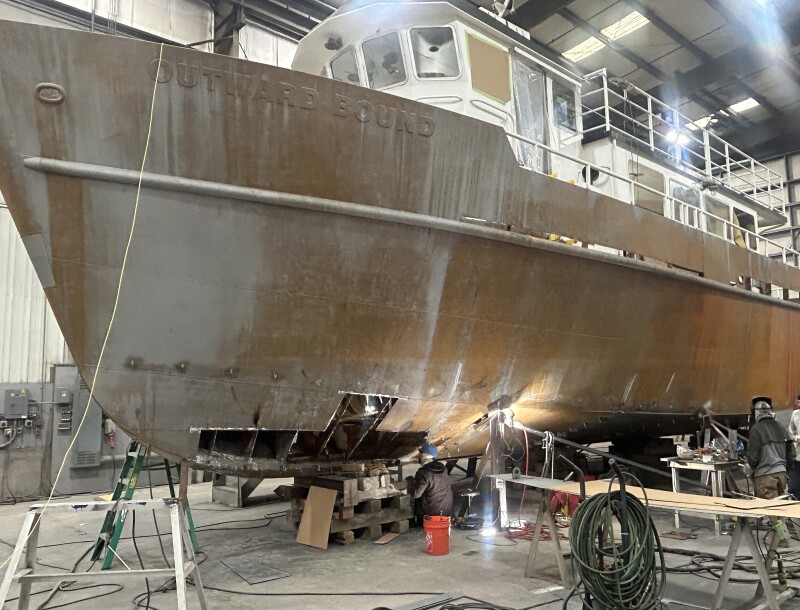
After three decades carrying passengers and supplies across Boston Harbor, the ferry Outward Bound is returning to service with a new engine, extensive steelwork, and the prospect of another 30 years on the water.
Key takeaway
Gladding-Hearn Shipbuilding completed a major structural and mechanical refit of the 1995 ferry Outward Bound, replacing its original engine and renewing the vessel for potentially another 30 years of service.
The 64', 140-passenger vessel underwent a major refit at Gladding-Hearn Shipbuilding, Somerset, Mass., where the scope grew as crews uncovered more hull and deck plating wastage than initially expected.
Even with the additional work, Gladding-Hearn Shipbuilding president Peter Duclos said rebuilding the 1995 ferry remained far less expensive than replacing a vessel that still suited the operator’s needs.
Purpose-designed by JW Gilbert Associates and built by Gladding-Hearn in 1995, the steel ferry carries visitors and supplies seasonally to the Cathleen Stone Island Outward Bound School in Boston Harbor.
Three decades of service had taken their toll, and the vessel was due for a broad mechanical and structural overhaul, said Duclos.
“The boat runs a lot, and it was time for a re-engine, shafting, propeller, mechanical systems, and a completely new paint job,” Duclos told WorkBoat. “There was a considerable amount of hull plating and deck plating wastage. They knew about it, but we didn’t fully appreciate the full extent until we got into it.”
The yard fully sandblasted and surveyed the hull before completing extensive replating. Doors, windows, and hatches were inspected, tested, and repaired as needed, while the interior and exterior received a new coating system.
Duclos said the scope grew as crews opened the vessel and worked through the findings with the Coast Guard.
“Once you get into it and start pulling the boat apart and finding the issues, you don’t really know what you’re getting into,” he said. “It’s like an archaeological dig.”
Despite the added work, Duclos said the refit remained considerably less expensive than replacing the ferry with a new vessel.
“Was it more than we thought? Yes,” he said. “Was it not worth doing? No, absolutely not. It was definitely worth doing.”
As part of the refit, Windward Power Systems, New Bedford, Mass., led the vessel’s repower, replacing the original 315-hp Detroit Diesel 8V92 with a 429-hp, EPA Tier 3 Mitsubishi S6B3-MPTAW-3 supplied by Laborde Products, Covington, La. Windward oversaw integration, installation, and commissioning of the new propulsion package.
“Every repower starts with understanding how a vessel operates and selecting the right engine for the application,” said Windward Power Systems president Nathan Tynan. “The S6B3 was a natural fit for the Outward Bound, and we're proud to have played a role in extending the service life of a vessel that has served Boston Harbor for decades.”
The new engine is connected to a Twin Disc MG-5114, 3:1 gearbox and delivers a top speed of 11 knots. The refit also included a new shaft and propeller, modifications to the engine bed, and replacement of the exhaust, cooling, and ventilation systems to accommodate the larger engine.
Vessel specifications
Duclos said the Mitsubishi was chosen in part because it meets emissions requirements without electronic engine controls.
“There are no computers on this engine,” he said. “It does not need electricity to operate. It’s like a traditional diesel engine. You give it air, you give it fuel, and it will run.”
That simplicity suited the ferry and avoided the need to add additional power sources, electronic controls, and related redundancies, Duclos said. The principal installation challenge was accommodating the engine’s larger footprint and the cooling, exhaust, and ventilation equipment around it.
The original Wagner steering system was replaced with a Dometic SeaStar Optimus system. Six electric heaters replaced the vessel’s diesel-fired boiler and heaters, while electrical and piping upgrades included new LED lighting, bilge piping, and domestic systems. The engine room was also fitted with a Fireboy GA Series fire-suppression system.
.jpeg.medium.800x800.jpg)
Duclos said Gladding-Hearn has completed similar projects on other older steel ferries, including the replacement of Detroit Diesel engines aboard a 1980s-era vessel that had operated in Bermuda.
The decision to reinvest in Outward Bound ultimately came down to whether the existing vessel continued to suit its owner’s mission.
“We had early conversations about whether they should invest in this boat or build a new one,” Duclos said. “I asked, ‘Does this boat do everything you want it to do?’ They said it was perfect. Well, then there’s no reason to build a new boat.”
With continued maintenance, Duclos said another 30 years of service is not out of the question.
“These projects are challenging, and things come up,” he said. “But when the boats are good boats, it’s worth investing in them.”
