



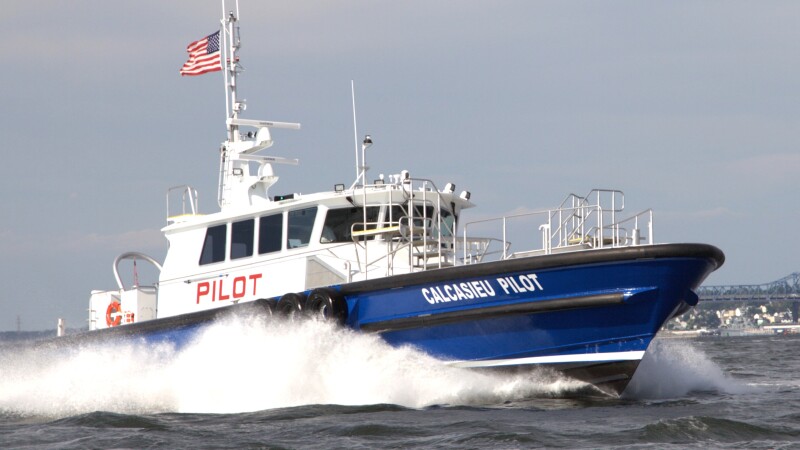
Gladding-Hearn Shipbuilding, Somerset, Mass., delivered the 73' Calcasieu Pilot to the Lake Charles pilots in June, adding a fourth vessel from the shipyard to the Louisiana group’s fleet.
The boat will support pilot transfers between the Cameron, La., jetties and the sea buoy, about 30 miles offshore. The pilots received their first Gladding-Hearn vessel, a 63-footer, in 1995.
Owned by Calcasieu Pilot No. 4 Inc., Lake Charles, La., the all-aluminum vessel is based on the Cameron Pilot II, which Gladding-Hearn delivered in 2019. Its keel was laid in November 2024, and the boat was launched in June.
The pilots initially wanted the new vessel to match the Cameron Pilot II as closely as possible, but the move from Tier 3 to Tier 4 propulsion required Gladding-Hearn to redesign much of the machinery arrangement.
“They loved the previous boat and said, ‘Build us exactly that boat,’” said Peter Duclos, president of Gladding-Hearn. “We couldn’t do that anymore because the engines had changed.”
The engines and their exhaust after-treatment equipment added roughly 6,000 to 7,000 lbs. compared with the earlier propulsion package. To offset most of the increase, Gladding-Hearn reduced the boat’s fuel capacity from 2,000 to 1,500 gal. The pilots generally did not need the full 2,000-gal. capacity for daily operations, Duclos said, though the additional fuel had provided reserve range during hurricane-related relocations.
Designed by Ray Hunt Design, the Calcasieu Pilot has a deep-V hull, a 23.3' beam, and a 5.3' draft. Twin Cummins QSK38-M1 Tier 4 diesel engines, rated at 1,300 bhp each at 1,800 rpm, give the vessel a loaded speed of more than 27 knots.
The engines turn five-blade Bruntons nibral propellers through Twin Disc MGX-6620A gearboxes. Gladding-Hearn fabricated shallow shaft tunnels into the hull to reduce the shaft angle and improve water flow to the propellers.
“Reducing the shaft angles and vessel draft and limiting cavitation damage can extend the life of propellers and improve efficiency,” said Winn Willard of Ray Hunt Design.
Gladding-Hearn also used the repeat build to revise the exhaust mounting, shaft line, and tunnels based on its experience with the Cameron Pilot II. Duclos said the changes made the new boat smoother and quieter during sea trials.
“We knew there were some things we could make better,” Duclos said. “As a result, the boat is smoother and quieter than the other boat.”
Each engine is equipped with a Cummins selective catalytic reduction exhaust after-treatment system. According to the shipyard, the systems reduce nitrogen oxides and particulate emissions by more than 80%.
Accommodating the Tier 4 package required an almost complete reconfiguration of the engine room. Mechanical equipment had to be relocated, and the builder needed to find space for the diesel exhaust fluid tanks and related systems.
“The big equipment goes in first, but then there is a lot of collateral work,” Duclos said. “A lot of the mechanical systems had to be redesigned.”
The project marked Gladding-Hearn’s first installation of a Tier 4 engine exhaust system. Duclos said the QSK38s were the first production engines from Cummins’ Tier 4 series, following prototype units already operating in the field.
“It was a real collaborative effort to get this to the finish line,” Duclos said. “Cummins was very supportive through the whole process.”
Other machinery includes twin Kohler 32-kW generators, a two-station Kobelt hydraulic steering system, and Humphree interceptors with automatic trim optimization and active ride control. Helm controls are located in the wheelhouse and at an aft-facing station on the transom.
The aft-of-amidships wheelhouse includes a centerline helm, eight Norsap shock-mitigating seats supplied by Imtra, a sofa, and baggage storage. The forecastle contains upper and lower berths, an enclosed head, a galley, lockers, and additional storage.
Imtra also supplied an Exalto Wiper Technologies B.V. wiper system, Sola-Cure window shades, Den Haan Rotterdam navigation lights, IML interior and exterior lighting, and Libra-Plast AS doors.
Pilot-transfer features include boarding platforms on both sides of the foredeck, wide side decks, and exterior handrails. The vessel also has a rescue recess built into the transom and a winch-operated J-basket system for recovering pilots from the water.
