



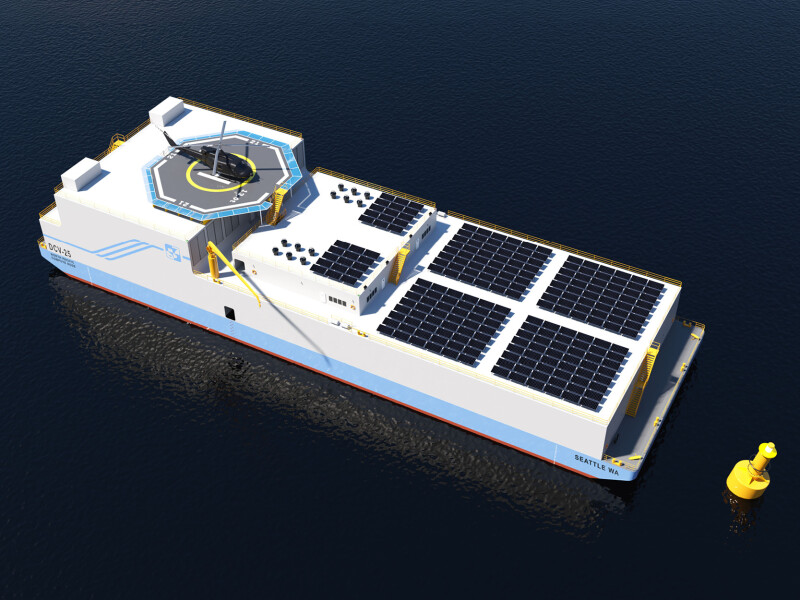
A naval architecture firm has introduced a solution to the community pushback that has stalled data center projects across the country.
Key takeaway
Hockema Group has developed a self-sufficient floating data center concept designed to reduce community concerns about the power, water and land requirements associated with shore-based facilities.
Hockema Group Inc., Seattle, has developed a concept design for a “good neighbor” floating data center. Basically, it’s a data center on a barge, and because it’s located on water, the facility would be self-sufficient, generating its own power and cooling with water in harbors, bays, and rivers.
“Data centers are expanding on land, and in many cases, they’re burning their bridges,” said Eric Blumhagen, senior principal naval architect at Hockema Group. “Many of the onshore ones feel like a cartoon villain going in with a briefcase full of money to buy a farm.”
Community sentiment on data centers seems to have soured. In Monterey Park, Calif., a permanent ban was passed in June. San Marco, Texas, became the first city in the state to prohibit data centers by updating its land development code. Virginia Beach, Va., voted to reject future large-scale projects after a wave of community opposition, and Denver residents said they wanted a year to study the impacts of new AI data center construction.
Putting a self-sufficient data center on the water is an answer to community concerns over excessive power and water usage, Blumhagen said.
“Here’s a way we could approach this as a concept design and do enough of our due diligence that this is a plausible thing,” he said. “We can have one installed in a much more reasonable way than screwing up farmland or taking people’s power.”
The steel barge would be 340'x105' and draw 18' with capacity for 340,000 gals. of diesel fuel with an option for natural gas. Data floor space would be 20,000 sq. ft. and data power capacity would be 25 MW.
Concept specifications
The Hockema team would be able to make the barge compliant with Coast Guard regulations, Blumhagen said. “We have a clear understanding of what the rules are,” he said. “You can put this into a reasonable port as long as you have rivers or tidal flow.”
The barge could be placed in a saltwater or freshwater harbor, and Hockema engineers have developed ways for the water-based data center to reclaim waste heat from cooling the chips to create energy. Power generation would also come from diesel generators or gas turbines. The hull would be built with piping for the cooling circuit to supply clean fluid to the server cabinets.
A data center consists of sets of server cabinets. Each one has a series of processing units similar to a computer’s motherboard. These are typically water-cooled with a clean circuit. Each cabinet would measure roughly 3' wide by 4' long and 6' to 10' tall. Each cabinet has a connection for power cooling, with space in between for maintenance and airflow.
The most cost-effective way to keep the climate consistent is by using evaporative cooling with a set of towers that evaporate water to cool the circuits.
Blumhagen said the most logical location for a floating data center would be next to a pier. Customers interested in higher security might consider anchoring a barge offshore. “My vision is that it goes into an industrial port,” he said. “You could put it in the back of a container port. It’s not going in the beautiful part of a waterfront.”
The data servers and cabinets would be in the bow of the barge with the generators in the stern with the fuel below. If a barge were to be positioned offshore, a helipad could be placed on the aft above the generators.
The barge is not self-propelled. It would be towed into position and anchored. To answer noise concerns, the builders would use extra insulation in the engine and generator rooms, and exhaust would be quieted with hospital-grade silencers. “We’re keenly aware that noise is one of the complaints from neighbors,” said Blumhagen.
The estimated cost of a good neighbor barge would be $80 million to $100 million plus the processing units.
