



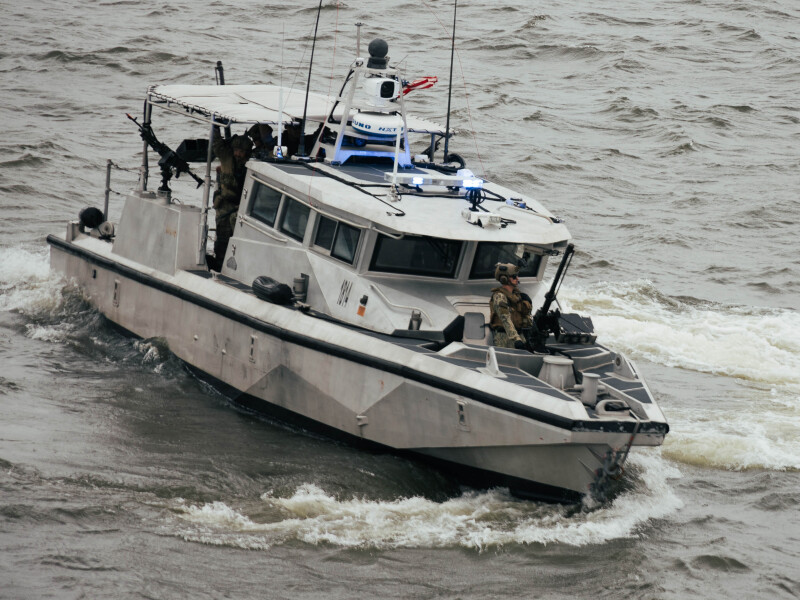
Patrol boats, ubiquitous and often sent into action, will not disappear from the U.S. maritime forces anytime soon. In fact, several types are being built and fielded in quantities.
The Coast Guard, for example, was awarded $25 billion by the One Big Beautiful Bill and will build a substantial number of vessels, including patrol boats.
“Patrol boats are essential to the Coast Guard’s mission because they provide agility, rapid response, and access to shallow or constrained waterways that larger warships cannot reach,” a Coast Guard spokesperson told WorkBoat. “Their size and capabilities allow for persistent presence and quick deployment in the U.S. maritime domain, making them indispensable for safeguarding ports, enforcing maritime law, and protecting critical infrastructure.”
Patrol boats can be “more cost-effective for many coastal and nearshore missions,” the spokesperson added, noting that they are often deployed for visit, board, and search-and-seizure duties, as well as port and coastal security, counter-narcotics and migrant interdiction, search and rescue, environmental protection, defense readiness, and support to Defense Department operations.
The “patrol boat” being built for the Coast Guard is the Sentinel-class Fast Response Cutter (FRC), a 154' ship that replaces the 1980s-era, 123' Island-class patrol boats, the spokesperson said.
The FRC sails with four officers and 20 crew at more than 28 knots. It has a 25' beam, a 9'6" draft, and a 353-LT displacement with an endurance of five days or 2,500 nautical miles. Main propulsion comes from twin MTU 20V4000 M93L diesel engines, each producing 2,900 hp.
FRCs are armed with one bow-mounted Mark 38 Mod 2 25-mm autocannon and four crew-served mounts for .50-cal. M2HB heavy machine guns, although a Mark 19 40-mm automatic grenade launcher replaces one .50-cal. gun for FRCs sailing in the Persian Gulf due to the higher threat level.
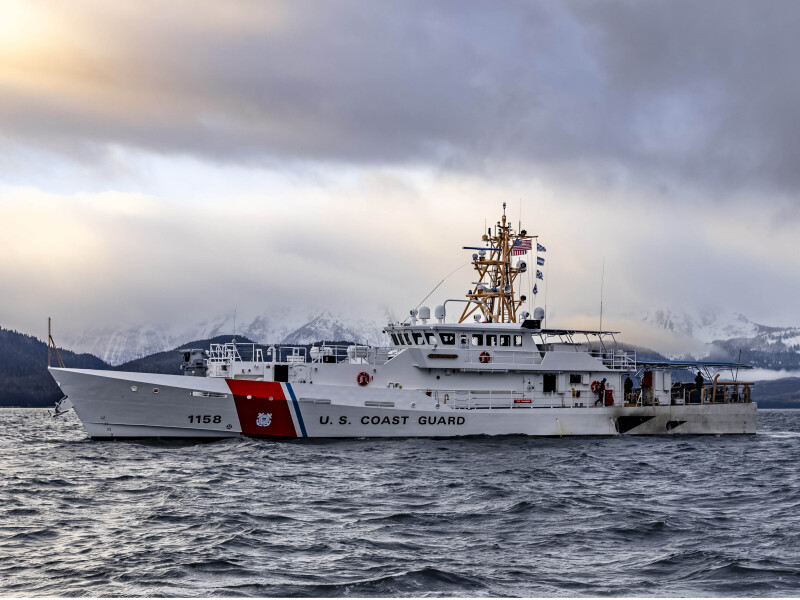
At an average cost of $65 million per ship, the FRCs are being built by Bollinger Shipyards, Lockport, La., based on the Stan 4708 patrol vessel design from the Netherlands-based Damen Shipyards Group. In 2008, Bollinger was tapped to build prototype FRCs, the first of which entered service in 2012. To date, 77 FRCs have been ordered, with 62 delivered as of February.
“The Sentinel-class Fast Response Cutters replace aging Island-class [patrol] boats and introduce advanced technology, improved crew accommodations, and enhanced mission capability,” said the Coast Guard spokesperson, who added, “Key lessons [over the past patrol boats] include the value of modular design for upgrades, improved crew habitability, and the need for advanced sensors and interoperability with other agencies.”
DEMONSTRATORS
In January, the Coast Guard awarded four contracts totaling about $3.6 million to Birdon America Inc., Denver; Metal Shark Boats, Jeanerette, La.; Inventech Marine Solutions, Bremerton, Wash.; and SAFE Boats International, Bremerton, for Response Boat-Small (RB-S) demonstrator boats. Each company will deliver one demonstrator boat within three months. The boats will measure from 29' to 37' and will be powered by twin outboards producing up to 600 hp.
The boats will help the Coast Guard develop and validate performance requirements, assess industry capabilities, and gather marketplace information. Data collected from operating the boats will guide future acquisition decisions, the agency said. The Coast Guard’s RB-S boats support missions including drug interdiction, migrant interdiction, search and rescue, law enforcement, living marine resources protection, defense readiness, aids to navigation, and ports, waterways, and coastal security operations.
The Coast Guard says it does not have plans to acquire unmanned patrol boats. However, it has conducted pilot programs and demonstrations using unmanned surface vessels, the spokesperson said.
SILVER SHIPS
Silver Ships Inc., Theodore, Ala., is building the aluminum 36' SPC-LE2 response boat for the Coast Guard and Naval Special Warfare Command. The order book sits at 110 between the two service branches.
The boat has a 10' beam and is capable speeds in excess of 50 knots using three 300-hp Mercury Verado outboards. It has a “[partially] enclosed [armored] cabin for missions demanding enhanced crew protection, climate control, or extended at-sea operations,” said Shawn Lobree, director of federal programs at Silver Ships.
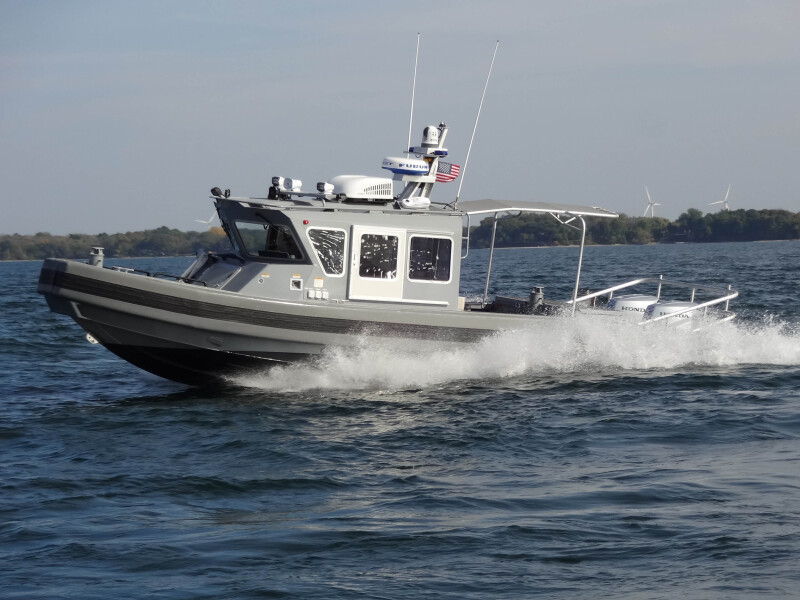
Two weapons stations, fore and aft, can accommodate 7.62-mm M240 or .50-cal. M2HB machine guns. The SPC-LE2 comes equipped with marine radios, Furuno radar and navigation system with two NAVNET 3D displays, L3 Harris automatic identification system, Gentex LVIS digital intercom system, Motorola 5000 digital mobile radio, and a Teledyne FLIR thermal imager.
According to the builder, the boat has a service life of 20 to 40 years, depending on maintenance practices.
METALCRAFT MARINE
MetalCraft Marine US Inc., Watertown, N.Y., is building several variants of “force protection” patrol boats, which are deployed at military bases around the world to protect U.S. fleets from small boat attacks, said Bob Clark, the boatbuilder’s contracts manager.
“We are building 20 of [them] for the U.S. Navy Force Protection Program in a different [enclosed] cabin layout, 47 in a 27-foot size,” Clark said.
“Available in sizes ranging from 7 meters through 12 meters, every boat comes with MetalCraft’s standard 10-year hull warranty. After a test and evaluation phase, the U.S. Navy has awarded MetalCraft a 67-boat, five-year contract for Force Protection Small (FPS 8 meters) and Force Protection Large (FPL 12 meters) patrol boats.
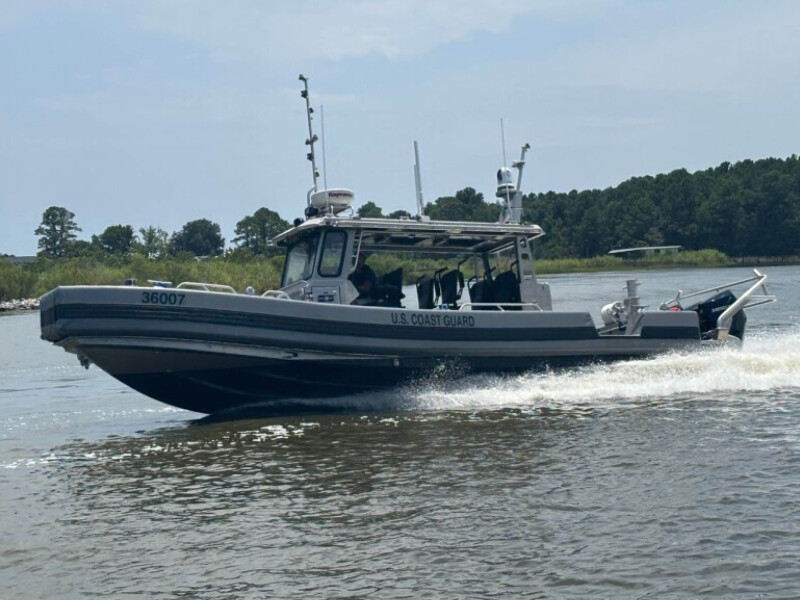
Propulsion for these boats is a mix of Honda, Mercury, and Yamaha outboards.
“This program started as a result of the terrible USS Cole incident, where many servicemen lost their lives in Yemen. The large version is intended for offshore bases where sea states can be much higher, such as Guam and Diego Garcia,” Clark said.
Under a separate contract awarded in 2023, MetalCraft is building 17 Long Range Interceptor IIIs for the Coast Guard. Specifications state that the Long-Range Interceptor III has “bow and stern machine gun posts and port and starboard positions are available with ammo storage. Full cabin with roll-up aft side curtains and aft wall curtains, large sliding side doors, multiple ingress/egress points, headroom of 6'10". The aft crew/gunner positions can provide return fire seated at a 135-degree arc and kneeling on the side deck 180 degrees of fire both port and starboard.”
Clark said the boats are designed to provide a soft, dry, and safe ride. “Operators regularly tell us they don’t like to be wet or cold and being jolted by waves,” he said. “[The operators’] job is to do the dangerous work. Our job is to provide the correct and best tools”.
METAL SHARK
The Defiant-class 40' patrol boat, or “40PB,” from Metal Shark is a welded-aluminum monohull with an enclosed armored pilothouse that has a crew of five sailors. It is capable of speeds of 35-40 knots using twin Cummins QSB 6.7 diesel inboard engines, paired with Twin Disc MG-5065SC transmissions to HamiltonJet HTX30 waterjets, according to the builder.
Armament consists of six weapon stations and a stabilized, remotely operated bow gun mount for a choice of .50-cal. M2HB heavy or 7.62-mm medium machine guns or miniguns, or Mark 19 40-mm automatic grenade launchers; it has no autocannons fitted. Its stern ramp can launch and recover a combat rubber raiding craft.
Government records show that Metal Shark was awarded the 40PB Flight 1 contract in 2017. In May 2024, Metal Shark and ReconCraft, Clackamas, Ore., were awarded seven-year indefinite delivery/indefinite quantity Flight 2 contracts worth up to $290 million to produce up to 73 of the 40PBs for Naval Expeditionary Combat Command. Under the deal, Metal Shark also supplies the spare parts, training, technical support, and engineering expertise.
