



Anyone in the maritime industry knows the challenge of being unseen yet indispensable. Fuel, food, furniture, fabricated goods — most everything that makes day-to-day life possible — depends on waterborne transport at some point in its journey. And yet ports and waterways are largely out of sight.
Harder for the public to see — yet just as essential — are the dredging contractors that maintain the channels and harbors vessels depend on and the shorelines people enjoy.
“Dredging is foundational to the nation’s maritime system,” said Erica Janocha, dredging program manager for the U.S. Army Corps of Engineers. “Federal navigation channels enable the movement of commerce, support ports and harbors, provide access for military and national security missions, and sustain the marine transportation system that the broader maritime industry depends on.”
With the Corps of Engineers serving as the largest contracting body for dredging in the United States, funding and policy trends with the Corps are important factors affecting the commercial dredge fleet. Most recently, the Corps’ “Building Infrastructure, Not Paperwork” initiative has put efficiency, both in pricing and delivering projects, firmly in focus.
“For the dredging program, this involves specific, targeted initiatives, such as ‘Smarter Contracting’ and ‘Expanding Dredging Capacity,’” Janocha said. “This means centralizing dredge contract handling to negotiate from a position of strength and improving environmental processes like mitigation banking and expanding environmental windows to increase dredge availability and ensure waterways remain open at a lower cost.”
Janocha said the result of those tactics will look different depending on the type of work. For maintenance dredging, the goal of centralized contracting and more flexible environmental windows would be to “improve predictability, workload planning, and procurement efficiency,” she said. For new-work dredging, initiatives like requiring designs to be at least 35% complete and using simulators to develop project execution plans, hopefully, would “enhance safety, reduce risk, and save millions in future maintenance costs,” she said.
“The overall objective is to deliver the federal dredging mission more efficiently to support navigation reliability, commerce, and national security,” Janocha said.
William P. Doyle, CEO and executive director of the Dredging Contractors of America (DCA), said the dredging industry is keenly aware of what Adam Telle, assistant secretary of the Army for Civil Works, hopes to accomplish with the “Building Infrastructure, Not Paperwork” initiative.
“He is clearly demanding productivity, accountability, and measurable performance,” Doyle said.
In terms of physical infrastructure, that focused approach likely has already had an impact on Corps projects, as with the cancellation of the Chickamauga Lock chamber contract on the Tennessee River.
“My understanding is that the Corps canceled the Chickamauga Lock chamber contract because it determined the contractor was falling behind schedule, struggling with quality control, and not meeting critical project management obligations,” Doyle said. “[The Corps] ultimately said it lost confidence in the contractor’s ability to deliver the work and made the decision to protect taxpayer dollars and keep a nationally important waterways project on track.
“On the dredging side,” Doyle added, “I think everyone is paying attention.”
Doyle said people in the dredging industry understand the expectation for performance and execution, but some aspects are out of a contractor’s control.
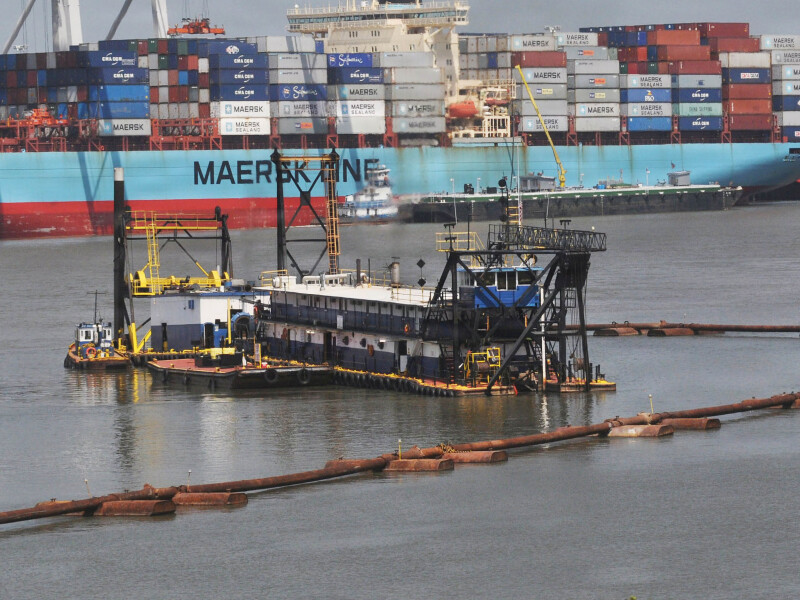
“This past winter, for example, portions of the Delaware River, the C&D Canal, and parts of the Chesapeake Bay froze over,” Doyle said. “That is an infrequent event in the Mid-Atlantic, but when it happens, dredging contractors have to become very creative with scheduling, equipment deployment, and sequencing to keep projects moving.”
Regarding environmental windows, Doyle said more flexibility would be welcomed.
“In some areas of the South Atlantic Division, contractors are effectively limited to roughly 60 days of dredging per year because ‘recommended’ environmental windows are being treated as rigid requirements,” Doyle said. “These constraints really are ridiculous. They create enormous inefficiencies, drive up costs, compress schedules, and reduce the ability to respond to navigation needs in a practical way.
“The encouraging part,” he said, “is that we are actively working with Assistant Secretary Telle and with Timothy Petty, assistant secretary of Commerce for oceans and atmosphere, to develop a more modern, science-based approach that allows for additional dredging days where the best available data supports it.”
Doyle said implementing the “Building Infrastructure, Not Paperwork” initiative ought to mean more than just “move faster.” Rather, it should involve “removing unnecessary process burdens while still maintaining environmental stewardship and accountability,” he said.
And while Doyle and Janocha both acknowledged areas for improving efficiency and driving down costs, they also alluded to huge dredging projects over the past decade and strong federal appropriations that have driven a wave of commercial newbuilds and the forthcoming Corps dredge Donnelly.
“The U.S. dredging industry is absolutely in a significant fleet renewal and modernization cycle, and I believe that trend will continue,” Doyle said.
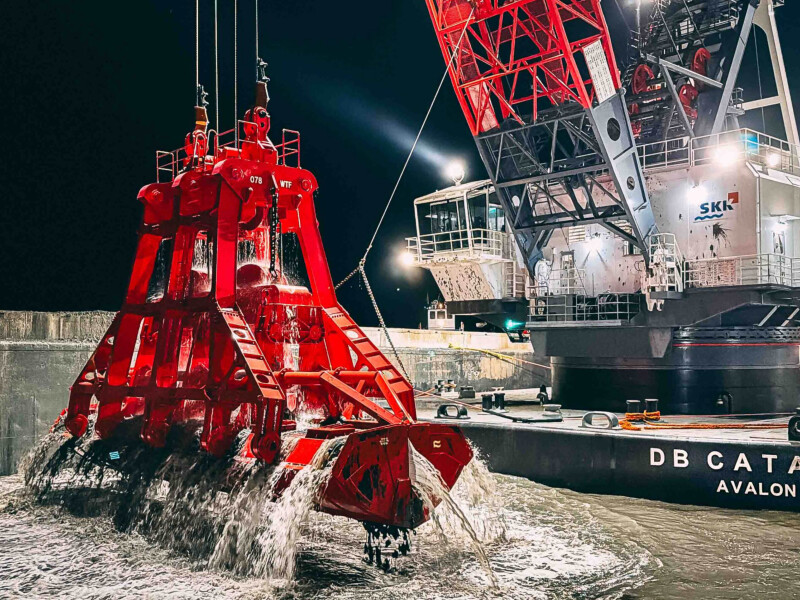
Just in the past year, Manson Construction Co., Seattle, and Great Lakes Dredge and Dock Co. LLC, Houston, have both christened new hopper dredges: the Frederick Paup, built by Seatrium AmFELS, Brownsville, Texas; and the Amelia Island, built by Conrad Shipyard, Morgan City, La., respectively. Late last year, Curtin Maritime Corp., Long Beach, Calif., took delivery of a huge mechanical clamshell dredge, the DB Catalina, built by LAD Services Inc., Morgan City.
“Most recently, The Dutra Group, [San Rafael, Calif.,] cut steel at Eastern Shipbuilding Group [Panama City, Fla.,] for a new, approximately 10,000-cubic-yard hopper dredge, which is another major signal that owners see long-term demand and opportunity in the market,” Doyle said. “A big part of this is simply keeping the fleet modern, efficient, and competitive.”
Demand signals play a big role in future asset investment as well, and the trend of late has been largely positive.
“FY 2024 was historic funding,” said Michael Gerhardt, vice president of external affairs at Muddy Water Dredging LP, Orange, Texas, and author of The U.S. Dredge Report, an annual, comprehensive breakdown of dredge contracts and projects throughout the country. “It was the best year on record, and before that, FY 2023 was the best year on record.”
And while fiscal year 2025 saw about a 25% decrease in total federal dredging awards compared to FY 2024, the $1.8 billion in federal funding for dredging in 2025 was still within 2% of the seven-year average.
“It came down because there was a reduction in new work contracts, deepening contracts, but the maintenance market remained strong,” Gerhardt said.
Congressional factors also affected the Corps’ dredging portfolio in 2025.
“In FY 2025, [the Corps] operated under a full-year continuing resolution and did not receive a traditional work plan,” Janocha said. “That affected certain funding and limited the Corps’ ability to advance some work. The year-to-year comparison also reflects the natural variability in the dredging program, as new construction and deepening projects are cyclical. This can result in periods of significant new work followed by years more heavily weighted toward maintenance dredging.”
Despite those variations, the market outlook remains healthy, Doyle said.
“Ports continue expanding for larger vessels, coastal restoration work is growing, and there is increasing recognition on Capitol Hill and with the White House that navigation infrastructure is directly tied to economic growth, national security, energy exports, and supply chain resilience,” Doyle said. “That gives companies confidence to continue investing in modern dredging assets and support equipment.”
And while those macro factors — harbor deepening projects, federal policy, and congressional spending — plot the course for the dredging industry in a broad sense, safety programs, technology, and product innovations continue to shape day-to-day operations in a big way.
Devon Carlock, vice president of safety and government affairs for Cottrell Contracting Corp., Chesapeake, Va., and president of the Council for Dredging & Marine Construction Safety (CDMCS), praised member companies for communication and collaboration that drive safety throughout the industry.
“It’s that collaboration between our organization, and we share that with everyone,” Carlock said, speaking of the council’s safety resources. “Member or not, you can go on the website and get the information.”
Carlock also mentioned vibration-resistant housing impact guns, the availability of electrolyte supplements, composite work boots, and oil-guard leather gloves as items that make work environments safer for dredge crews.
Crewmembers prefer leather gloves, Carlock said, particularly when working with heavy equipment and impact guns, because the leather reduces vibrations.
“The problem is, when the gloves would get wet, the leather would swell, and you’d basically have a fairly expensive glove that was unusable,” he said.
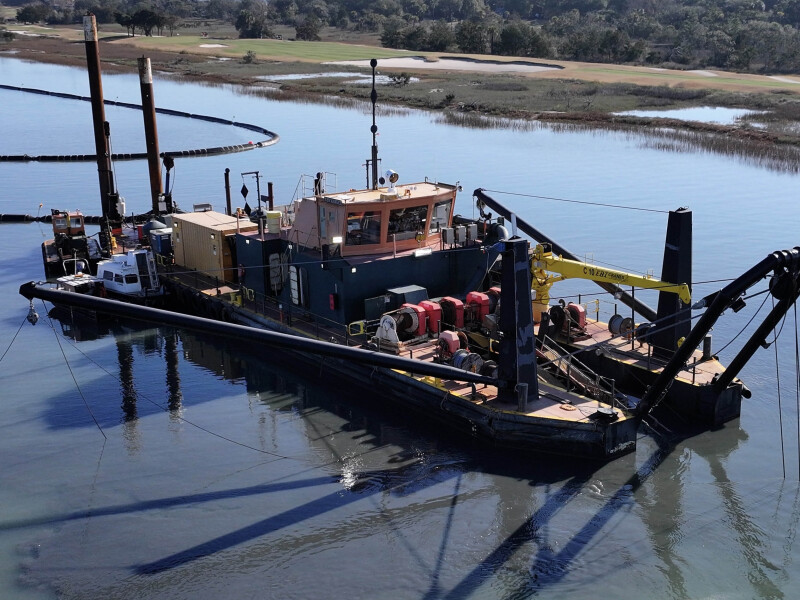
CDMCS worked with HexArmor, Grand Rapids, Mich., which developed oil-guard leather gloves that are both waterproof and provide vibration reduction essential for assembly pipelines and other dredge work.
“Of course, there’s a glove for every job,” said Carlock, who then mentioned gloves that offer various levels of cut protection.
Gloves, vibration reduction for power tools, monitoring electrolytes, and lighter work boots — all are issues addressed and solutions identified through CDMCS discussions.
“I think out of everything, that sharing of information is so critical,” Carlock said. “That’s really been the pivotal achievement of our organization and different communities speaking to each other.”
Carlock highlighted locating, surveying, and marking underwater utilities as an important issue from a safety standpoint for crews and for avoiding utility disruptions. The depth and location of utility pipelines are both dynamic. While company A might have a dredging contract and survey utilities in one year, company B might get that contract the following year, and there’s no standard for sharing that information. Carlock said that’s a top issue for discussions between the dredging industry and the Corps.
Whether marking underwater utilities, securing beaches, or employing the best equipment for building and laying dredge pipelines, it all comes back to safety, Carlock noted.
“It’s not all about the amount of sand or mud you’re putting on a hill or taking out of the channel,” he said. “It’s about making sure that everybody goes home safe and can see their families.”
