



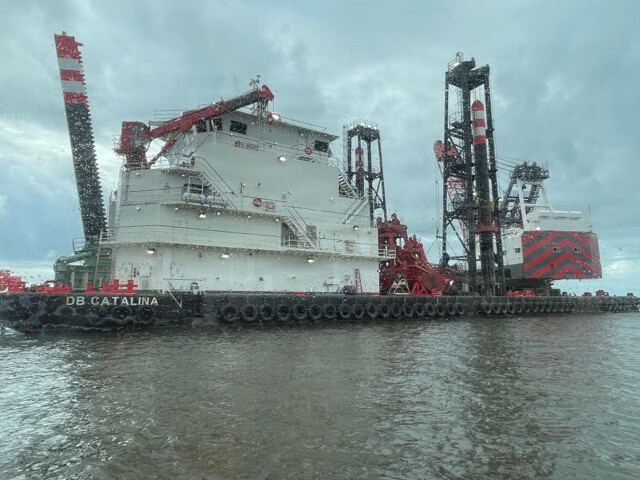
Annual maintenance dredging has wrapped up at Military Ocean Terminal Sunny Point (MOTSU) in North Carolina, restoring federally authorized navigation channels to their required depths after removing hundreds of thousands of cubic yards of accumulated sediment, the U.S. Army Corps of Engineers announced.
MOTSU is the U.S. military's largest ammunition ocean terminal and the Department of Defense's primary East Coast strategic ammunition port, supporting operations in European, African, and Middle Eastern theaters. Situated on the banks of the Cape Fear River, the installation serves as a multimodal transfer point between rail, trucks, and ships for the import and export of weapons, ammunition, explosives, and military equipment.
"MOTSU is an ocean terminal, so the waterways must be deep enough for vessels to maintain missions," said Clare Williams, navigation project manager with the Corps' Wilmington District. "If the vessels can't make it in, the mission is compromised."
In a typical year, between 500,000 and 600,000 cu. yds. of material are removed from MOTSU's federal waterways and transported to a designated offshore placement area.
The recently completed $6.3 million dredging project saw a subcontractor complete a portion of this year's work in March, with Curtin Maritime Corp., Long Beach, Calif., handling the remainder between May 19 and June 13.
Curtin Maritime deployed the DB Catalina for the project — the largest mechanical dredge in the Western Hemisphere. Despite its size, the vessel carries a notably light environmental footprint. "The Catalina's emissions are about one-tenth of a typical dredge, which is impressive for its size," Williams said.
The Wilmington District favors mechanical dredges for operations near MOTSU for both environmental and practical reasons. "Typically, a bucket dredge has fewer 'takes' each year," Williams said. "Cutterhead and hopper dredges pose a higher risk to marine life, so we prefer not to use them near MOTSU."
Mechanical dredges also require less pipeline infrastructure, reducing interference with vessel traffic during operations.
Keeping that traffic moving throughout the dredging window presents one of the project's central logistical challenges. "If a vessel is coming, under orders, or leaving, the dredge must stay out of the way," Williams said. "That requires heightened coordination between the contractor, the Corps, and the customer."
Environmental considerations add another layer of complexity. MOTSU provides habitat for several protected species, including sturgeon that nest and breed in the area, and dredging schedules are planned around those restrictions. "MOTSU supports and protects a number of critically endangered species, and we will continue to support that part of the mission as well," Williams said.
