



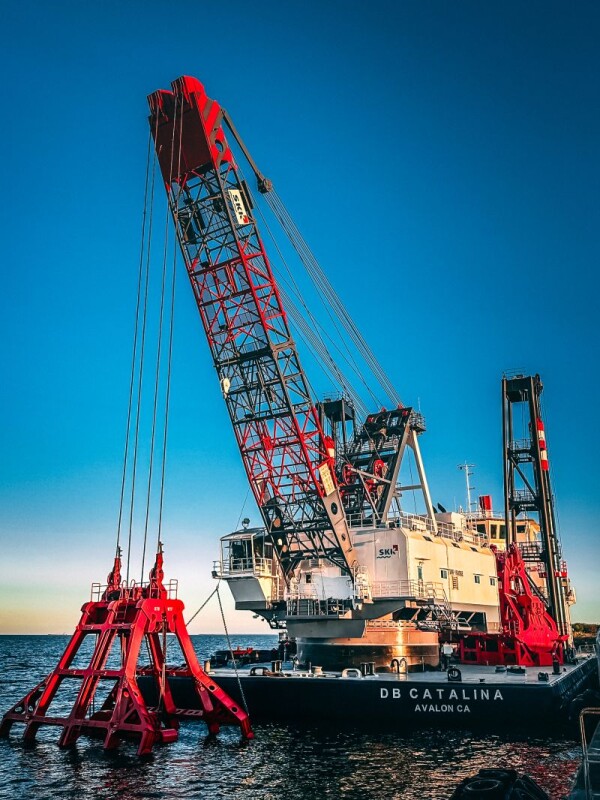
Curtin Maritime Corp., Long Beach, Calif., has taken delivery of its new dredge DB Catalina, adding significant capacity to the Jones Act fleet amid robust demand in the U.S. dredging market.
The 254'x86' DB Catalina, built by LAD Services Inc., Morgan City, La., surpasses the company’s 250'x77' DB Avalon — built in 2022 by Conrad Deepwater South, Morgan City — as the largest mechanical clamshell dredge in the Western Hemisphere, according to Curtin Maritime CEO Martin Curtin.
When designing the DB Catalina in partnership with The Shearer Group Inc., Houston, Curtin Maritime took cues from its DB Avalon build but amplified its size and capacities. “Ultimately, it’s just a larger version of the same thing,” said Curtin. “The large maintenance bucket on the DB Avalon is a 70-cubic-yard bucket, the DB Catalina’s is 100 … The DB Avalon is 110-metric-ton single-line capacity as far as its dredge capacity. This one is 160-metric-ton, so it’s just shy of one and a half times the size.”
The dredge's electric-driven grab dredging crane — which Curtin Maritime calls "Mechagodzilla" — is a SKK-1600GE built by SKK Corp. in Japan. The crane has a boom length of 105' and a maximum hoisting load of 352,740 lbs.
The hybrid-electric dredge is highly efficient, with automated dredging capabilities and the option to operate as a fully electric plug-in for zero-emissions performance. “Energy is harnessed through regenerative braking as the bucket lowers, charging onboard supercapacitors. The energy is then deployed to assist hoisting of the bucket, alongside the [two main Wabtec 12V250 EPA Tier 4] generators,” said Davlyn Freitas, project manager at Curtin Maritime. “This system results in lower fuel consumption and allows for smaller generators to be installed due to lower peak energy load demand.”
The DB Catalina has been built with a pair of 128' fixed spuds and a 125' walking spud. It features a full commercial galley and air-conditioned accommodations, with 24 berths and 11 heads.
The DB Catalina was launched in October and is now working its first job in the Port of Houston.
STRONG DEMAND
Martin Curtin told WorkBoat earlier this year that the increasing number of port-deepening projects worldwide, needed to accommodate larger ships, as well as “an obscene amount of beach nourishment and shoreline resilience projects,” are driving demand across the dredging industry.
“We’re seeing a large uptake in the dredging markets wholesale. Every genre — whether it’s cutterhead, suction hopper dredging, or mechanical clamshell — all three are seeing large increases in volume and projects," he said. "So, you’re seeing a lot of investment across the board between new hopper dredges being built, new cutterhead dredges being built.”
“We have not seen a lot of capex” — capital expenditure — “in the clamshell dredging markets,” said Curtin. “Everybody’s building new hopper dredges and new cutterhead dredges. We felt the fleet on the clamshell side was aging and outdated. And so we thought that, coupled with the difficulty of mechanical dredging and our specific skill set, was the area that we wanted to continue to expand in.”
