



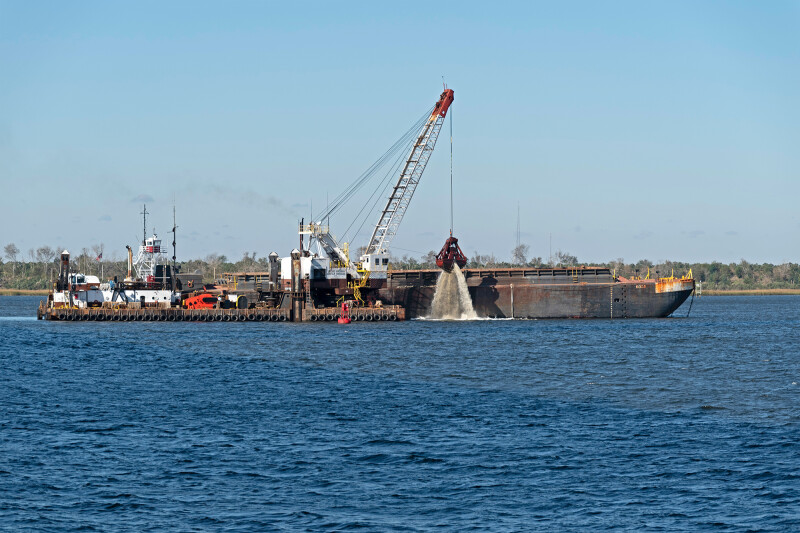
President Trump’s proposed FY 2027 budget that dropped on April 3 sends two strong messages to the maritime industry. It also opens the door for Congress to have a meaningful say in new starts and smaller navigation dredging projects.
On one hand, the budget makes the largest proposed investment in American shipbuilding, sealift, and the maritime industrial base in generations. It seeks major increases for Navy shipbuilding, merchant marine programs, shipyard modernization, workforce development, and the broader goal of rebuilding America’s maritime strength.
On the dredging side, the budget continues strong support for annual maintenance dredging and the operation and maintenance of the nation’s ports, channels, and waterways. The administration continues to recognize that reliable navigation channels are essential to commerce, military readiness, energy exports, and America’s broader maritime future.
Where the budget is more restrained is in new navigation construction. The proposal provides less funding for major harbor deepenings, widenings, and expansion projects than in prior years. Those projects are not necessarily stopped, but they will face greater competition and will likely need to be championed and justified by states, local sponsors, and members of Congress in the months ahead.
For the dredging industry, the message is clear: maintenance dredging remains a national priority, while the next generation of expansion projects will need to prove their economic, commercial, and national security value.
The administration proposes approximately $6.7 billion for the Corps of Engineers Civil Works program in FY 2027, down from roughly $7.5 billion in FY 2026. Commercial navigation remains one of the administration’s stated priorities, but the emphasis shifts toward maintaining existing channels and harbors rather than beginning major new projects.
The clearest indication is found in the Commercial Navigation Construction account. The budget proposes $1.004 billion for navigation construction in FY 2027, down from approximately $1.243 billion in FY 2026. That nearly 20 percent reduction affects the account used for new navigation projects, harbor deepenings, channel widenings, and other major dredging construction.
Importantly, this does not mean those projects disappear. Rather, it means there will be fewer new starts and greater competition among projects seeking funding. Harbor deepenings, channel widenings, and expansion projects that demonstrate strong economic returns, military value, export benefits, or regional support are still likely to move forward.
The burden will now shift to states, local sponsors, and members of Congress to make the case for those projects during the appropriations process. Senators and Representatives from port states are likely to spend the coming months pressing the case for navigation improvements that support trade, energy, manufacturing, agriculture, and national defense.
By contrast, annual maintenance dredging appears to remain protected.
The administration continues to emphasize the “operation, maintenance, and care” of existing commercial navigation projects. That means routine maintenance dredging of federal channels, ports, harbors, and inland waterways remains a priority. The Harbor Maintenance Trust Fund also continues to play a central role in supporting these activities.
The Harbor Maintenance Trust Fund is financed by the Harbor Maintenance Tax, which is paid on imported cargo moving through U.S. ports. For years, the Fund has accumulated a multi-billion-dollar balance because annual appropriations have not kept pace with collections. The FY 2027 budget continues to rely on Harbor Maintenance Trust Fund revenues to support navigation maintenance dredging and does not propose diverting those funds to unrelated purposes.
The concern for many smaller ports is not that they are specifically targeted for cuts. Rather, the administration states that it intends to prioritize “high-performing projects.” Smaller, recurring maintenance dredging projects that do not score as highly under traditional Corps criteria may therefore be more vulnerable.
That concern is already familiar in several parts of the country.
In recent years, a number of smaller California harbor dredging projects were omitted from administration requests and later restored by Congress. These included Channel Islands Harbor, Morro Bay Harbor, Oceanside Harbor, Santa Barbara Harbor, Santa Cruz Harbor, and Ventura Harbor. Congress ultimately restored or earmarked funding for several of those projects, including approximately $4.12 million for Morro Bay Harbor, $8.23 million for Channel Islands Harbor, and $5.98 million for Ventura Harbor.
Congress has repeatedly restored or added funding for smaller navigation and dredging projects that were not fully reflected in the President’s request. In California, Congress restored funding for Morro Bay Harbor, Channel Islands Harbor, and Ventura Harbor. Similar efforts have occurred in the Great Lakes, where Members continue to push for dredging at harbors such as Two Rivers, Wisconsin, and in the Pacific Northwest, where Congress restored funding for Columbia River navigation improvements, Seattle Harbor studies, and other regional projects.
The same dynamic has emerged in other regions.
Great Lakes communities have repeatedly warned about the consequences of delayed or insufficient dredging at smaller harbors. In Wisconsin, for example, local officials have warned that shoaling in Two Rivers Harbor threatens the harbor’s ability to continue commercial operations. Similar concerns have been raised across the Great Lakes, where advocates estimate that more than $1 billion in harbor maintenance dredging needs remain unmet.
In the Pacific Northwest, local interests have likewise expressed concern that smaller navigation and harbor maintenance projects could fall behind larger, nationally significant projects if funding becomes more constrained.
The pattern is consistent: large, nationally significant commercial channels are likely to remain protected, while smaller, annually dredged harbors may need Congress to restore funding after the administration submits its request.
That has often happened in the past. Congress has repeatedly stepped in to restore funding for local navigation and dredging projects that were not included in the President’s budget. Given the broad bipartisan support for harbor maintenance in coastal and Great Lakes states, many of these projects are likely to continue receiving support.
Still, the FY 2027 budget suggests that competition for dredging dollars will become more intense.
At the same time that the budget tightens funding for some Corps navigation accounts, it dramatically expands federal support for shipbuilding and the maritime industrial base.
The administration proposes approximately $65.8 billion for Navy and sealift shipbuilding, the largest shipbuilding request in decades. The proposal would fund a wide range of vessels, including submarines, frigates, amphibious ships, auxiliary vessels, replenishment ships, tankers, roll-on/roll-off vessels, and other sealift assets.
Equally important for the commercial maritime sector, the budget proposes a new Maritime Security Trust Fund administered through the Maritime Administration. The proposal includes approximately $1.4 billion in mandatory funding to support commercial shipbuilding, shipyard modernization, maritime workforce development, port and inland waterway infrastructure, and modernization of the U.S. Merchant Marine Academy.
The administration’s broader maritime agenda is also built around support for American-built, American-flagged, and American-crewed vessels. It includes proposals to expand cargo preference, strengthen sealift capability, and create new incentives for domestic shipbuilding.
For the dredging industry, there is an important connection between these two trends.
The same administration that is calling for a stronger merchant marine, more shipbuilding capacity, and greater sealift readiness is also depending on reliable navigation channels, maintained ports, and resilient coastal infrastructure. America cannot build a larger maritime industrial base if ships cannot safely reach shipyards, ports, military installations, and commercial terminals.
That is why maintenance dredging remains protected in the FY 2027 budget, even while other navigation accounts are reduced. It is also why Congress is likely to continue restoring funding for smaller harbor projects that may not initially appear in the administration’s request.
The long-term challenge is ensuring that America’s maritime ambitions are matched by sustained investment in the navigation infrastructure that supports them.
The U.S. is making a significant new commitment to shipbuilding and maritime strength. But dredging and harbor maintenance are every bit as essential to that effort. If America intends to build more ships, move more cargo, strengthen sealift, and compete globally, it must also continue to maintain and improve the ports and waterways on which that entire system depends.
