



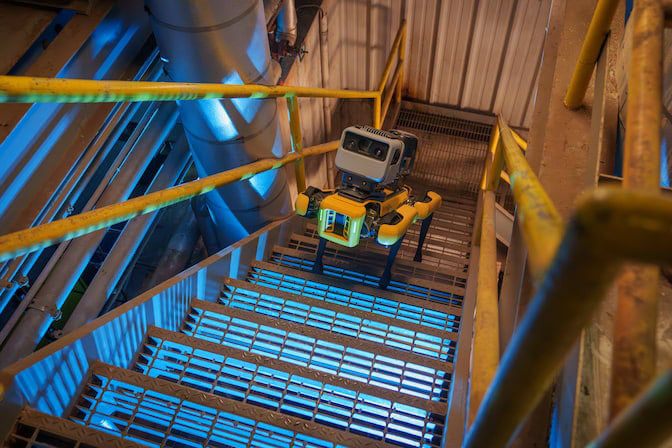
With a $6.2 million grant from the Japanese Ministry of Land, Infrastructure, Transport, and Tourism, American and Japanese researchers plan to design and prototype autonomous robots equipped with artificial intelligence models that will analyze ship construction as it progresses and provide early detection of divergence between project design and the ship under construction.
University of Michigan Engineering is leading the American team, which also includes researchers from the Massachusetts Institute of Technology (MIT). The Japanese team is made up of representatives from Yokohama National University, Osaka University, Osaka Metropolitan University, and Japan’s National Maritime Research Institute.
Alan Papalia, assistant professor of naval architecture and marine engineering at the University of Michigan and the leader of the American research team, said the goal of the project is to assist shipbuilders.
“We want to build a co-pilot system that uses AI and robotics to take some of the detective work off workers’ shoulders,” Papalia said. “The system should automatically map what’s installed, identify where reality is drifting from design, and suggest workable alternatives when something needs to change.”
The American team will focus on developing technology to aid in outfitting, or the installation of pipes, cables, electrical systems, and other equipment inside the vessel. As construction progresses, parts may not fit as expected or the vessel’s original drawings may prove impractical. In those cases, early detection of issues can help avoid delivery delays.
According to the project announcement from the University of Michigan, the robots will be designed to roam the vessel as it’s built, feeding LiDAR and camera data into an AI model. The AI model will then build a digital model of the structure as-built and compare it to the intended design.
“When the model finds a problem — such as a pipe that no longer fits as expected or a build sequence that will likely be disrupted — the system will generate a list of potential solutions and the tradeoffs between them,” the University of Michigan stated in announcing the program.
In addition to verifying construction, the AI model will also send an alert if it detects insufficient data, which would dispatch a person to that area.
According to researchers, the team will interview shipbuilders in both the United States and Japan to make sure how the AI model understands the shipbuilding process matches how workers reason on the job.
The team of engineers will test the robots and AI models on a physical model of a ship section, which the team has called the Shipbuilding Test Block. The model will be reconfigurable to simulate various stages of vessel construction.
Dave Singer, professor of naval architecture and marine engineering at the University of Michigan, will lead the work to establish shipyard collaborations. University of Michigan professors Matt Collette, Leia Stirling, and Patricia Alves-Oliveira will interview tradesmen and work to integrate human knowledge into the AI models. Thomas McKenney, also with the University of Michigan, will lead the team designing and producing the Shipbuilding Test Block. Finally, Faez Ahmed, associate professor of mechanical engineering at MIT, will lead AI model development efforts.
“It’s very complementary to our other research projects led by Japanese universities, in which the main focus is robots for automation of hull construction and steel welding,” said Hideyuki Ando, managing director of the Monohakobi Technology Institute. “We wanted to partner with the University of Michigan because of their unique status as a high-output research university with a dedicated department for naval architecture and marine engineering.”
The project is funded through the first quarter of 2027.
