



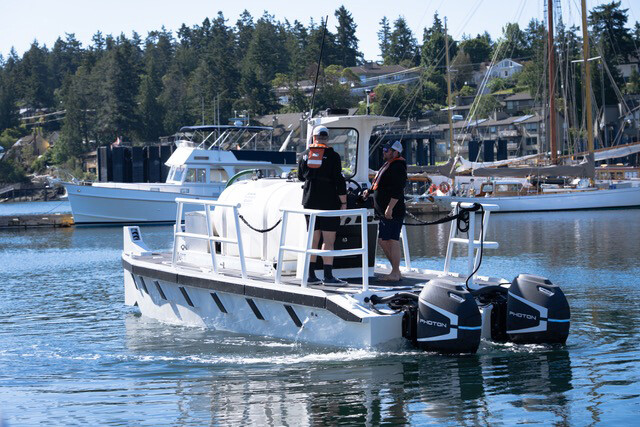
The Port of Friday Harbor in Washington State took delivery in September of a new pump-out boat powered by twin electric outboards from Photon Marine. The vessel was funded through the Washington State Department of Transportation (WSDOT) Port Electrification Grant Program. It allows the port to launch a broader program of carbon-reduction projects and establish sustainable maritime practices in the Salish Sea.
“In our marinas the old gas-powered pump-out boat was the obvious place to start,” Kyle Gropp, deputy director of Port of Friday Harbor, wrote in an email. “It burned roughly 3,160 gallons of gasoline a year, and during peak season it shifted gears up to 3,000 times a day, which wore out the lower unit and drove up maintenance costs.
“An electric outboard has no gears in the lower unit to grind; reversing just spins the motor the other way. That made the pump-out boat a natural first candidate for electric power.”
The vessel was christened Pooseidon, and it is a 28' aluminum VersaBarge monohull designed and built by Silverback Marine in Tacoma, Wash.
It’s powered by twin Photon Marine electric outboards that make peak power at 300 hp and 150 hp continuously. Electricity is provided by 63-kWh batteries made by Kreisel Electric, an Austrian company in which John Deere acquired a majority stake in 2022. Production will be moved to the United States, according to Alana Kambury, director of operations at Photon Marine.
Each battery weighs about 800 lbs., and depending on how you use them, they can be recharged with a DC fast charger in approximately 45 to 120 minutes or overnight when plugged into a standard 120-volt marina pedestal.
Pooseidon can carry up to 325 gals. of wastewater (hence the spelling of its name). During a busy weekend motoring out to moored vessels, Port of Friday Harbor estimates that the boat will run 10-hour shifts and average six hours per day for 300 days a year.
The gasoline-burning, outboard-powered boat used 1.5 gph, which translated to $45 per day in fuel compared to $1.75 for electricity to charge the Photon outboards. In a YouTube video on the delivery of the new boat, the port said it spent $20,000 per year on maintenance for the gasoline outboards.
Gropp added that going with Photon Marine, based in Portland, Ore., kept the project close to home. “It gave the port a completed Pacific Northwest-built solution, pairing locally developed electric propulsion technology with a Silverback Marine hull built in Tacoma,” he wrote. “That combination aligned well with the port’s operational needs and long-term electrification goals.”
The base cost of the hull, motors, and batteries was $444,792. Electric outboards cost more up front, primarily because of the batteries, but Gropp said the savings come during operation. Fuel costs are minimal, and there are no oil changes or lower-unit rebuilds. The port estimates it will recoup the added cost in roughly two to three years.
Electric outboards also work well in a pump-out application because the job requires short, low-speed transits and low-power operation. Typically, the batteries can last a full day before recharging.
Photon Marine is focusing on commercial applications such as crew transfer, surveillance, oyster-bed work, and uncrewed vessels from 24' to 42'.
While other electric-propulsion suppliers have acquired boat manufacturers or built their own hulls, Photon has partnered with Silverback and other builders so that it can concentrate exclusively on designing and supplying complete electric propulsion systems.
Many of the components for these systems often come from familiar names such as Dometic and Garmin, because commercial operators tend to prefer equipment they already know, according to Kambury.
“We make many bespoke parts, but no more than necessary,” she said. “We source many parts for our system from the automotive industry because high production volumes drive down cost and improve reliability. We don’t white-label any parts. If a part comes from Bosch, it will say Bosch. If a part is our own, it will carry the Photon trident brand.”
For example, the Intrepid, a 24' workboat that Photon built with Silverback for the New York Power Authority, includes software that tracks charging status, maintenance schedules, environmental and navigation data, motor and power history, battery levels and power consumption over time. “This centralized platform is designed for commercial operators managing multiple fleets, marinas or port locations on a single screen,” said Kambury.
Pooseidon is the first vessel in a program developed by WSDOT’s Climate Commitment Act that Gropp said allows the port to think more broadly. The harbor is acting on a comprehensive electrification strategy that includes electric workboats, a 40-ton travel lift, cruise-ship shore power, a vessel charging infrastructure, and a nearly quarter-acre solar array.
