


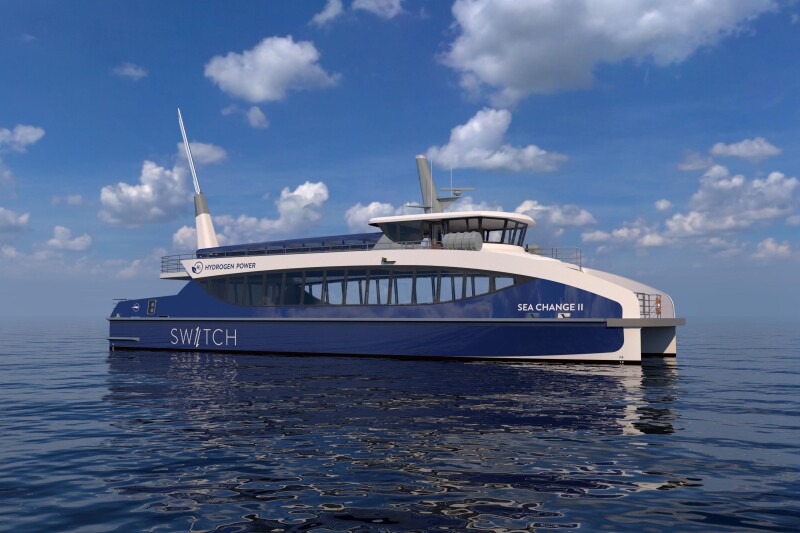
Switch Maritime has secured a design basis agreement (DBA) from the Coast Guard for the Switch-150, a 150-passenger hydrogen fuel cell-electric ferry, the company announced Wednesday.
The agreement sets the regulatory framework that will govern the vessel’s construction, commissioning, and operation. A DBA is an early-stage Coast Guard approval that establishes the standards a novel design must meet.
“Signing the DBA with the Coast Guard is a critical milestone in advancing the development of the Switch-150. With the DBA in hand, Switch, our project team, and the USCG have a clear and defined framework that will inform vessel construction, commissioning, and ultimately operation,” said Francisco Planells, newbuild program director at Switch.
The announcement did not include a construction schedule, shipyard, or planned delivery date.
The Switch-150 uses an integrated hydrogen fuel cell-electric propulsion and storage system. Its only emission is water vapor, according to the company.
Switch said the vessel is designed to match the service speeds of diesel ferries and operate on a daily bunkering schedule, without added dwell time for charging. It requires only mobile hydrogen refueling equipment, not shoreside charging infrastructure or power grid upgrades, the company said. A comparably specified battery-electric ferry would require scheduling changes or a system-wide reorientation, Switch said.
Incat Crowther, the naval architecture firm, designed the 93'6"x29'6" aluminum catamaran. It is the second Switch vessel the firm has designed, after the Sea Change, built by All American Marine.
Coast Guard Subchapter T rules, which cover passenger vessels carrying 150 or fewer passengers, do not currently include provisions specific to hydrogen fuel cell-electric propulsion and hydrogen storage. Switch and its project team worked with the Coast Guard to build a framework demonstrating equivalent safety and risk mitigation.
The International Maritime Organization approved Interim Guidelines for the Safety of Ships Using Hydrogen as Fuel in May 2026. Switch said the guidelines served as a foundation for the SWITCH-150 DBA process, adding structure and reducing time to approval.
Incat Crowther led vessel design and initial development of the regulatory matrix. Other project partners include Hexagon Purus, a hydrogen storage systems developer; Hornblower Marine, the operational advisor; LH2 Shipping, a hydrogen propulsion system design and safety specialist; PowerCell Group, a fuel cell system developer and manufacturer; and Seam, the propulsion system integrator.
The New York State Energy Research and Development Authority (NYSERDA) provided a $2 million grant to develop and demonstrate the first hydrogen-powered ferry in New York State. The grant came through NYSERDA’s Advanced Fuels and Thermal Energy Research Program, which aims to accelerate deployment of commercially ready clean hydrogen technologies that reduce greenhouse gases across sectors.
The first Switch-150 is intended to operate in New York City, based at the Brooklyn Navy Yard, using clean hydrogen to achieve the lowest possible “well-to-wake” emissions, according to Switch. The company said the vessel’s propulsion system could also serve high-frequency commuter routes elsewhere in the U.S.
The Switch-150 draws on the technical, regulatory, and operational framework established by Switch’s first vessel, the Sea Change. The Sea Change, the first hydrogen fuel cell-electric ferry in the U.S., began passenger service in July 2024. It received its DBA from the Coast Guard in 2020 and its Certificate of Inspection in 2024, which cleared it for commercial operation. Switch said it was the first hydrogen fuel cell-electric vessel to complete the Coast Guard’s alternative DBA process.
