



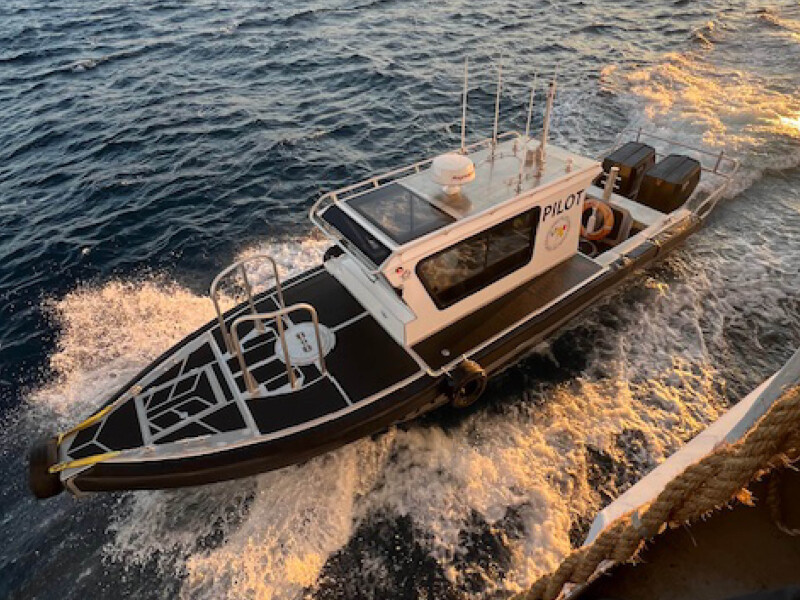
The Port Everglades (Fla.) Pilots have been running inboard-powered boats longer than 40' for decades. Then Robert Bodvake introduced them to the idea of a 9-meter (29'6") aluminum center-console design powered by twin outboards.
Bodvake launched Disruptor Maritime LLC, Norfolk, Va., three years ago. Initially, the company outsourced manufacturing, but it opened its own manufacturing facility in May 2025. Disruptor builds designs from Icelandic naval designer and builder Rafnar.
Rafnar’s reputation for building boats that can handle rough water comes from the ÖK Hull that was designed by the company’s founder, the late Össur Kristinsson. The bottom can best be described as a hybrid displacement/deep-V design. The keel is in the middle of the hull and water flows around it, creating pressure beneath the aft running surface that is basically flat. That lifts the stern while the bow stays down. The company said the design reduces slamming in waves because the boat doesn’t leave the water.
That kind of performance would make the Rafnar 9-meter pilot boat powered by twin outboards attractive as a potential pilot vessel. Bodvake made the Disruptor version out of aluminum and convinced the team at Port Everglades Pilots in Fort Lauderdale, Fla., to charter the boat for an extended four-month sea trial.
“They wanted the opportunity to try something different, and chartering the boat made sense for them,” said Bodvake.
“Our charter of the Rafnar allowed us to try three things: a smaller pilot boat, a faster pilot boat, and a boat with outboards,” said Port Everglades Pilot Capt. David Ulrich. “Outboards were once uncommon in our industry, but more pilot organizations are adding outboard boats to their fleet, so we were curious to see if they would work with our operation. We were fortunate Disruptor had the Oxe [Marine] diesel outboards available because it was one less hurdle for us: we could fuel the boats the same way we fuel our other boats without needing to fill up with gasoline at the local marina.”
Ultimately, the Everglades Pilots decided the Disruptor wasn’t for them, but Bodvake still considered the extended test a success. The biggest difference was the shorter size of the Disruptor compared with the boats the pilots have been running. Most of those boats exceed 40' long, and Bodvake explained, “The bow space matters. They’re used to having the space, and sometimes, that gets to be muscle memory.”
Rafnar has 11-, 12-, and 15-meter designs that the Port Everglades Pilots are considering for the future.
“By the end of the charter, we had gained valuable knowledge about what does and does not work for our operation,” said Ulrich. “We concluded we liked the extra speed of a 40-knot boat, and the outboards had minimal downsides, but because of our need to operate in any and all weather conditions, a 9-meter boat was ultimately too small for us. I would love to see a 40- or 45-foot aluminum Rafnar in our fleet someday.”
The 9-meter Disruptor has an enclosed pilothouse with a single Ullman Dynamics shock-mitigating seat on the centerline, and the helm is outfitted with Raymarine electronics.
Raymarine developed a platform for the Coast Guard called Scalable Integrated Navigation System II, which can send encrypted data for secure vessel-to-vessel messaging. If the Coast Guard is coordinating a rescue or similar situation, it can securely send tasks and orders to cooperating agencies.
Engine controls would depend on the propulsion chosen, as would the steering system. “We’re willing to work with the customer on that,” said Bodvake. “We understand that there’s some brand loyalty.”
