



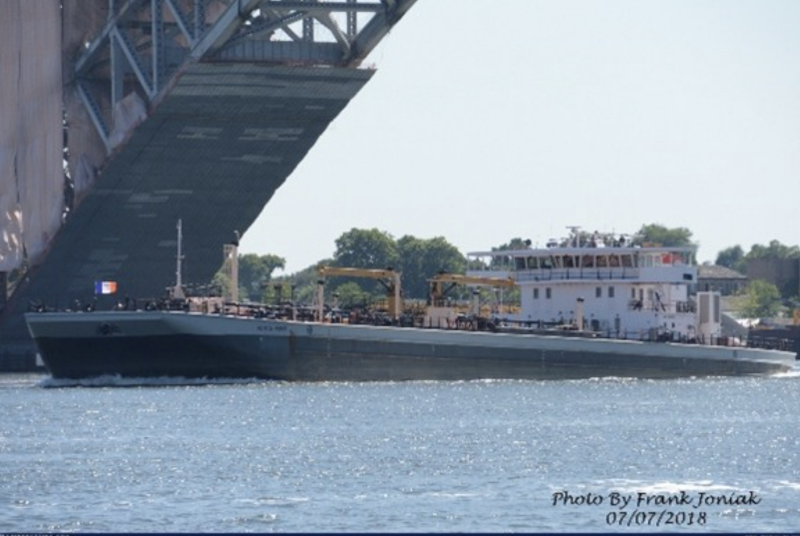
A 2025 explosion that killed the chief engineer on a sludge vessel in New York City was set off by “unapproved hot work” above a cargo tank with flammable methane gas, the National Transportation Safety Board reported.
The Hunts Point was moored at the North River Wastewater Treatment Plant on the Hudson River when the tank exploded around 10:20 a.m. May 24, 2025. The ignition of the gas overpressurized the cargo tank; the blast blew the chief engineer off the deck, inflicted injuries on three other crew and caused $10 million in vessel damage, the NTSB said.
The 288.7’ Hunts Point was one of five sludge vessels the city Department of Environmental Protection used to transport liquid sludge each day from six wastewater treatment facilities to the Wards Island Wastewater Treatment Plant, located on the East River. The vessel had six cargo tanks and could transport up to 140,000 cu. Ft. (1 million gals.) of liquid sludge.
Sludge is the residual solid or semi-solid organic material that remains after wastewater has been treated. Sludge produces flammable gases including methane, hydrogen sulfide, ethane, and ammonia. During a dewatering process it is put through a centrifuge, which removes much of the remaining water, leaving a solid treated material that can be used for fertilizer.
On the day of the casualty, about 40,000 cu. ft. of sludge remained aboard the Hunts Point from the previous day’s operations.
“Because the remaining sludge had become too viscous to pump from the cargo tanks, the crew had to perform a process called innage reduction – loosening the sludge by adding water to the tanks,” the NTSB report notes.
“To perform the process, the chief engineer had to remove the pipe plug from the modified cleaning hatch cover on each of the cargo tanks. However, since it had been about 5 years since the innage reduction process had been completed on the Hunts Point, all of the pipe plugs (connected to the flange) were rusted and seized, preventing their removal.”
To deal with the problem the chief engineer – a 33-year DEP worker who had served on the Hunts Point since it was commissioned in 2014 – removed the flange from each hatch so the pipe plugs could be removed in the machinery shop within the engine room.
“Once the flanges were removed from the cleaning hatch covers, there was nothing to prevent an ignition source, such as a flame or a spark, from coming into contact with the flammable gas exiting the cargo tanks,” NTSB investigators wrote.
As the chief engineer and the assistant engineer were removing the steel bolts for the flanges at the no. 1 port and starboard and no. 2 port and starboard cargo tanks, several of them broke, leaving the threaded part of the bolt within the cleaning hatch cover.
With the broken sections of the bolts rusted and difficult to remove, “the chief engineer decided to use a heating torch to facilitate their removal,” according to the report.
The assistant engineer told investigators the chief engineer successfully removed one of the broken bolts from the No. 2 port cleaning hatch flange using the torch.
“However, as the chief engineer started to heat a second broken bolt, the assistant engineer saw a yellow flame appear above the holes in the cleaning hatch cover, indicating that the flammable gas existing in the tank had ignited.”
Within seconds “after seeing the flame, the assistant engineer heard a ‘whistle’ noise and then a rumbling noise from within the cargo tank No. 2 port,” the report says. “This prompted him to move away from the hatch cover by dropping backward to his right and rolling to the deck.”
Meanwhile the master and other crew who were in the house aft, heard a “hissing” noise and felt the vessel vibrate as the explosion happened.
“Following the explosion, there was no fire; however, sludge burst out of the tank and covered the assistant engineer and the exterior of the vessel. The crew went out on deck to investigate and found that the deck above the No. 2 port cargo tank had expanded upward during the explosion.”
The crew found the assistant engineer injured but conscious, and the chief engineer could not be found on deck. The master notified the dispatch at the DEP office, requesting they notify the New York City Fire Department and the Coast Guard Sector New York Command Center of the explosion and that the chief engineer was missing.
Before the arrival of the fire department at 10:30 a.m., the chief engineer was found between the concrete dock and a wooden fender located on the starboard side of the vessel. He was declared dead at the scene by Fire Department paramedics.
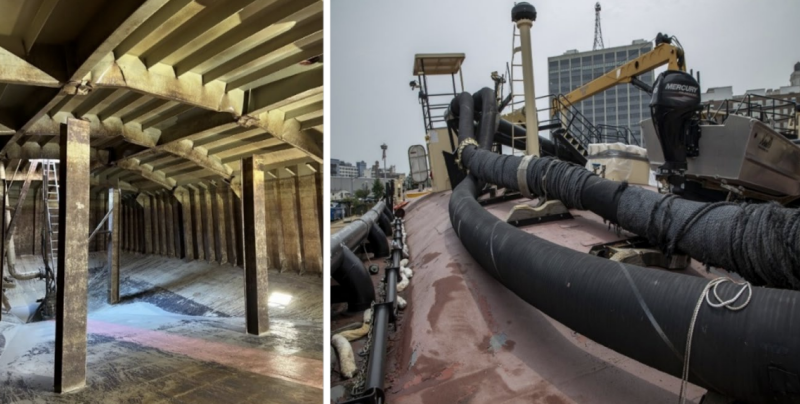
Under DEP policy, use of a torch on deck was considered hot work and a permit required.
“Additionally, there were placards warning of the vessel’s dangerous cargo as well as guidance not to smoke or have open lights, and the master had warned the chief engineer not to use a torch on deck,” according to the NTSB. “A review of the chief engineer’s training record did not identify training specific for hot work, and the NYC DEP annual field safety training conducted in 2024 did not discuss hot work procedures (except the need for a fire watch) or the risk of the gases produced by the sludge.”
“Regardless of his training record, based on his previous experience supervising hot work, the chief engineer should have known that using an open flame torch on deck would have been considered hot work that required him to obtain the proper permits and implement safety measures to remove the risk of an explosion. Additionally, the master warned the chief engineer twice not to use the torch out on deck.”
