



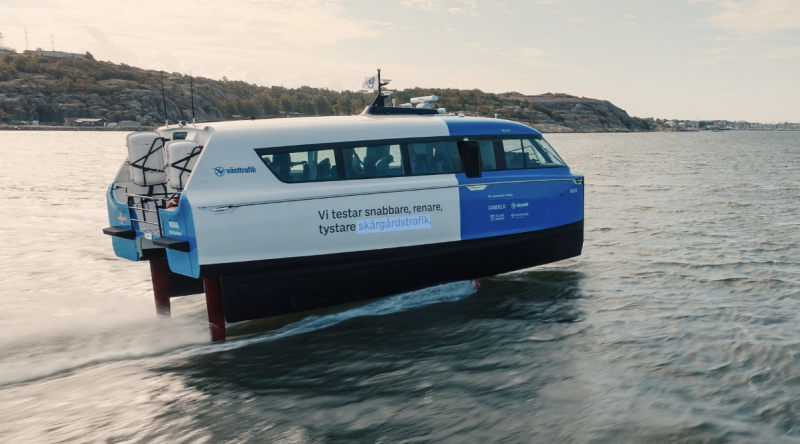
The Candela P-12 electric hydrofoil ferry has been recognized with Sweden’s most prestigious design distinction, joining the Nordic nation’s other renowned industrial and engineering achievements.
Built by Candela, an electric boat builder based in Stockholm, the ferry was selected for the Utmärkt Svensk Form 2026 award by Svensk Form, one of the world’s oldest design organizations founded in 1845. The organization and an independent jury conduct “a broad review of the Swedish design landscape and select works considered to be of exceptional quality and to contribute to the development of Swedish design,” according to a statement from Candela.
The 39.2’x14.7’ 30-passenger Candela P-12 is the world’s first high-speed, long-range electric ferry. Using computer-controlled hydrofoils to lift the vessel above the water, designers achieved energy use reduction of 80% while eliminating emissions and wake.
In announcing the award Aug. 27, Candela founder and design team leader Gustav Hasselskog recounted how the team “started with a blank sheet of paper.”
“The first stage was to completely free ourselves from what a ferry is supposed to look like and ask: what is the most efficient way of transporting people on water?” said Hasselskog.
To unlock underused urban waterways for fast, convenient public transport, the design team had to rethink the conventional ferry. Traditional vessels consume large amounts of energy, produce emissions and, due to their large wakes, are often subject to speed restrictions.
“This became the design brief for P-12: create a vessel that could make waterborne transport faster, cleaner, less costly and more frequent,” the company said in a statement.
The ferry’s small size means that instead of relying on a few large vessels, operators can deploy more units and offer frequent departures, creating a system that operates more like a bus network than a traditional ferry service.
The next stage of the design process, said Hasselskog, was about Candela’s guiding principle. How could every part of the ferry be made more efficient, from energy consumption and charging to passenger flow? And how could an entirely new type of vessel fit seamlessly into the existing urban web of infrastructure?
“It’s about the hard engineering stuff, like removing every unnecessary kilogram and adapting to different quays and accessibility needs, while at the same time rethinking the experience. How can we create a much better journey?” Hasselskog explained.
Large diesel ferries are often built as one-offs close to their intended area of operation. To allow for industrial manufacturing and shipments around the globe - including to inland cities and lakes that cannot be reached by sea - the design team kept the P-12 dimensions within limits to make it transportable on roads.
“The goal was to achieve a long range, a high speed and low operational cost,” according to the company. “That means, among other things, an extreme focus on keeping the weight down and hunting every single percent of hydrodynamic and drive train efficiency.”
“I believe some of the greatest creativity comes from hard constraints, and P-12 is very much a product of that. Its beauty comes from its purpose: every line has a reason and every part is necessary. In this way, it follows the classic functionalist idea,” Hasselskog noted.
Thirty passengers sit in a bright cabin surrounded by large windows, giving panoramic views of the very thing that makes traveling by boat special: the water.
The cabin is quiet, as the P-12’s electric C-POD motors sit submerged beneath the surface and have no mechanical transmission, minimizing both noise and energy losses. When the vessel takes off, its onboard computer controls the hydrofoils to keep the vessel stable above the waves.
New ferry routes typically require new docks. Conventional electric ferries also need heavy-duty cables and dedicated charging infrastructure. Both are costly, complex and can take years to build.
To avoid the expense of charging infrastructure, the P-12 uses standard automotive DC chargers. The technology is already widely available, keeping installation simple and costs low.
The P-12’s flexible, dampened bow ramp allows the vessel to quickly embark passengers at everything from low floating jetties to high concrete quays, while providing an accessible boarding angle for wheelchairs and strollers.
“With these two features, we can deploy at scale within weeks rather than in years,” said Hasselskog.
On conventional boats, hydrodynamic resistance dominates, making aerodynamic drag comparatively unimportant. Once P-12 rises above the surface, water resistance falls dramatically and aerodynamics becomes a much larger part of the equation. Its profile is therefore designed to be as efficient as possible, contributing to its long range.
“The elements – air drag and water drag – have shaped P-12 more than anything else. The streamlined silhouette is unmistakably Candela, but it is driven by function rather than styling. Every line is there for a reason,” said Hasselskog.
