



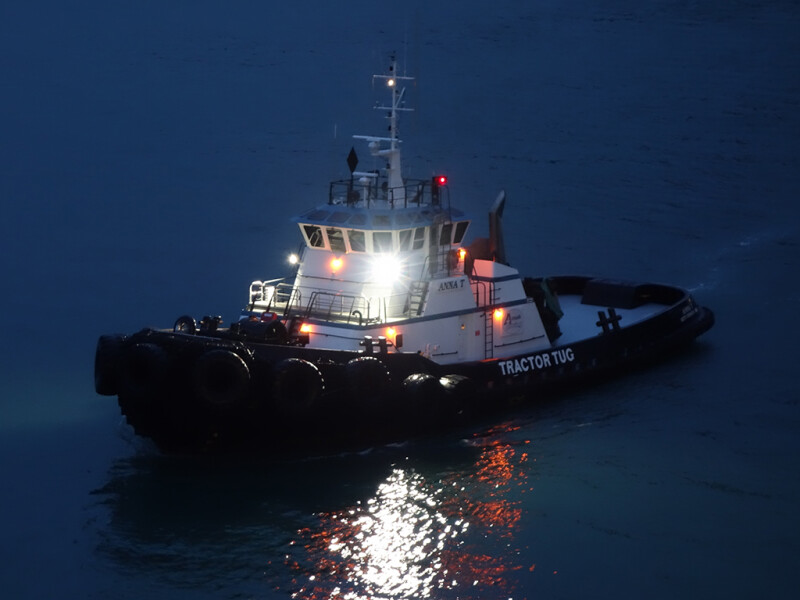
If a navigation light on your tugboat goes out, do you know the standards or certifications to reference when procuring a new one? Here’s a hint. Don’t look for a Coast Guard-certified navigation light.
“There is no such thing as just a U.S. Coast Guard-approved navigation light. It needs to have UL 1104,” said Tony Crane, director at Britmar Marine Ltd., North Vancouver, B.C., which supplies navigation, masthead, stern, and deck lighting for workboats throughout North America. “When we first started 15 years ago with LED navigation lights, most of my job was to educate people on these things,” said Crane.
The Code of Federal Regulations is the basis for regulations on navigation lights in the U.S. When Crane gets a new light, he sends it to one of several facilities in the country that are authorized to test it. One of those businesses is UL LLC, Northbrook, Ill. If it passes testing, the light gets a UL 1104 certificate. In Canada, the light would need to comply with the International Maritime Organization’s International Convention for Safety of Life at Sea regulations, which were developed in 1974 and came into force in 1980.
Companies like Britmar, McDermott Light & Signal, New York, and Phoenix Lighting, Milwaukee, are among suppliers that specialize in heavy-duty lighting for commercial, military, and law-enforcement vessels.
“Our clients lean on us specifically for 24-7 operation, rigidity, and built-to-withstand marine grade,” said Steve Paulus, director of marketing at Phoenix Lighting.
SERIOUSLY LONG RANGE
There haven’t been many standout trends in workboat lighting since the transition from incandescent to LED began more than a decade ago.
However, that doesn’t mean there’s been a lack of innovation. One recent example is a laser searchlight for on-deck use from Francis Searchlights Ltd., Bolton, England.
According to the manufacturer, the 250-watt laser system gives illumination characteristics that exceed those of a 2,500-watt xenon lamp with a 12,000-hour life expectancy. It’s made from marine-grade materials and fittings, finished in powder-coating and stove enamel paint. The gearbox is sealed to an IP66 rating, and the light itself is rated at IP56.
Before laser searchlights, most vessels used 1,000-watt xenon searchlights rated at 45 million candlepower. One use for these lights is spotting icebergs in northern waters. In a searchlight, the light source is pushed back against a reflector that shoots the beam toward the target. A 250-watt plasma searchlight will shoot a beam 5 miles, while a 500-watt one covers 10 miles.
“The biggest factor is the diameter of the reflector, and xenon searchlights use nickel-silver that is like a heavy glass,” said Crane. He said the costs for laser-based products are similar to xenon technology.
Conversely, floodlights that are used for lighting the deck on a workboat or fishing vessel have a narrow beam angle that extends about a mile but covers a wider area.
RED LIGHT, GREEN LIGHT
When it comes to workboat lighting, much discussion revolves around navigation lights. Choosing the right model for a given application involves more than making sure red is port and green is starboard.
Most current navigation lights are LED-based, but many captains or owners are unknowingly taking shortcuts when attempting to upgrade from incandescents. “A lot of people are putting LED bulbs in their incandescent fixtures,” said Crane. “It looks bright when you’re close to it, but at 2 miles, it won’t give 112.5 degrees,” the required arc in the International Regulations for Preventing Collisions at Sea 1972, also known as Collision Regulations (COLREGS).
“It may fit in the fixture, but if there’s an accident and the safety board gets hold of it and there’s a problem, the vessel owner and supplier could be liable,” Crane continued.
Once a fixture and bulb are it’s certified by UL, the same make of bulb must be used for the life of the fixture, said Crane.
With LED lights, there’s also the matter of degradation. For a vessel measuring between 65.6' and 196.8' in length, Crane said the minimum candela requirement is 26. “You never know how much it’s degraded by looking at it until it’s degraded so poorly,” he said.
It’s estimated that LED lighting lasts 30,000 to 40,000 hours based on light loss over time. Some vessels require a monitoring system that will sound an audible alarm when a navigation, anchor, or masthead light drops below a certain current charge. Once again, when a boat is upgraded to LED lights, its monitoring system needs to be improved too.
McDermott Light & Signal was founded in 1943 to make lamps for the Navy during World War II. The company manufactures lighting for rail transit and emergency services as well as maritime operators. Jonathan Giammarco, who works in sales for the company, said that 99% of McDermott’s products are LED and that it was one of the first suppliers to make the shift about 25 years ago.
Primarily, McDermott supplies navigation lights for tugs and ferries ranging from 25' to large, oceangoing tankers.
Subchapter M requires towing vessels to have backup or reserve lights that can be activated when a primary fixture fails, and the Coast Guard has been stringent in enforcing this requirement, said Giammarco. McDermott offers a double-head fixture, it calls a Tophat light, with an integrated backup system.
All McDermott’s nav lights are direct current and come with a long power cable. Customers specify the voltage when ordering a light. On request, the company will supply a large solar panel and battery to power lights on a barge, buoy, or pier.
“One of our biggest sellers is the Tophat solar light,” said Giammarco. “You can put it on almost anything you need to mark.”
At Phoenix Lighting, much of the company’s focus is on heavy-duty navigation lights for inland tugs, dredges, and workboats. “From a quality and rigidity perspective, we are top of the line for marine-grade build and design,” said Paulus. Phoenix works mainly in LED.
The company also supplies lights for military vessels, and Paulus said its non-military clients benefit from being able to order products built to Navy or Coast Guard specifications. “When you build something from a marine-grade standpoint, it plays throughout other rugged industrial environments,” he said, noting that Phoenix complies with 2021’s Build America, Buy America Act, which mandates that federally funded infrastructure projects use products produced in the United States.
In addition to complying with regulations, lighting suppliers must consider the specific needs of vessel operators — especially regarding color and shade for each application. For example, in northern waters, a helmsman’s vision can be impaired by lighting that reflects poorly off ice. When high-powered floodlights are needed, Britmar offers an alternative orange hue, similar to a high-pressure sodium light, to address such challenges.
On passenger vessels such as ferries, emergency lighting is another requirement. If a passenger area has 50 lights, 10 need to be ready to kick in for emergency use and require batteries and an AC power backup. “It lets people see if they need to evacuate and get to a disembark area,” said Crane.
But one of the most valuable things a lighting supplier can offer is versatility and the ability to create custom solutions that address a customer’s specific needs. “As long as the casing and fixture are in good shape, we can usually do it,” said Crane.
