



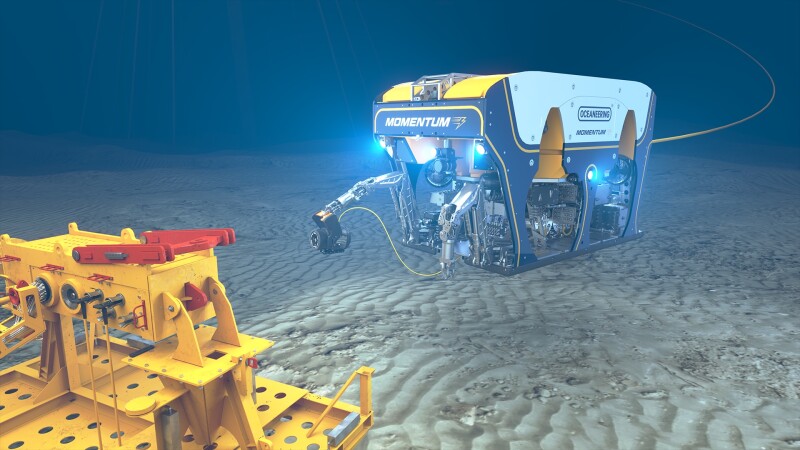
Oceaneering International Inc., Houston, has introduced a new electric work-class remotely operated vehicle (ROV) designed to support extended subsea operations while reducing maintenance demands.
The company unveiled the Momentum Electric Work Class ROV this week at the Subsea Tieback Forum in New Orleans. Developed by Oceaneering’s Subsea Robotics segment, the vehicle represents a shift toward electric propulsion within the company’s work-class ROV portfolio.
According to Oceaneering, the Momentum platform was developed using a reliability-focused, data-driven design approach that re-engineers the traditional work-class ROV architecture around electric propulsion. The redesign simplifies system components while improving efficiency and operational availability.
The vehicle is designed to remain subsea for up to 30 days of continuous operation. Oceaneering said the extended residency capability is intended to support drilling programs, inspection, maintenance and repair (IMR) work, subsea surveys, and offshore construction campaigns that require sustained intervention capability.
The Momentum ROV features plug-and-play sensor integration, 360° vision systems, and automation capabilities aimed at improving operational awareness for pilots and subsea teams. The platform is also built to deliver the thrust and payload capacity required for heavy-duty work-class tasks.
A key design consideration was compatibility with existing infrastructure. The Momentum system maintains backward compatibility with Oceaneering’s Millennium Plus ROV support equipment, allowing operators to upgrade vehicles without replacing existing launch, control, and support systems.
“With the Momentum Electric ROV, we focused on what matters most to customers: availability and capabilities that deliver confidence during critical offshore work,” Martin McDonald, senior vice president of subsea robotics at Oceaneering International, said in a statement.
“By applying electrification through a disciplined, data-driven approach, we’ve reduced vehicle maintenance while improving efficiency and operational availability,” McDonald added. “This allows customers to execute longer, more predictable subsea campaigns.”
