



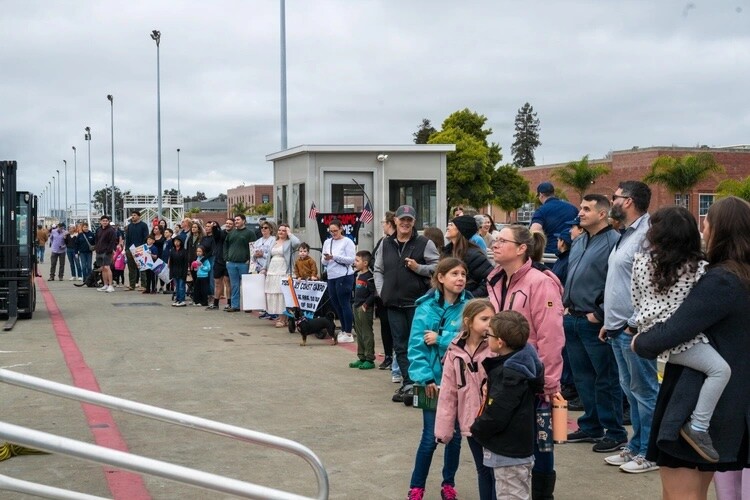
The U.S. Coast Guard’s dispersed operating footprint often places service members and their families in small coastal or remote communities where they live alongside the civilian populations they serve. A new report from the U.S. Government Accountability Office (GAO) finds that while the service has policies to address incidents of hostility or discrimination from local communities, inconsistencies in how those policies are interpreted and documented may limit the Coast Guard’s ability to respond effectively.
As a multi-mission maritime military service within the Department of Homeland Security, the Coast Guard maintains more than 40,000 active-duty personnel stationed at operating locations across the United States. Many of those locations are situated along major waterways and coastlines, where operational access to the maritime domain is critical.
According to the GAO, the geographic nature of Coast Guard operations often places units in isolated areas. As of 2023, about 41% of Coast Guard units were located in remote areas, high vacation rental areas, or both. Service members and their families typically live in the surrounding communities and rotate to new duty stations every three to four years.
The Coast Guard mandates that all personnel be treated fairly and with respect in order to carry out its missions effectively, including within the communities where members reside. However, service members and their families sometimes experience hostility, harassment, or discrimination from members of those communities, classified by the Coast Guard as “social climate incidents.”
Examples cited in the report include cases where Coast Guard members reported being subjected to racial slurs, and in one incident in 2023 a service member reported their child was targeted by antisemitic hate speech at school. According to the Coast Guard, such incidents can negatively affect the emotional, physical, and social wellbeing of service members and their families, potentially affecting morale and job performance.
GAO said it was asked to review the policies and procedures the Coast Guard uses to track, monitor, and address social climate incidents. The review examined the service’s available data on reported incidents, how consistently policies are applied, and how the Coast Guard responds when incidents occur.
From fiscal year 1998 through fiscal year 2024, Coast Guard members reported 112 incidents of community hostility, harassment, or discrimination directed toward them or their families. More than half of those reports occurred between fiscal years 2019 and 2024. Most incidents were perceived by reporting members to be motivated by race or ethnicity.
The GAO found that Coast Guard commands generally followed procedures outlined in the service’s civil rights manual when responding to reported incidents. However, district commands reported differing interpretations of the definition of a social climate incident, particularly regarding whether incidents must involve legally protected classes.
According to GAO, the lack of a consistent definition may lead to uneven application of reporting and response policies across the service.
The report also identified issues with documentation. The Coast Guard’s civil rights directorate, which oversees management of social climate incidents, was unable to locate documentation for six of the 30 incidents from fiscal years 2020 through 2024 that GAO selected for review.
GAO said establishing a standardized process for collecting and retaining documentation could improve oversight and help the service better identify trends in reported incidents.
The review also found that awareness of available reporting tools varies across the service. The Civil Rights Directorate maintains an internal website that tracks reported incidents and provides data on trends, locations, and incident types. However, seven of the nine Coast Guard district commands interviewed by GAO said they were unaware of the tool.
Improving awareness of those tools could help commands better prepare for and respond to incidents affecting Coast Guard personnel and their families, GAO said.
The report includes three recommendations for the Coast Guard: clarify the definition of a social climate incident across agency policies, develop a standardized process for collecting and retaining related documentation, and ensure all commands are consistently aware of available reporting tools.
The Department of Homeland Security, which oversees the Coast Guard, agreed with the recommendations. GAO said the recommendations remain open pending agency action.
