


Bluecore Energy, Long Beach, Calif., has raised $50 million in seed financing to advance the development, testing and regulatory approval of its floating nuclear power systems.
The round, led by Silverton Partners, follows a $10 million pre-seed financing announced when Bluecore emerged from stealth in July. Existing investor Slauson & Co. also participated, along with Harlem Capital, Precursor Ventures, Karman Ventures and several other institutional and individual investors.
Bluecore is developing compact, water-cooled nuclear systems for deployment aboard floating platforms. Its first system is being designed to generate approximately 10 MW of continuous electrical power for ports, critical infrastructure and other high-demand locations.
The system would operate for several years between refueling periods and could be scaled by adding additional units as power demand grows, according to the company.
Bluecore said the financing will support engineering, hardware development, testing, manufacturing, hiring and regulatory and classification work. The company is working with the Nuclear Regulatory Commission and Coast Guard as it develops its first system.
“Six months ago, we were building the foundation. Today, we have the capital, the team, the hardware, and some of the most important institutions in nuclear and maritime working alongside us,” Kofi Asante, Bluecore founder and CEO, said in a statement. “Our focus now is simple: create and deliver zero-emission energy as safely and quickly as possible.”
The NRC and Coast Guard have established a memorandum of understanding outlining how the agencies will coordinate oversight of civilian floating nuclear power plants and nuclear propulsion systems. Bluecore said its licensing, safety and classification work is proceeding alongside development of the technology.
“The MOU between the NRC and Coast Guard signals that the federal government is taking maritime nuclear seriously, and our experience so far has been encouraging,” said Megan Moyette, Bluecore’s licensing and safety lead and a former Navy nuclear submarine officer. “We’ve had both agencies at the table from our very first meeting, actively coordinating.”
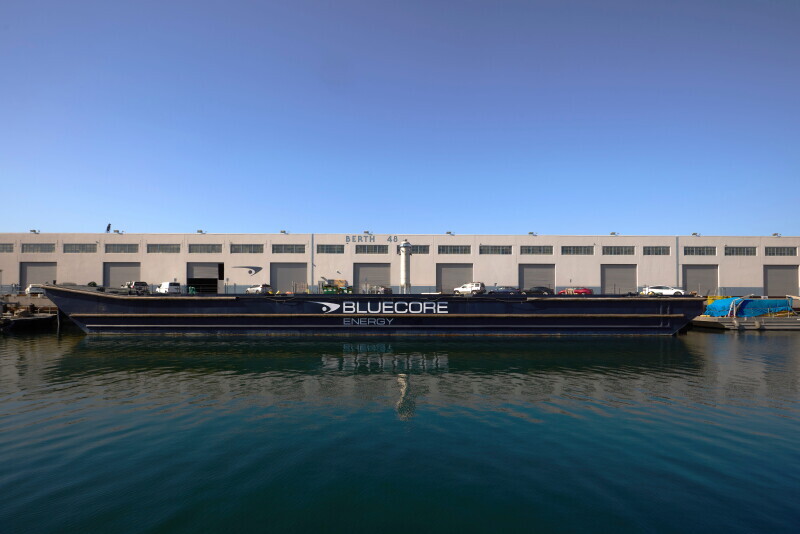
Bluecore is headquartered at the Port of Long Beach, where it has secured its first barge and is developing a non-fueled maritime reactor module prototype. The prototype will be used to test and validate monitoring, sensor and control systems. Any future fueled system would require federal licensing and environmental, maritime, safety and security reviews before deployment.
The company said possible applications include supplying power to ports, coastal infrastructure and data centers. Future operating locations and configurations would depend on site-specific safety analyses and regulatory requirements.
In July, the Port of Long Beach and the U.S. Maritime Administration entered into a memorandum of cooperation to study maritime energy systems, including small modular reactors, port microgrids, shoreside power infrastructure and advanced vessel propulsion technologies.
“Guided by our new 2050 vision, the Port of Long Beach is preparing for a future defined by electrification, growing energy demand and the transition to zero-emissions operations, which will require hundreds of megawatts of energy,” said Noel Hacegaba, the port’s CEO. “Meeting that future will require new technologies and approaches to energy sources.”
