



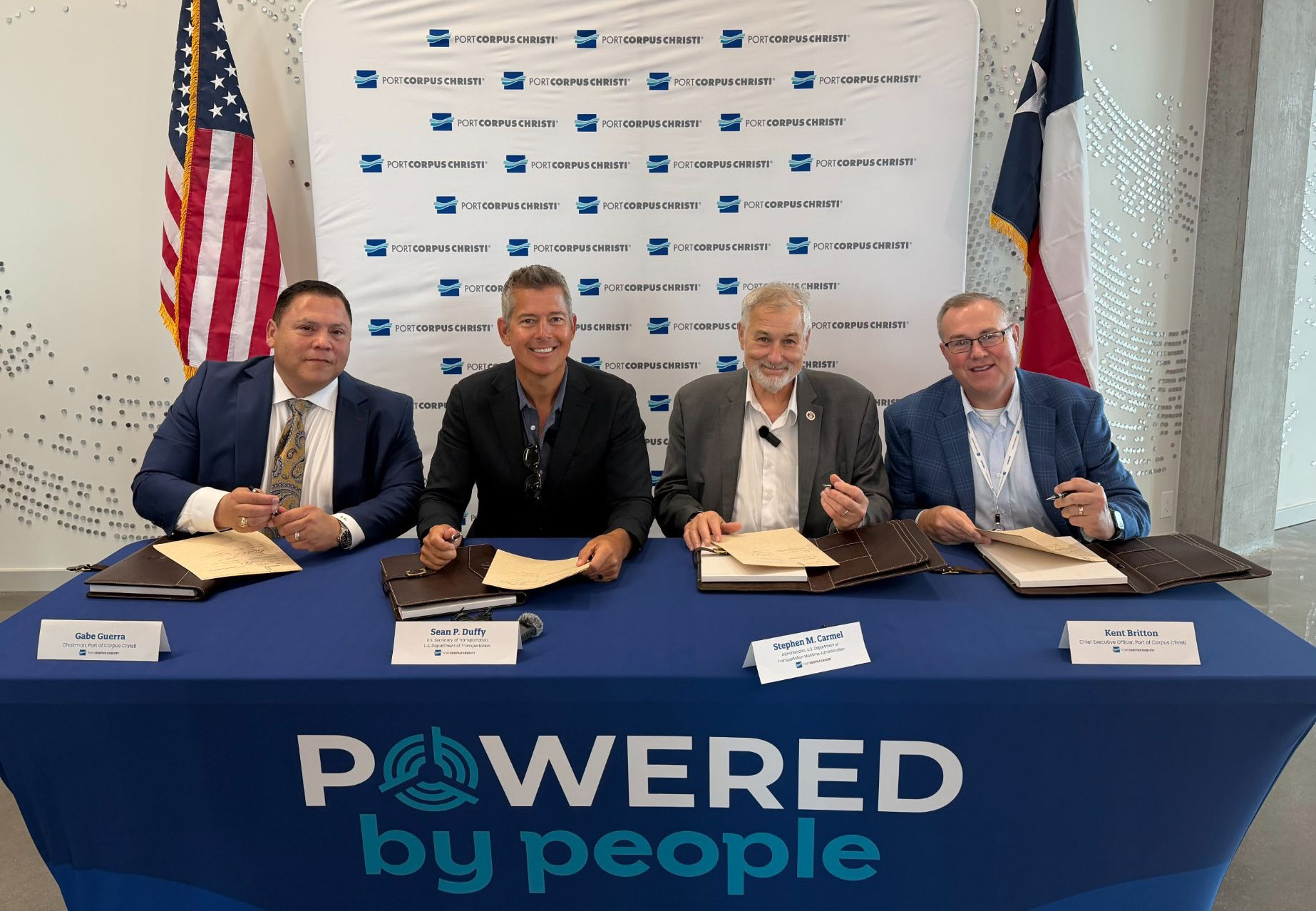
U.S. Secretary of Transportation Sean Duffy, Maritime Administrator Stephen Carmel, Rep. Michael Cloud (R-Texas), and leaders from the Port of Corpus Christi gathered at the Texas port August 19 to announce a partnership to explore maritime applications for small modular reactors (SMRs).
The memorandum of cooperation between the Maritime Administration (Marad) and the Port of Corpus Christi calls for the two agencies to work together to advance maritime energy systems — which could include SMRs, port microgrids, shoreside power architecture, and the infrastructure needed to support emerging vessel propulsion and power concepts — and to develop the workforce necessary for those systems.
“Small modular reactors have the potential to reshape America’s maritime sector, lower shipping costs, and bolster our supply chains,” Duffy said. “I’m thrilled that the Port of Corpus Christi is embracing this exciting partnership with the Trump administration to ensure the United States leads the way in innovation. Maritime dominance starts with rebuilding America’s fleet with this state-of-the-art technology.”
The partnership only adds to the Port of Corpus Christi’s status as the nation’s leading energy port. In the first half of 2026, energy-related cargo movements at the port included 11.5 million tons of liquefied natural gas (LNG), a 36.3% increase year-over-year, 17.1 million tons of refined products, 8.2 million tons of bulk liquids, 914,606 tons of natural gas liquids, and 66 million tons of crude oil. With 110.3 million tons of cargoes moving through the Port of Corpus Christi through June, the first half of 2026 represented the best first half of the year in the port’s history.
“This agreement with the Port of Corpus Christi demonstrates that the leading energy port in the nation understands the significance of this technology,” Carmel said. “SMR integration has the potential to drive down costs and guarantee that our critical Gulf Coast maritime supply chains remain resilient against any contingency, from extreme weather to power grid disruptions, while training the next generation of high-skilled American mariners."
Following the announcement of the port’s memorandum of cooperation with Marad, Core Power announced a partnership with the Port of Corpus Christi to develop a framework for a site-specific maritime nuclear readiness study. Specifically, the study will assess how a port like Corpus Christi could prepare to become a potential location for a floating nuclear power plant and how the port could prepare for future calls by nuclear-powered commercial ships.
“Port Corpus Christi, as the preeminent energy gateway in North America, is committed to remaining a leader in the global energy marketplace, even as that marketplace expands and evolves,” said Jeff Pollack, chief strategy and innovation officer for the Port of Corpus Christi. “This collaboration will help us understand what would be required technically, environmentally, operationally, and commercially for floating nuclear power plants and future calls by nuclear-powered commercial ships to be considered in the real-world context of the port. It is about gathering evidence and keeping our region competitive for future investment, industry, and high-value jobs.”
The port’s agreements with Marad and Core Power could prove to be key steps forward for energy infrastructure and ports in the United States, Core Power stated in its announcement.
“Taken together, these separate but complementary agreements represent an important step toward translating maritime nuclear technology into practical readiness requirements for U.S. ports,” Core Power stated in its announcement.
The port’s agreement with Marad is the second partnership to grow out of the Department of Transportation’s initiative, announced in May, aimed at employing SMRs in the commercial shipping space.
That request for information called for “input from industry and innovators” on how to advance the efficiency, affordability, national security benefits, scalability, shipbuilding and workforce issues, and regulatory readiness related to small modular nuclear reactors.
In June, the Trump administration announced an agreement with the Port of Long Beach to establish the nation’s first testing area for nuclear-powered commercial vessels.
Earlier this month, Core Power issued its own response to Marad’s SMR request for information. That response outlined the company’s “Project Pathfinder,” a program for designing, building, and placing into service a U.S.-flagged nuclear-powered commercial vessel.
“Commercial nuclear propulsion is not simply a reactor challenge,” Core Power said when it announced the plan. “It requires the vessel, reactor, operator, ports, shipyard, workforce, fuel, insurance, financing, and end-of-life arrangements to work as one integrated commercial system. Project Pathfinder is designed to turn those elements into a repeatable pathway to commercial operation rather than another one-off demonstration.”
More information about the Maritime Administration’s request for information for SMRs is available on the Federal Register under docket number MARAD-2026-0729. Core Power’s Project Pathfinder framework is available at corepower.energy.
