


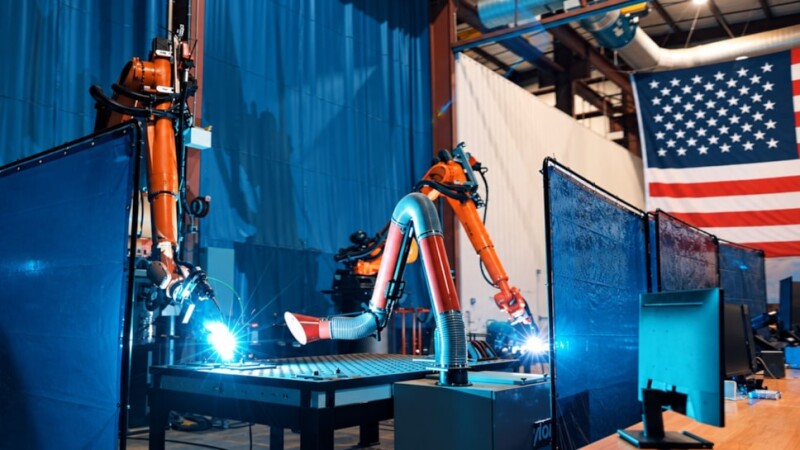
ABS has launched a joint development project with Radian Forge, Portsmouth, Va., to test whether digital manufacturing data can be used to qualify metal components produced through wire arc additive manufacturing.
Radian Forge will manufacture components, collect production and sensor data, and conduct material testing, while ABS will independently review the results and assess the proposed qualification methodology for potential marine and offshore applications.
Wire arc additive manufacturing, or WAAM, uses an electric arc and metal wire to build components layer by layer. The process can provide another production option for large metal parts that otherwise may face lengthy lead times through traditional casting or forging.
“Digital qualification has an important role to play in the adoption of additive manufacturing across the marine and offshore sectors,” said Michael Kei, ABS vice president of technology. “We are proud to work with Radian Forge to strengthen confidence in additive manufacturing by improving how qualification evidence is generated, evaluated, and traced.”
The project will look at information generated throughout the manufacturing process, including operating parameters, real-time sensor data, inspection records, and material test results. The goal is to determine whether those records can provide a reliable technical basis for verifying the consistency and performance of finished WAAM components.
Radian Forge combines industrial robotics, WAAM, engineering, and process monitoring at its Portsmouth operation, located inside an active shipyard. The company says manufacturing data, inspection, and testing can be tied to individual components to support customer acceptance requirements.
ABS already maintains requirements covering additive manufacturing for marine and offshore applications, including qualification of manufacturing procedures, materials, personnel, and finished components.
“Traditional manufacturing timelines can create significant challenges when critical components are needed,” said Jeff Yeager, CEO of Radian Forge. “Our goal is to build confidence in a manufacturing process that can respond to those needs.”
The collaboration comes as Radian Forge increases its manufacturing capacity in Portsmouth. The company announced in February that it plans to invest $10.5 million and create 53 jobs as it expands production of large-scale maritime components, primarily for the U.S. Navy.
