


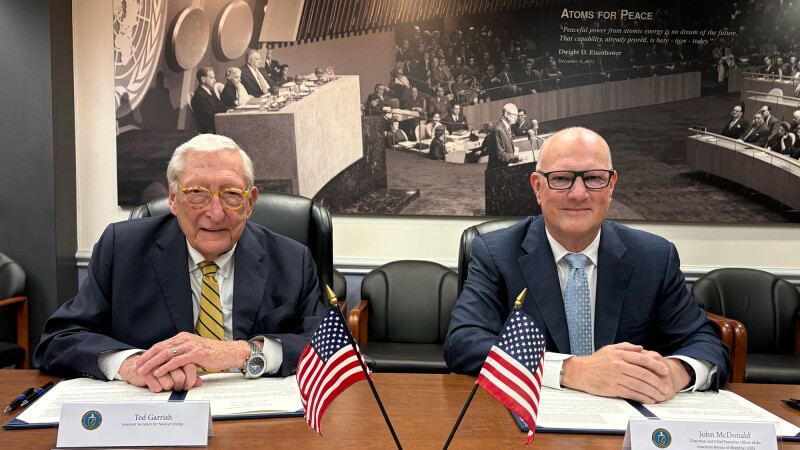
ABS and the U.S. Department of Energy’s Office of Nuclear Energy have signed a memorandum of understanding to advance commercial maritime applications of nuclear technology, including floating power plants, nuclear-powered vessels and supporting shoreside infrastructure.
The agreement covers concept and feasibility studies for floating nuclear power and nuclear transportation corridors, along with efforts to develop the ports, shipyards and industrial base needed to build, operate and maintain nuclear-powered assets.
Under the agreement, ABS will co-manage the Maritime Nuclear Applications Group and provide technical, regulatory, economic and policy support for concept and feasibility studies. The classification society will also work with DOE on interagency coordination to support development of a U.S. maritime nuclear sector.
ABS will coordinate related work through the U.S. Maritime Administration’s U.S. Center for Maritime Innovation, for which it serves as secretariat.
“Advanced nuclear technology is moving from concept to application, and the maritime industry needs to be ready for it,” said John McDonald, ABS chairman and CEO. “This agreement with DOE reflects the depth of work already underway and provides a framework to go further.”
Assistant Secretary for Nuclear Energy Ted Garrish said the partnership will explore how next-generation nuclear technologies could be applied to commercial maritime operations.
“The Department of Energy’s partnership with the American Bureau of Shipping will help explore how we can build on decades of experience to safely bring next-generation nuclear technologies to the maritime sector and position America to lead this emerging industry,” Garrish said.
ABS has published classification rules for floating nuclear power plants and awarded approvals in principle for several nuclear projects.
