



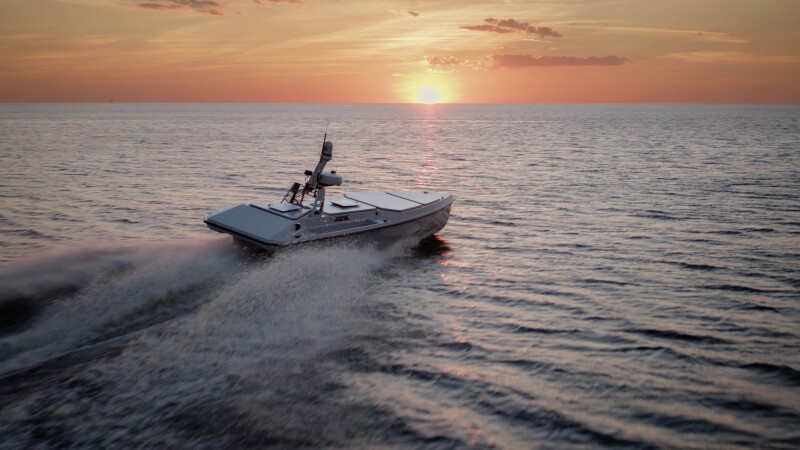
A new partnership will pair collaborative autonomy software with a portfolio of uncrewed surface vessels, with the companies planning to develop systems capable of coordinated multi-vessel operations for U.S. and allied defense customers.
Under the agreement announced Aug. 17, Blue Ops, West Palm Beach, Fla., plans to integrate software and command-and-control capabilities from Havoc, Providence, R.I., across multiple Blue Ops USVs, including the Variant 7 and additional platforms as they are introduced.
Blue Ops, the maritime division of Red Cat Holdings, Salt Lake City, said the integration is intended to support operations involving multiple autonomous vessels. The partnership also calls for the companies to establish operational fleets in Florida and Rhode Island for demonstrations, testing, training, and operational evaluation.
The agreement builds on Blue Ops’ Modular Open Systems Architecture, or MOSA, approach, which is designed to allow autonomy software, sensors, communications equipment, payloads, and other mission technologies to be integrated as operational requirements change.
“This partnership is exactly what our open-architecture strategy was built for,” said Barry Hinckley, president of Blue Ops. “Our goal is to build the best small USVs in the world while making it easy to integrate leading technologies from across the U.S. and our allies. Havoc has developed a powerful collaborative autonomy solution and integrating it with Blue Ops platforms gives customers greater choice and flexibility while accelerating how quickly advanced autonomous maritime capabilities can be fielded.”
Havoc develops collaborative autonomy technology for maritime, air, and land systems. The companies said Havoc’s technology has been deployed for the U.S. Department of War in multiple operational contexts.
The planned fleets at the companies’ respective headquarters would give U.S. and allied defense customers and partners access to the integrated systems for live demonstrations and evaluation. The companies said the sites are expected to support testing of both single-vessel autonomy and coordinated multi-vessel operations.
“Havoc’s primary strategy is to pair our leading-edge collaborative autonomy software with platform manufacturers who have already proven innovation, excellence, and scale,” said Paul Lwin, CEO and co-founder of Havoc. “Blue Ops is the perfect partner to continue our journey because they are building an open, flexible family of maritime systems that align directly with how we believe autonomy should be deployed.”
Lwin said integrating Havoc technology across the Blue Ops portfolio is intended to allow operators to command and coordinate multiple autonomous vessels while retaining the ability to adapt the systems as requirements change.
The companies also plan to jointly pursue government and commercial opportunities involving autonomous maritime systems. Blue Ops and Red Cat intend to introduce Havoc’s autonomy and command-and-control capabilities to their customers, while Havoc plans to market Blue Ops’ USVs to its customer base.
The partnership establishes a framework for further technical integration, demonstrations, and joint customer engagement as the companies develop their commercial relationship.
