



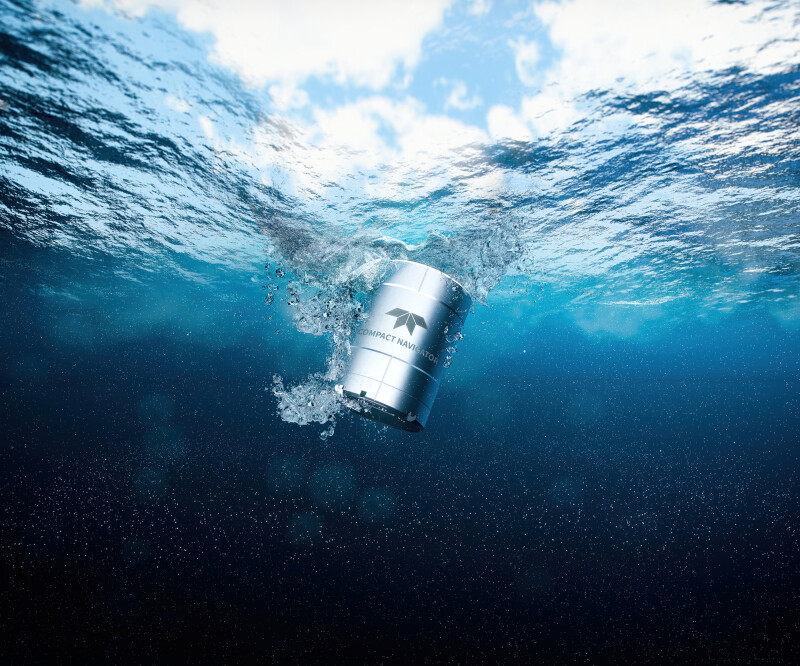
Teledyne Marine has introduced a compact, integrated navigation system designed to bring higher-end positioning capability to smaller unmanned marine platforms, including remotely operated underwater vehicles (ROV), autonomous underwater vehicles (AUV), and autonomous surface vessels (ASV).
The Compact Navigator combines multiple sensors, including an inertial navigation system, Doppler velocity log (DVL), pressure, and temperature sensors, into a single unit, allowing vehicles to operate without relying on external positioning inputs.
“It’s what we call an integrated navigation solution,” said Rolf Christensen, head of product management at Teledyne Marine. “It integrates various sensors that make it an autonomous navigation solution. It doesn’t need any additional information coming into the system.”
The system is aimed at addressing a long-standing tradeoff in subsea navigation, where smaller systems typically come with reduced performance. Christensen said the Compact Navigator is designed to close that gap by delivering higher accuracy in a smaller, lower-power package.
“There’s nothing else in the market today that gives this performance from a system that’s this small, weighs that little and uses that little power,” he said.
According to product specifications, the system delivers survey-grade performance with position accuracy as low as 0.05% error over distance traveled, along with a DVL bottom-track range of up to 420 meters. The compact form factor, measuring roughly 114 mm in diameter and 135 mm in height, allows the system to be integrated into platforms where space and power constraints have historically limited navigation capability.
Christensen said that the shift is particularly relevant for smaller ROVs and AUVs.
“Everything you put in the water would like to have a robust navigation system, but sometimes you can’t fit it because it’s too big or takes too much power,” he said. “This opens up for more vehicles being able to have a robust navigation solution.”
Beyond size, the system’s integrated design reduces the number of individual components required onboard. This can improve reliability by minimizing cabling and connection points, which are common failure areas in subsea systems.
The Compact Navigator is also designed for operation in GNSS-challenged or denied environments, an area Christensen said is becoming increasingly important across both defense and commercial applications.
“We see that all over the world that it’s becoming incredibly important,” he said. “Not just for defense, but for commercial operations where GPS can be spoofed or jammed, or simply unavailable in places like harbors, under bridges, or along rivers.”
In addition to subsea vehicles, Teledyne is seeing interest from operators of smaller autonomous surface vessels, particularly for applications requiring stable navigation at higher speeds. The system’s flat DVL array allows for flush mounting to a hull, reducing drag compared to traditional protruding sensors.
The company said early interest has been strongest among ROV manufacturers and AUV developers, with applications ranging from inspection and survey work to mine countermeasure operations.
For smaller platforms in particular, Christensen said the system enables missions that were previously out of reach.
“If you wanted this level of performance before, you had to go to a much larger system,” he said. “Now, smaller vehicles can do operations like deeper inspections or missions that they couldn’t do before.”
