



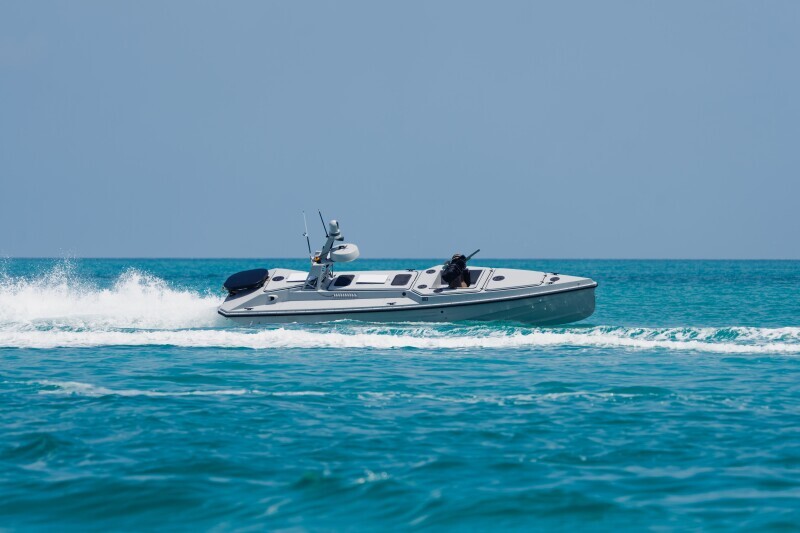
Blue Ops has begun sea trials of its first Volvo Penta-powered Variant 7 uncrewed surface vessel after adding the engine package to reduce its dependence on a single propulsion supplier as production of the platform increases.
Additional testing of the vessel is planned over the next several weeks at Blue Ops’ headquarters in West Palm Beach, Fla., according to Barry Hinckley, president of Blue Ops. The company plans to release performance figures and test results after the work is complete.
Blue Ops, the maritime division of Red Cat Holdings Inc., Salt Lake City, Utah, integrated a 320-hp Volvo Penta D4-320 diesel engine and DPI drive with the V7’s autonomous navigation, remote operation, mission planning, and payload management systems.
Hinckley said the addition was not prompted by a particular mission requirement. The company wanted to expand its engine supplier base so future production would not be limited by the capacity of one manufacturer.
Based on Blue Ops’ longer-term production plans, Hinckley said demand for the V7 could eventually exceed the manufacturing capacity of any single engine supplier. The Volvo Penta package joins the other propulsion configurations available for the vessel as Blue Ops moves the platform into full-rate production.
Volvo Penta had been a longtime partner in the recreational boat business, Hinckley said, making the company a natural candidate when Blue Ops began evaluating another engine package.
The D4-320 was considered during the V7’s early design phase, but the available engine packages differed in weight by several hundred pounds. Blue Ops initially selected the lightest option to preserve payload capacity and vessel performance.
The Volvo Penta system offers a higher level of factory integration, according to Hinckley. Sensors used by the V7’s autonomy and control systems for steering and drive trim are incorporated into the Volvo Penta drive, reducing wiring, installation work, and the labor required to connect the propulsion package with the vessel’s controls.
The package also includes a hydraulic system that controls both steering and drive trim. Hinckley said combining those functions in one factory-engineered system reduces the number of separate components and simplifies installation and maintenance. The arrangement could also improve overall system reliability, he said.
“We design our boats to give customers flexibility while maintaining the reliability, maintainability and mission performance required for demanding maritime operations,” Hinckley said. “Integrating the Volvo Penta D4-320 gives operators another proven propulsion option from a manufacturer they know and trust, while preserving the common autonomy and mission architecture at the core of the platform.”
The D4-320 is a 3.7-liter, four-cylinder common-rail diesel engine paired with Volvo Penta’s DPI DuoProp drive. Volvo Penta said the package is designed for responsive handling, durability, and efficient operation.
The company’s international parts and service network could also support V7 operators deploying the vessels outside the United States or in areas where access to maintenance and replacement components may be limited.
“Volvo Penta is committed to delivering dependable propulsion solutions, as well as parts and support for customers where and when they need it,” said Brock Gavin, vice president of marine sales and service for Volvo Penta North America. “The integration of the D4-320 and DPI drive into Variant 7 demonstrates how proven propulsion technology can support the growing requirements of autonomous maritime operations in demanding environments.”
The V7 is designed, built, and assembled in the United States for U.S. and allied defense missions. Potential applications include intelligence, surveillance, and reconnaissance; force protection; harbor and coastal security; contested logistics; and missions requiring different payloads, sensors, or communications systems.
Blue Ops developed the vessel around Modular Open Systems Architecture principles, allowing propulsion equipment, payloads, sensors, communications, and mission systems to be configured without replacing the platform’s underlying autonomy and control systems.
Red Cat said the V7 combines that open architecture with an integrated autonomy stack and a U.S. manufacturing operation that can be expanded as demand grows. The vessel is part of the company’s broader portfolio of military, government, and public-safety systems, which includes small uncrewed aircraft, uncrewed surface vessels, wireless power-transfer technology, and autonomous swarming software.
The company cautioned that statements concerning future production, demand, deployment, and operating plans are based on current expectations and remain subject to risks and uncertainties.
