



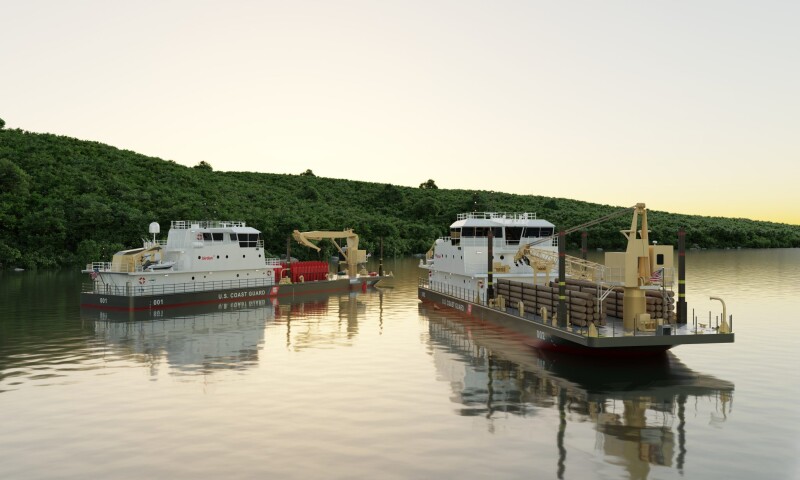
Shipbuilder Birdon, Bayou La Batre, Ala., announced it has begun construction on the third Waterways Commerce Cutter (WCC) vessel, marking another milestone in the company’s 27-vessel contract with the U.S. Coast Guard.
The start of the 120' Inland Construction Tender WLIC 1602 follows the launch of construction on Inland Construction Tender WLIC 1601 in June and the first 180' River Buoy Tender, WLR 1801, in September.
Birdon said it was able to begin work on WLIC 1602 ahead of schedule thanks to investments made at its Bayou La Batre, Ala., facilities and the U.S. Coast Guard’s confidence in the program, including $110 million in production and long lead time material contracts awarded on Sept. 30.
“We are honored to support the U.S. Coast Guard’s mission and appreciate the trust they have put in us to deliver vessels that meet the highest standards of quality, performance, and reliability,” said Hoby Swiney, vice president and general manager of Birdon’s Alabama shipyard. “This achievement is possible because of the Coast Guard’s support and our team’s commitment to program success and making Birdon a great place to work.”
Since acquiring the Bayou La Batre facility in spring 2024, Birdon has added nearly 100 full-time employees, with strong retention, and has dozens of subcontractors and suppliers working onsite, the company said, adding that workforce growth remains on track to support the WCC program.
Birdon was awarded a $1.187 billion contract in 2022 to design and build 27 WCC vessels for the U.S. Coast Guard, including 16 River Buoy Tenders (WLR) and 11 Inland Construction Tenders (WLIC).
A third WCC variant, the 120' Inland Buoy Tender (WLI), will be acquired under a separate contract. The Coast Guard said it plans to order three WLIs.
The Chief Petty Officer-class WCCs will replace the Coast Guard’s aging river tender fleet and will support the safe, secure, and reliable flow of commerce on the nation’s marine transportation system. The cutters will maintain aids to navigation, ensuring the safe movement of goods, energy, and materials across U.S. waterways.
The Coast Guard has said that the new tenders will have greater endurance, speed, and deck load capacity than their predecessors. The three cutter variants — each of which will be self-propelled, monohull vessels — will also feature improved habitability.
