



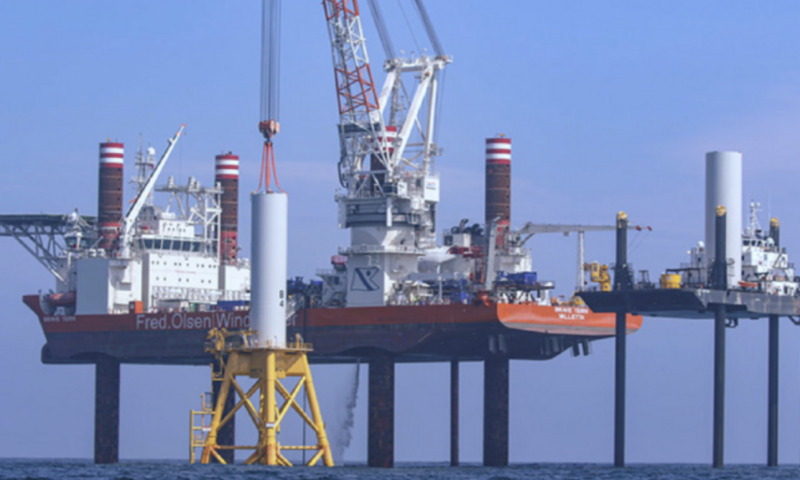
A detailed study of the U.S. offshore wind fleet found it is about 80% Jones Act-compliant vessels, and 20% foreign flag, the latter “generally “large, specialized vessels for which there were no U.S.-flag counterparts,” according to the federal Government Accountability Office.
Growth in the fleet’s Jones Act fleet component – encouraged during the first Trump administration and the Biden administration by federal and state policies – has been hobbled by the second Trump administration’s 180-degree turn on offshore energy policies.
The study focused on three projects: Vineyard Wind, with 62 turbines off the coast of Massachusetts; Coastal Virginia Offshore Wind, comprised of 176 planned turbines off Virginia; and Revolution Wind, 65 turbines off the coast of Rhode Island.
The 80/20 split between U.S. and foreign vessels was typical in those three projects. The GAO counted “more than 300 unique vessels involved in the construction” and estimated “that a similar number of foreign and domestic mariners worked across the vessels for the three selected projects, since the larger, more complex foreign-flag vessels required more mariners.”
“Operators will have to invest in new vessels or upgrade existing ones to install the super-sized turbines that are expected to become the norm by the end of the decade, or the pace of offshore wind installations could slow down, Norway-based research firm Rystad Energy reported then.
As of August 2025, citing the wind industry Clean Power Association, the GAO reported 50 new offshore wind vessels had been delivered, were under construction, or were on order at U.S. shipyards.
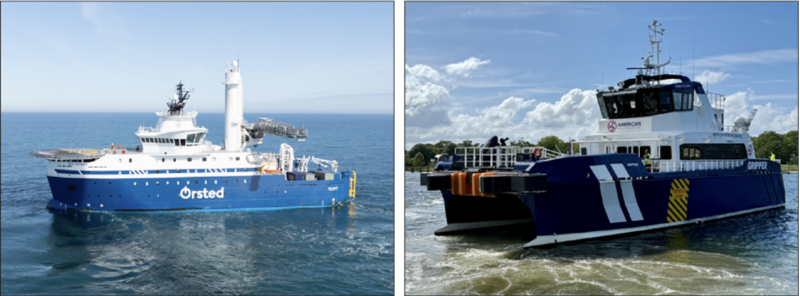
Significantly, the GAO noted “none of the vessel construction was financed using Maritime Administration assistance programs. According to vessel owners GAO interviewed, that was, in part because the application process took too long.”
Marad officials said told GAO researchers “their review process takes, at best, 6 to 9 months. The vessel owners said it often takes much longer. They also said additional vessel construction was unlikely given a lack of future projects.”
To develop its analysis, the GAO looked at wind developers’ data on the vessels used as of November 2025, and estimated the range in number of mariners on these vessels based on vessel specifications and discussions with the U.S. Coast Guard and a mariners’ union.
Along with looking at the American Clean Power Association’s August 2025 fleet tallies, the agency “spoke with 11 vessel owners and 11 stakeholders identified based on their expertise; reviewed relevant laws; and interviewed officials from the Maritime Administration, Interior, Department of Energy, and Department of Homeland Security.”
The GAO review says the agency was tasked to review “the extent to which the U.S. maritime industry is constructing U.S. offshore wind projects,” including how many U.S.-flag vessels and domestic mariners are employed used at offshore wind projects, investments in U.S.-built offshore wind vessels and use of Maritime Administration financial assistance programs.
The GAO report was submitted to the House Committee on Transportation and Infrastructure. It lays out three major constraints on the future of U.S. offshore wind projects.
Industry and regulatory uncertainty: With five offshore wind projects permitted and under construction, activities, the Trmp administration’s January 2025 permitting and approvals pause leaves “the timeline for other projects became increasingly uncertain.”
“Without greater certainty about the development of the overall market, vessel owners are unable to develop a sufficient business case for investments.”
Shipyard capacity: In 2020 the GAO first reported that there were a limited number of shipyards with capacity to builds big specialized offshore wind vessels. In August 2025 one vessel owner told GAO analysts that “only five U.S. shipyards have the capacity to construct them.” Vessel owners experienced cost increases; one told the GAO that “constructing an offshore wind vessel in the United States can be more than twice as expensive as constructing a vessel in China, and while Singapore and Turkey are not as cheap, they can also offer significant cost savings.”
“To make infrastructure investments, a shipyard would need an acceptable return on investment,” GAO auditors noted. One shipyard representative told them “a contract for one vessel has no return on investment because there is no guarantee of building more vessels with a similar design. Without a larger contract for multiple vessels, the shipyard does not have a business case to invest in infrastructure improvements that could make future investments more efficient.”
Foreign competition: U.S. vessel owners interviewed by the GAO said “competing with foreign-flag vessels is difficult because the cost of constructing and operating U.S.-flag offshore wind vessel is higher,” the report notes.
U.S. operators carry a comparatively high structural cost burden, from federal state and local taxes, to operating costs “materially higher due to U.S. labor requirements, U.S. wage and benefit levels, and the need to comply with U.S. licensing, documentation, safety, and liability requirements.”
Foreign governments heavily subsidize production in their shipyards, up to 25 percent of vessel construction costs.
“That allows foreign operators to pay lower capital expense costs. In addition, foreign vessel operators may also pay lower mariner wages. According to this vessel owner, U.S. operators can expect to pay their mariners about $10,000 per day to operate the vessel, whereas it might cost about $2,000 per day for foreign operators,” the report states.
Vessel owners that invested in two U.S.-built installation vessels, Dominion Energy’s Charybdis and Great Lakes Dredge and Dock Company’s Acadia, told analysts said they “expect significant efficiencies from using these vessels in offshore wind construction, due to their ability to move between U.S. coastwise points, unlike foreign vessels.”
The Charybdis installs offshore wind turbines in about half of the time needed to install them using a ‘feeder’ system with a foreign-flag WTIV and U.S.-flag feeder barges. For installing rock for scour protection, With regard to scour protection, it takes approximately seven to nine days for a foreign subsea rock installation vessel to go from their site, refill with rocks in Canada, and return to the site.
“Representatives from the Great Lakes Dredge and Dock Company (owners of the Acadia) told us they can undertake a similar round trip in less than two days using a domestic port. However, as a developer told us, these potential efficiencies become inconsequential without future projects in the pipeline.”
