



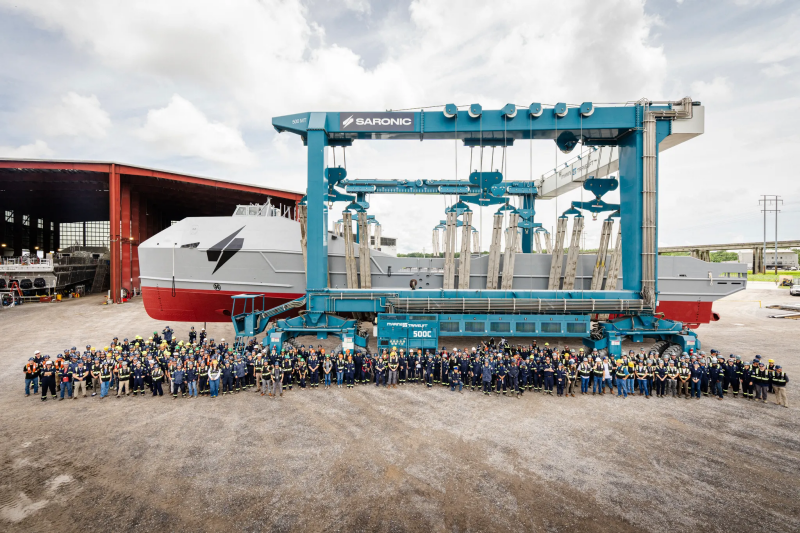
Saronic, Austin, Texas, announced the launch of its first Marauder medium unmanned surface vessel (MUSV), marking the start of on-water trials for the autonomous vessel and a milestone in the company's effort to scale domestic production of uncrewed ships.
According to the company, the vessel moved from initial design to launch in less than a year at Saronic's Franklin, La. shipyard, where the company integrates vessel design, manufacturing, and autonomy development under one roof.
“I’m incredibly proud of our team for achieving this milestone. Designing, building, and launching an entire new class of ships in under a year is a feat the American shipbuilding industry hasn’t seen in generations,” said Dino Mavrookas, co-founder and CEO of Saronic. “It’s what happens when design, production, and manufacturing are fully integrated under one roof. With multiple hulls already underway and our shipyard continuing to grow, this is what revitalizing American shipbuilding actually looks like — autonomous ships delivered at speed and scale, with the production capacity to back it up.”
Designed for defense and commercial applications, Marauder is intended to conduct long-range operations either fully autonomously or under remote human supervision. According to the company, the vessel is capable of operating far from shore for extended periods without an onboard crew.
Saronic said the aluminum-hulled vessel has a top speed of more than 25 knots and a range of up to 5,400 nautical miles. The vessel can carry payloads of up to 150 metric tons and is configured to accommodate up to four 40' ISO containers or eight 20' ISO containers. Potential missions include logistics support, maritime domain awareness, intelligence, surveillance and reconnaissance, research operations, and other commercial or government applications.
The company said Marauder's modular design allows operators to adapt the vessel to changing mission requirements without modifying the underlying platform.
Saronic is expanding production capacity at its Franklin shipyard and expects the facility to be capable of producing up to 20 Marauder vessels annually by the end of 2026. The company said the second Marauder hull is currently being outfitted with mechanical, electrical, and autonomy systems, while the third and fourth hulls are under construction. Work on the second hull is progressing approximately 25% faster than the first, according to Saronic.
The company attributes the accelerated production timeline to its vertically integrated approach, which combines vessel design, manufacturing, and autonomy software development in-house. Saronic said the production model utilizes modular construction methods, manufacturing-focused subassemblies, and commercial off-the-shelf components to reduce build times while maintaining repeatability across multiple hulls.
“Our ships, even our 150-foot ship, have seven or eight major movers,” Mavrookas told WorkBoat in September 2025. “It has the jets, the engines, the fuel tank, the bowthrusters, sensors, a really large computer, and then whatever the payload is, that’s essentially it,” he said. “So you’re stripping 85 to 90% of the complexity out of the design right up front… You have this design for a manufacturing concept that underlines everything we build.”
Alongside the vessel platform, Saronic has developed a software-based fleet intelligence system that provides operators with real-time visibility into vessel operations and autonomous functions. The platform continuously monitors vessel telemetry, subsystem status, and operating conditions while allowing remote intervention when necessary.
Marauder is the latest vessel to emerge from Saronic's growing autonomous shipbuilding operation in Franklin, where the company has invested more than $500 million in a shipyard intended to support serial production of unmanned vessels for defense and commercial markets.
