


This year has been a whirlwind for U.S. shipbuilding, with policy moves and federal attention shifting the industry’s focus. With offshore wind projects stalled and investment declining, America’s shipyards are now looking to a more dependable customer: the Department of Defense (DoD).
Federal investment and policy moves have reset priorities across the industry, redirecting resources toward rebuilding domestic shipbuilding capacity and accelerating production of both traditional naval assets and new autonomous vessels.
The push has been visible on several fronts, including a presidential executive order, the reintroduction of the bipartisan Shipbuilding and Harbor Infrastructure for Prosperity and Security (SHIPS) for America Act, and the creation of the White House’s Office of Shipbuilding (recently moved from the National Security Council to the Office of Management and Budget). For the first time in a long time, the maritime sector is receiving sustained national attention.
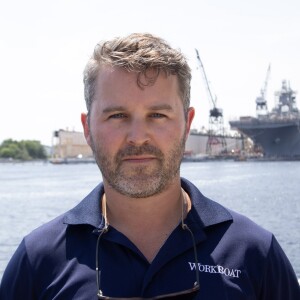
“This is certainly a fascinating time,” said Ted Williams, Senesco Marine president and a 31-year Navy veteran. During a July visit to the North Kingstown, R.I., shipyard, Williams discussed with WorkBoat the stark imbalance in global maritime capacity. “Forty-five thousand commercial cargo-carrying vessels; 200 U.S.-flagged,” he said. “China right now has a larger Navy than we do… out-building us from a navy, military perspective, five-to-one, [and] from a commercial perspective, 10-to-one.”
That imbalance has spurred Washington to act. President Trump’s executive order pledged billions for new naval capacity and unmanned surface vessels. The order outlined a Maritime Action Plan (MAP) led by the Maritime Administration (Marad), pairing yard investment with workforce support and new demand signals for U.S.-flag shipping. “Rectifying these issues requires a comprehensive approach,” the order read, “that includes securing consistent, predictable and durable federal funding, making United States-flagged and built vessels commercially competitive in international commerce, rebuilding America’s maritime manufacturing capabilities, and strengthening the recruitment, training and retention of the workforce.”
A central provision of the executive order sets a 210-day deadline (Nov. 5) for a multiagency effort to create a MAP providing a clear strategy with actionable steps to restore and sustain resiliency in the U.S. maritime industry. While the full plan is still in development, the order lays out its framework and interim milestones. Broadly, it will focus on three areas:
- Proposals for financial incentives and subsidies to support shipyards,
- acquisition reforms and regulatory adjustments,
- and a series of strategic initiatives, including workforce development.
Still, shipbuilders face steep obstacles. A February Government Accountability Office report identified two major challenges — infrastructure and workforce — echoing concerns raised by shipyard leaders.
Many shipyards rely heavily on subcontractors and green card holders to meet staffing needs. It’s not uncommon for shipyards to print out construction plans and memos in multiple languages. But new Pentagon cybersecurity requirements (Cybersecurity Maturity Model Certification) set to take effect in 2026 will soon restrict work access for noncitizens, further tightening the labor pool.
AUTONOMOUS WARSHIPS
“That’s really where the future of shipbuilding is right now,” Williams said of national defense. His vision mirrors World War II–era output. “If I had the workforce, I could put out one a week. It goes back to the Liberty ship days. Nationwide, we were putting out one a day,” he said.
Williams said autonomy may be the best route forward. “The best way, in my opinion, to resolve this discrepancy is autonomy. Medium, 150- to 200-foot vessels with the right speed, fuel, and cargo capacity,” he said. “Imagine you get 100 or 500 of these to work in a hive around a carrier. The power and capacity of that is amazing.
“A carrier is $12 billion,” he added. “If that helps defend a carrier, you just saved money.”
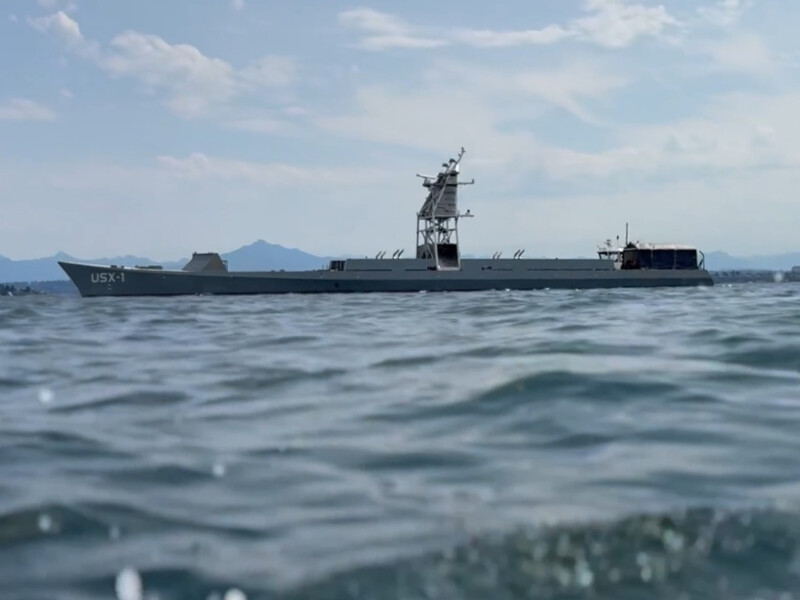
But Williams acknowledged time pressure. “Adm. Phil Davidson told Congress that by 2027 China will be ready to invade Taiwan. Right now, we would lose that war. The Navy is asking us — industry — to get vessels on the water by 2027. They should have asked us two years ago,” he said. “It’s happening, and we’re talking to companies right now to build prototypes. Senesco is perfectly positioned as a Tier II shipyard to build these medium vessels all day long.”
The new push for 150' autonomous naval vessels would require production adjustments, Williams said. He estimated that if he were to increase operations to a workforce of 1,000 to 1,200 people, the yard “would work three shifts, probably seven days a week, and just bang them out,” he said.
Williams displayed a rendering of a planned 400,000-sq.-ft. shipbuilding hangar superimposed on an aerial photo of Senesco’s property. If the shipyard were to secure a substantial DoD contract, the proposed facility could support a dozen production lines, he said, each stacked three vessels deep, moving steadily through construction.
“They’re not complex, because they’re unmanned,” he explained, noting that the absence of piping, heads, and galleys would further shorten delivery times.
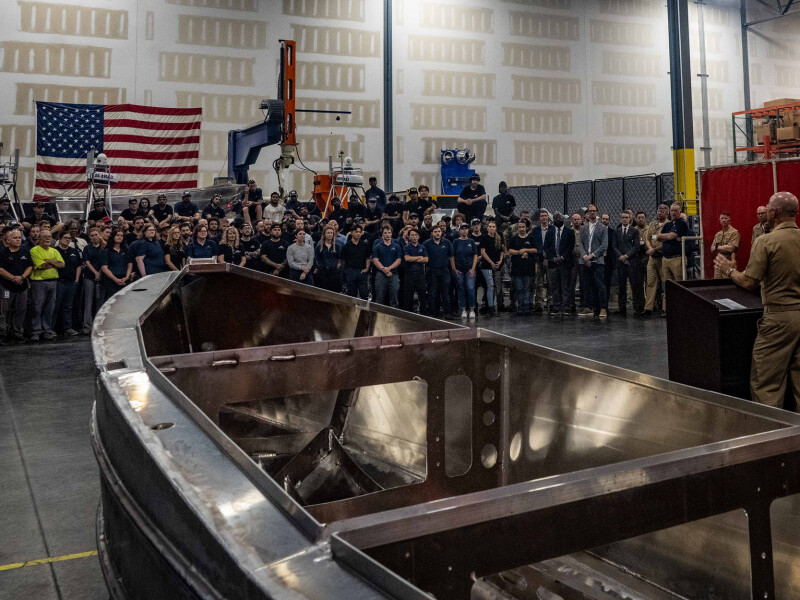
Senesco is one of many companies — including both established and emerging shipbuilders — eyeing opportunities in the growing market for uncrewed and autonomous vessels. Companies already active in this space include Bollinger Shipyards, Lockport, La.; Austal USA, Mobile, Ala.; Nichols Brothers Boat Builders, Freeland, Wash.; Swiftships, Morgan City, La.; Metal Shark, Jeanerette, La.; and BlackSea Technologies, Baltimore.
In August, Blue Water Autonomy, Boston, announced it had raised $50 million in Series A (venture capital) financing, following a $14 million seed round in April.
The funding will support the development and deployment of its first full-scale, long-range autonomous ship in 2026.
SHIPBUILDING RECONFIGURED
In Texas, a newer player is betting that a reimagination of the shipyard itself is the key to American maritime resurgence. Dino Mavrookas, president and founder of Saronic Technologies, spoke with WorkBoat about the company’s rapid growth, its attention-grabbing investment rounds, and shipyard operations. In February, the company closed its Series C (growth capital) funding round at $600 million, valuing the Austin-based tech firm at $4 billion.
Mavrookas, a former Navy SEAL, founded Saronic in September 2022 with the aim of “redefining maritime superiority for the U.S. and our allies around the world, starting with defense, but expanding into commercial,” he said. The company’s first projects were three small autonomous boats, which Mavrookas said were launched in the first two years of his starting the company.
That momentum has led Saronic to expand its operations and product line, advancing from the six to 24 initial builds to today, constructing a large autonomous warship in its recently acquired Franklin, La., shipyard.
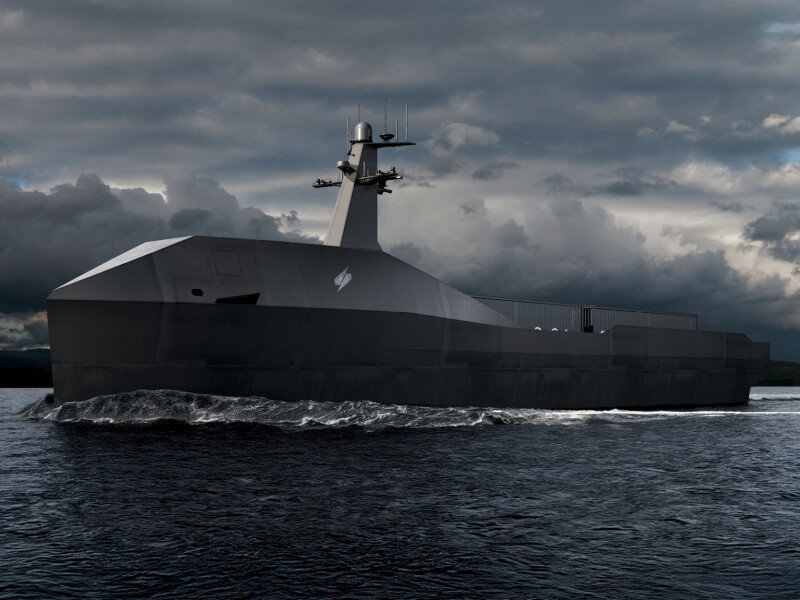
Mavrookas said that the 150' Marauder-class vessel, currently under construction in Franklin, is slated for launch by the end of the year. He emphasized that the vessel is not a retrofit, but a purpose-built autonomous ship designed from the keel up.
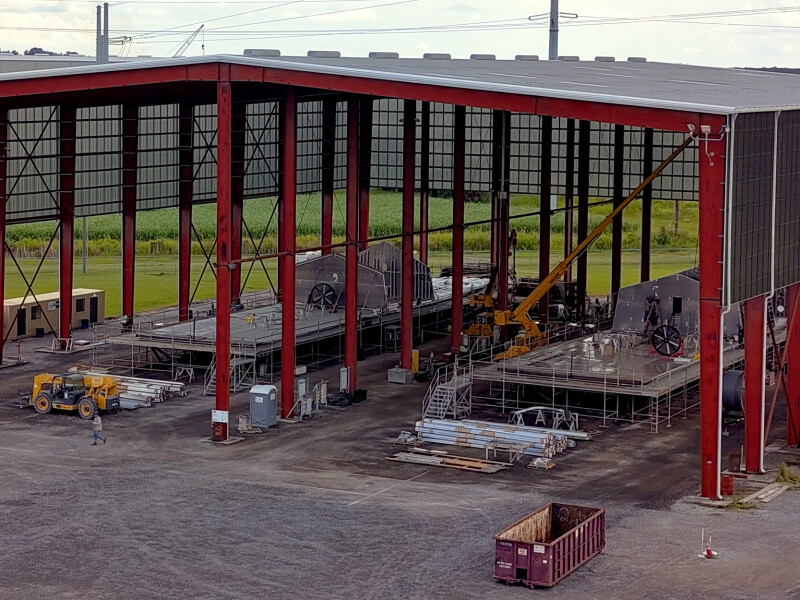
“All of that is fully vertically integrated,” he stated, noting that hardware and software development run in parallel within the company. “That’s really how you build autonomous vessels at scale. You need the hardware and the software to be co-developed alongside each other so that they can integrate and be produced at scale. Unless you do that together, the production line never really works in complete harmony.”
The approach includes control over electronic components, supply chain partnerships, manufacturing, integrations, software, and autonomy development, he said. According to the company, this structure allows for faster iteration cycles and more efficient scaling of production.
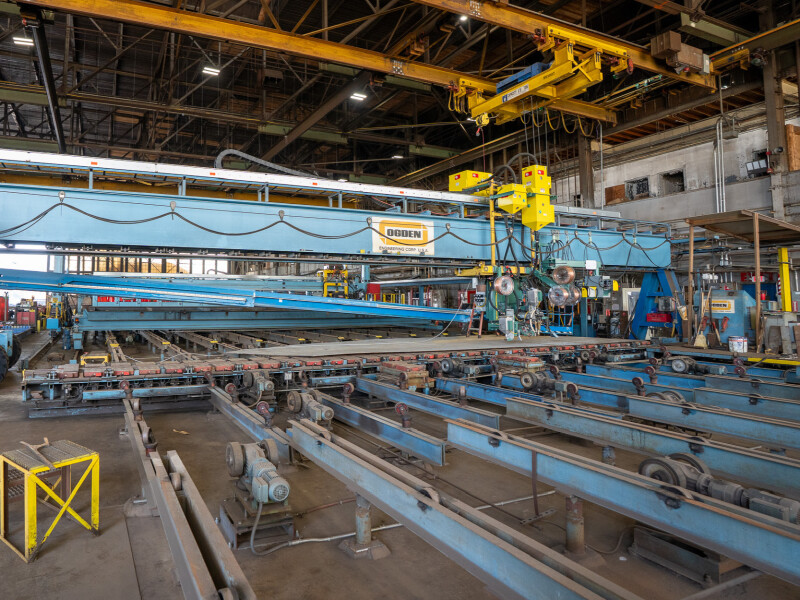
After acquiring the Gulf Craft yard in April, Saronic invested heavily to revive what had been a flagging operation, said Mavrookas. “We acquired the yard in under 45 days, we retained 100% of the workforce, and in less than 60 days after the acquisition, we more than doubled the workforce,” he said. “We stepped in, and we offer job security, excitement, and mission back into a yard where the capacity for our industrial base in this country was literally going to zero.”
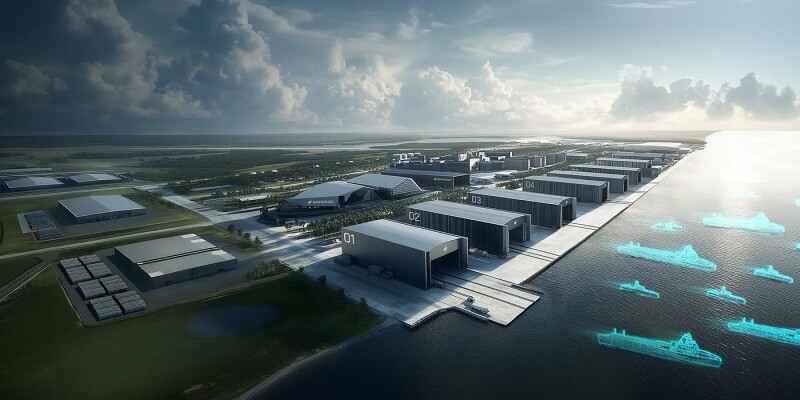
The company plans to spend more than $500 million on upgrades at Franklin and billions more on a next-gen facility, Port Alpha, beginning in 2026. Unlike most legacy yards, the focus will be on modularity, automation, and scale.
Mavrookas said vessel anatomy will dictate shipyard operations, as well as the company’s plans to overcome an industry-wide workforce shortage.
“Our ships, even our 150-foot ship, have seven or eight major movers. It has the jets, the engines, the fuel tank, the bowthrusters, sensors, a really large computer, and then whatever the payload is, that’s essentially it,” he said. “So you’re stripping 85 to 90% of the complexity out of the design right up front… You have this design for a manufacturing concept that underlines everything we build.”
He noted that simplicity feeds directly into how the shipyard itself is being planned. “The shipyard is going to be purpose-built for modularity and construction at scale of those types of ships,” he said. “What I mean is, you’re going to be able to have subassembly productions that then come together very, very quickly to roll… dozens of ships off the line at Port Alpha. We want to get hundreds of ships off the line every year, depending on the size ship.
“You’re not going to be able to fully automate the shipbuilding process, so it’s finding where do you insert automation into the actual build process to augment the people that are building the ships,” he said. “And then how do you actually recreate and rebuild the workforce in this country?”
Traditionally, he noted, it takes more than a decade of experience to become productive in shipbuilding. The Saronic model aims to shorten that learning curve. “Right now, you need 10 or 15 years of experience, because ships are very exquisite and hard to build,” he said. “How do you take that away? Well, it all starts with the design that I mentioned and the processes that I laid out.”
The company draws parallels to other manufacturing sectors. “Why can’t we take a person that’s working at a Ford factory or a Chevy factory and very quickly make them productive in a shipyard? If we can’t do that, then there’s a problem in either our design or our processes or our training,” he said. “That’s something we actually take on us, not on the person or the individual or… the overall workforce talent pool.”
The Port Alpha facility is envisioned as a high-capacity, modular yard capable of turning out hundreds of autonomous vessels annually. “We’re rebuilding the workforce and redefining the culture around shipbuilding,” said Mavrookas. “We want to create an environment where people see working in a shipyard as being part of an innovative defense technology company, not just a legacy industry.”
Looking ahead, Saronic plans to continue scaling production capacity while also pursuing international expansion and new product development.
In August, the company announced a partnership with the American Bureau of Shipping (ABS) to certify its autonomy stack and classify larger autonomous vessels. A joint press release said the classification society will review the designs against safety, reliability, and performance standards, while Saronic will support updates to ABS requirements for autonomous ships as the technology develops.
Stakeholders beyond the defense sector are also exploring potential uses for USVs, and commercial applications are part of Saronic’s strategy, Mavrookas said. “The same Marauder that can carry government payloads could be adapted for short-haul cargo delivery or port security. That commerciality is absolutely critical when you talk about producing at scale,” he said.
