



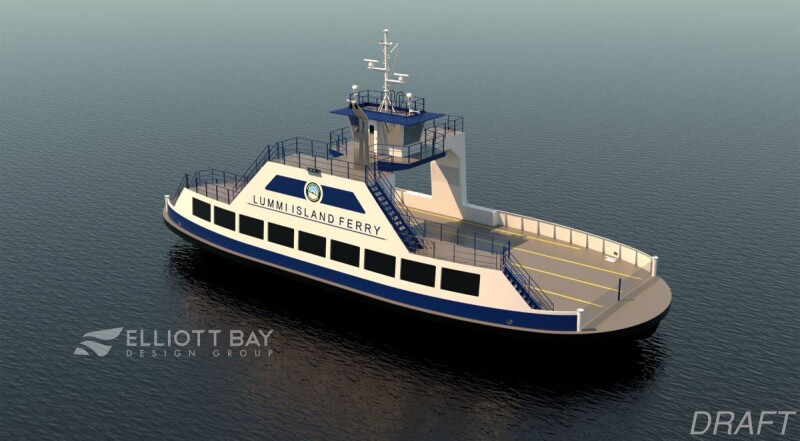
Whatcom County Public Works (WCPW), Bellingham, Wash., has issued a request for proposals (RFP) for a propulsion system integrator to support the design and construction of a new vehicle ferry serving the Lummi Island route in Washington state.
The solicitation, released March 16, outlines requirements for a diesel-electric hybrid propulsion package incorporating lithium-ion battery storage, with the selected providerexpected to work closely with naval architect Elliott Bay Design Group, Seattle, during the contract design phase and through vessel delivery.
The new ferry is intended to operate on a short, repetitive 0.8-nm route between Lummi Island and Gooseberry Point, completing up to 30 round trips per weekday and approximately 9,360 annually.
To support that operating profile, the county is targeting a diesel-electric, battery-hybrid propulsion system capable of maximizing electric-only operation while maintaining redundancy through onboard diesel generators. The system is expected to balance battery capacity, vessel weight constraints, and fuel efficiency, with onboard generators providing recharging capability in the absence of shore power infrastructure at the island terminal.
The RFP calls for a fully integrated propulsion system consisting of two marine-duty generator sets rated at approximately 300-ekW each, paired with two electric propulsion motors and a lithium-ion battery system sized at roughly 220-kWh. The system will also include dual DC propulsion bus line-ups with associated converters and connection equipment, along with a fully integrated alarm, monitoring, and control system designed for both local and remote operation. A ship service switchboard and a shore power isolation transformer supporting an estimated 200-amp AC connection are also included in the scope.
All equipment must be new, fully integrated, and compliant with applicable U.S. Coast Guard inspection requirements, EPA emissions standards, and industry guidelines for shipboard electrical systems and lithium-ion battery installations.
The propulsion system will drive a double-ended ferry configuration using fixed-pitch propellers at each end, with independent electric motors enabling maneuverability and redundancy.
Beyond equipment supply, the selected provider will be responsible for full system integration and engineering support, ensuring all propulsion components function seamlessly together. The scope also includes factory testing and analysis, delivery of equipment to a Pacific Northwest shipyard, oversight of installation, commissioning and sea trials, as well as training for vessel operators and crew. Providers are also expected to offer maintenance strategies and remote monitoring capabilities to support long-term vessel performance.
In addition, respondents must submit detailed documentation outlining their proposed system architecture, a rough order-of-magnitude cost estimate in 2026 dollars, equipment dimensions and weights, recommended spare parts, and experience navigating the marine regulatory environment. Responses are limited to 100 pages and will be evaluated based on system design, technical performance, lifecycle support, experience, and commercial deliverability.
Following selection of a propulsion provider, WCPW will incorporate the chosen system into final contract specifications that will be issued to shipyards as part of a subsequent vessel construction procurement.
The selected integrator is expected to remain engaged throughout detailed design, construction, sea trials, and operator training, supporting the county’s transition to a modernized, hybrid-electric ferry platform.
Proposals for the propulsion system integrator contract for the Lummi Island Ferry Replacement Project (CRP No. 919008) are due to Whatcom County Public Works by 2:30 p.m. PDT on Tuesday, April 14, 2026. The procurement marks a key step in the county’s broader Lummi Island Ferry Replacement and System Modernization effort, which has been supported in part by a $25 million RAISE grant awarded by the U.S. Department of Transportation in August 2022 to replace the 63-year-old ferry.
