



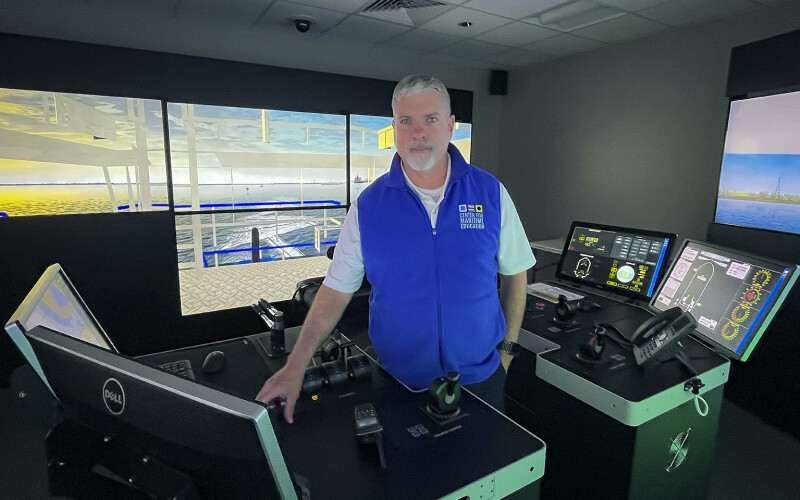
The Seamen’s Church Institute’s Center for Maritime Education (CME) has entered into a partnership with the U.S. Army Engineer Research and Development Center aimed at advancing maritime simulation, improving training, and enhancing safety across U.S. waterways.
The agreement, formalized through a memorandum of agreement under the U.S. Army Corps of Engineers, builds on months of discussions between mariners, industry stakeholders, and federal partners. Those conversations centered on how to better align simulation tools and environmental data to reflect real-world operating conditions.
Industry feedback played a central role in shaping the collaboration. An SCI press release noted mariners and operators pointed to the value of ERDC’s environmental modeling capabilities alongside CME’s high-fidelity towboat simulators, while also identifying gaps in access to project data such as bathymetry, current patterns, and environmental conditions. The partnership aims to integrate those capabilities rather than treat them as separate systems.
Under the agreement, CME and ERDC’s Coastal and Hydraulics Laboratory will work jointly to enhance ship simulation technologies, expand access to training, and support navigation project design and delivery for USACE. The effort is expected to improve simulation accuracy, inform infrastructure planning, and support safer vessel operations.
“We’re excited about this partnership because it shows what’s possible when mariners and maritime engineers work toward a shared goal,” said Capt. Stephen Polk, director of CME. “By combining our strengths, we’re building better training tools that help mariners operate more safely and effectively. At its core, this effort is about impact—better data leads to better simulations, better simulations lead to better-trained mariners, and ultimately safer waterways for everyone.”
ERDC serves as the research and development arm of USACE, conducting work across water resources, infrastructure, and environmental engineering to support navigation and national security missions.
CME operates simulation and training facilities in Paducah, Ky., and Houston, Texas, providing simulator-based instruction and assessment services for inland and Gulf Coast mariners. The organization also works with engineering firms, ports, and public agencies on simulator-based feasibility studies to evaluate vessel operations and project design in complex marine environments.
