



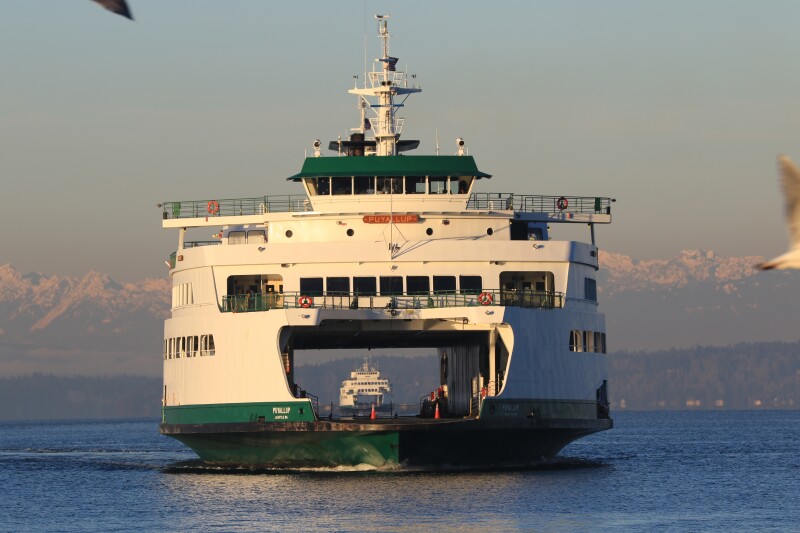
A Washington State Ferries’ (WSF) press release highlighted a nearly 1-million-passenger increase in systemwide ridership in 2025, as the return of full domestic service and a reduction in canceled sailings helped push annual passenger counts to 20.1 million. The total marked a 5% increase from 19.1 million riders in 2024 and represented the first time the state ferry system surpassed 20 million passengers since 2019.
Washington State Ferries attributed the year-over-year growth primarily to the restoration of service on several core routes. In June, a second vessel returned to the Seattle–Bremerton route, while the Fauntleroy–Vashon–Southworth “Triangle” route resumed a daily three-boat schedule. Seasonal capacity was added in July with the return of a second vessel on the Port Townsend–Coupeville route from Fridays through Mondays during the peak travel season.
The press release also pointed to improved operational reliability as a key driver. Canceled sailings declined to 2,222 in 2025, down from 2,620 the previous year and the lowest annual total since 2020. Cancellations attributed to crew shortages saw the most significant reduction, reflecting recent workforce recruitment and retention efforts. Overall, WSF operated more than 150,000 sailings in 2025 (nearly 7,000 more than in 2024) and completed 98.6% of all scheduled trips.
Passenger growth was seen across all categories. The number of vehicles carried and the number of walk-on passengers each increased by roughly 350,000 during the year, while passengers traveling in vehicles increased by about 250,000.
According to the release, the largest route-level gains came with the return of two-boat service on Seattle–Bremerton. Total ridership on the route increased 31.9% year over year, with vehicle traffic up 26.1% and walk-on passengers rising 35.7%.
The Seattle–Bainbridge Island route remained the system’s busiest, carrying 5.2 million riders in 2025. Total ridership increased 6.4%, driven by an 8.6% increase in foot passengers, while vehicle traffic rose 2%.
On the Fauntleroy–Vashon–Southworth route, total ridership grew 4.7% and vehicle traffic increased 5.5%, though walk-on passengers declined 7.4% compared with 2024.
The Port Townsend–Coupeville route recorded a 4.7% increase in total riders, supported by a 5% rise in vehicle traffic and a 0.9% increase in foot passengers.
Edmonds–Kingston, the system’s second-busiest route, carried 3.9 million passengers in 2025. Total ridership rose 3.4%, with vehicles up 4.5% and walk-on traffic increasing 2.9%.
Other route-level changes included a 1.8% increase in total ridership on the Anacortes–San Juan Islands route, with vehicles up 2.3% and foot passengers up 3.8%. On the Mukilteo–Clinton route, which remained the busiest for vehicle traffic, total ridership increased 0.9%, vehicles rose 1.2%, and walk-on passengers increased 6.3%.
Ridership on the Point Defiance–Tahlequah route remained essentially flat in 2025, with vehicle traffic increasing 0.2% and foot passengers decreasing 0.6%.
WSF said a more detailed look at the system’s 2025 performance, including additional operating metrics and priorities for 2026, is available in the agency’s 2025 Year in Review.
