


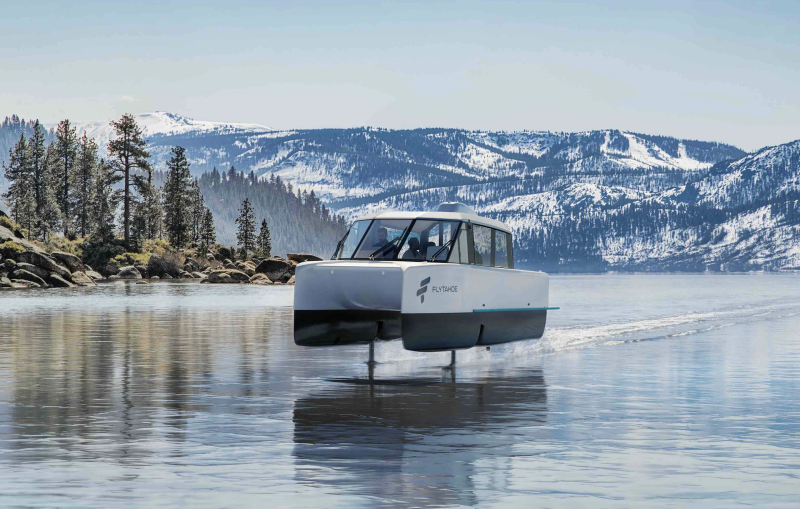
Auckland, New Zealand’s Vessev plans to build electric hydrofoiling ferries in the United States for FlyTahoe, San Francisco, Ca., its first U.S. commercial customer, as the company expands into the market with $19 million in new financing.
Vessev said the Series A and follow-on financing was led by Australia-based Blackbird Ventures with participation from new investors GD1 and Rypples and existing investors K1W1, Icehouse Ventures, Shasta Ventures, NZVC, and angel investors.
The capital will support serial production of Vessev’s 10-passenger VS–9, development of its onboard software and telemetry platform, work on larger vessels, expansion of its global market team, and plans for U.S. manufacturing.
For FlyTahoe, the VS–9 will join a fleet plan that already includes Candela’s larger P-12 electric hydrofoil ferry.
“The VS-9 will be a complementary addition to FlyTahoe’s fleet alongside the P-12 for our sustainable water transit network,” FlyTahoe founder and CEO Ryan Meinzer said in an email to WorkBoat.
FlyTahoe is developing a passenger transportation network on Lake Tahoe intended to move travelers between the lake’s North and South shores. The project is included in the Lake Tahoe Regional Transportation Plan but remains subject to permits and approvals from the Tahoe Regional Planning Agency and other agencies.
Meinzer said the VS–9 will arrive in the U.S. shortly for demonstrations on Lake Tahoe later this year. He did not provide a timetable for the start of passenger service.
“The VS-9 will arrive in the U.S. shortly, with on-water demonstrations planned for Lake Tahoe later this year,” Meinzer said. “We’re excited to share more about those plans in the coming months. Timing for commercial service remains subject to regulatory approval, and FlyTahoe is actively working through the required federal, state and local processes with the goal of bringing service to Lake Tahoe as quickly as possible.”
Vessev co-founder and CEO Eric Laakmann said the vessels intended for FlyTahoe are planned for U.S. construction. Vessev has not yet named a shipyard partner.
“Vessev plans to build the VS–9s for FlyTahoe in the United States, subject to the necessary regulatory approvals,” Laakmann told WorkBoat. “The company is currently exploring partnerships with U.S.-based shipbuilders to undertake the manufacture of Vessev's hulls.”
As part of the broader U.S. expansion, Vessev said it intends to work with domestic shipbuilders while continuing to design, engineer, and produce its core technology in-house, including foils, hardware, and flight-control systems.
The battery-electric VS–9 has capacity for 10 passengers and a range of up to 40 nautical miles with a full load and 50 nautical miles with a light load. Vessev said VS–9 vessels have logged more than 11,000 nautical miles in commercial service in New Zealand.
The company said its hydrofoil system lifts the vessel above the water to reduce hull drag and wake. The foils automatically adjust to changing conditions, with the control system making adjustments up to 100 times per second.
FlyTahoe said it selected the VS–9 in part for its commercial configuration, passenger cabin, and relatively modest charging requirements, which the operator said could allow the vessel to use existing marina infrastructure.
Vessev will begin its U.S. showcase in New York City ahead of New York Climate Week, followed by on-water demonstrations at the Washington Navy Yard in late September. Demonstrations are also planned for Lake Tahoe later this year.
“Hydrofoiling doesn’t just make boats better, it redefines what’s possible on water,” Laakmann said in the company’s announcement. “By combining electric propulsion, advanced foiling systems, and software, we’re making vessels significantly more efficient, better for passengers and more scalable for operators.”
