


Around the country, shipyards are taking advantage of renewed investment in American shipbuilding to acquire equipment that increases capacity, improves efficiency, and opens the door to larger projects.
Cranes as well as mobile boat hoists, also known as travel lifts, are central to that expansion. Though the machinery requires significant investment, its effect can extend throughout a yard’s operations.
Dave Matsuda, president of the Small Shipyard Grant Coalition, described large travel lifts as transformative investments that open shipyards to larger vessels while allowing yards to place more boats ashore at once.
The machines do far more than haul vessels for maintenance or launch completed boats. Shipyards use travel lifts to move vessels between production areas, place hulls inside buildings, join structural sections, and flip hulls during construction. Overhead and crawler cranes move plate, machinery, deckhouses, and other heavy components through busy facilities.
Federal support is accelerating that investment. In August, the U.S. Maritime Administration (Marad) awarded $35.18 million to 45 shipyards in 24 states and the U.S. Virgin Islands through the fiscal year 2026 Small Shipyard Grant Program, up from $8.75 million in each of the previous two rounds. Other yards are purchasing equipment directly.
From a used 600-ton hoist being assembled on the Gulf Coast to an 820-ton lift that helped turn a Hudson River fleet-maintenance facility into a commercial repair yard, the investments are changing what shipyards can build, lift, and service.
MORE WEIGHT, MORE WORK
At Steiner Shipyard, Bayou La Batre, Ala., a used 600-ton Marine Travelift arrived by barge after a nine-day tow around the Florida Keys. Steiner purchased the lift from Safe Harbor Rybovich, West Palm Beach, Fla.
The lift is the same width as Steiner’s existing 400-ton machine, allowing the shipyard to add 200 tons of capacity without immediately making extensive infrastructure changes. The yard is building a new travel-lift slip, which will eventually allow it to handle vessels up to 43'6" wide, with Steiner considering widening the machine to between 48' and 50'.
Gregory Marshall, project manager at Steiner Shipyard, told WorkBoat the lift will support new construction and repair work. The yard is completing two 130'x35' towboats for Florida Marine Transporters, one with a conventional pilothouse and the other with a retractable pilothouse.
The additional capacity gives the yard more options as it pursues larger projects, particularly azimuth stern drive (ASD) tugs. Steiner has built three ASD tugs, but the weight of larger vessels can force yards to install engines after launching to remain within a lift’s capacity.
“It just opens up a lot of these vessels that have always been on the teeter-totter edge of ‘Can we do them? Can we not do them?’” Marshall said.
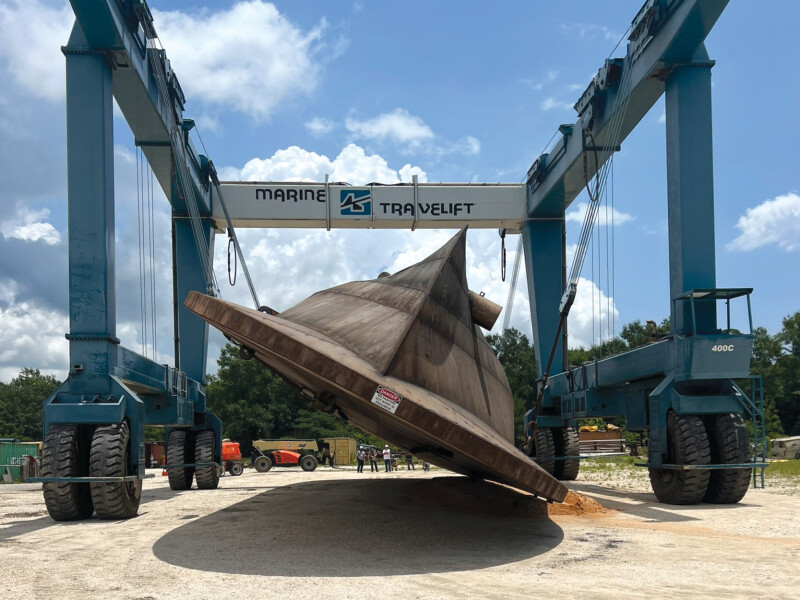
Steiner also uses its travel lifts to assemble hull sections and turn hulls during construction. For a hull flip, crews raise and reposition the structure incrementally, transferring the load among temporary lifting points.
That capability can reduce the need for large rental cranes. Marshall said Steiner recently required two 500-ton cranes to turn a roughly 300-ton hull.
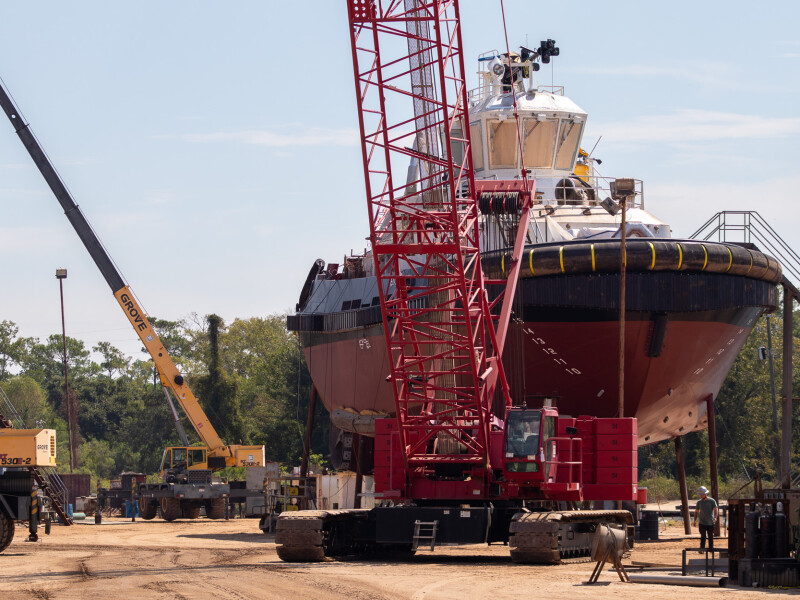
Steiner also acquired a 220-ton-capacity crawler crane about 18 months ago, expanding its ability to turn hulls, position deckhouses, and perform other heavy lifts.
WORK SHIFT
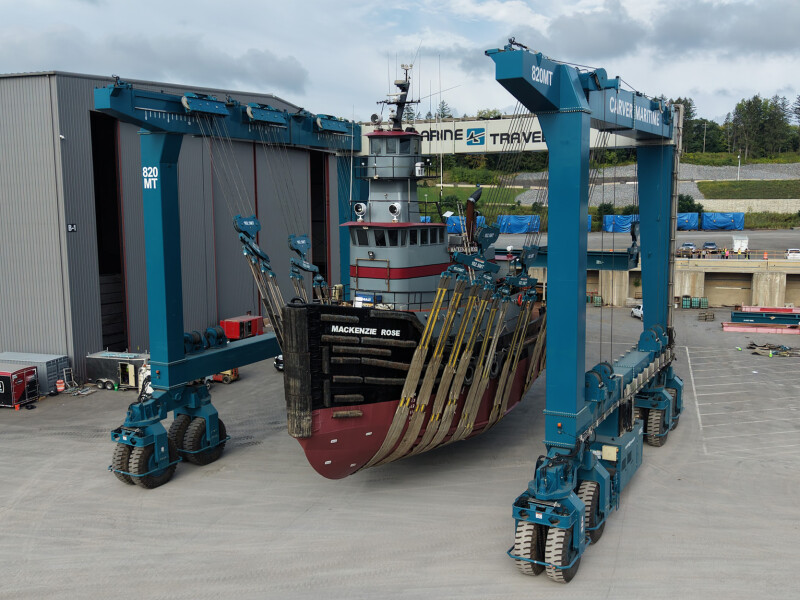
At Carver Marine Steel Works, Coeymans, N.Y., an 820-ton Marine Travelift purchased new five years ago has helped transform an internal maintenance operation into a commercial repair facility.
Carver initially acquired the lift to support its fleet of 10 tugs and 50 barges. The company previously had relied on airbags and a ramp-style arrangement that limited haul-outs primarily to smaller hopper barges. Maintenance was often reactive rather than preventive.
As Carver’s fleet grew, the company needed a faster, more predictable way to remove vessels from the water, said general manager Philip Gallo.
The lift can operate on grades up to 7% and accommodate vessels as wide as 60'. Initially, almost all its capacity was devoted to Carver equipment. About three years ago, around 90% of the yard’s work was internal, Gallo said. After bringing its fleet up to standard and establishing a preventive-maintenance schedule, Carver began marketing the yard to outside operators.
External customers now account for approximately 80% of its work.
“The biggest part of that was honestly picking up overflow from yards in the city being packed out, and also people learning that we’re here and we’re capable,” Gallo said.
Turnaround time is another advantage. A travel lift can remove a vessel and place it on blocks within hours. The lift can then return to the water for another job rather than remain occupied throughout the repair.
Gallo said the machine’s width created a challenge when Carver hauled the company-owned 96'x33'x17'9" ocean tug Mackenzie Rose.
“With the design of our lift, it being so wide, the sling angle can actually hurt us on vessels like tugs because they’re narrower, right? We’ve lifted barges that are in the 800-metric-ton range, but the Mackenzie being light-ship around 520 with a shorter keel, it was the largest tug [hauled to date].”
Carver fabricated a lifting frame in-house to eliminate the angle. The structure can serve as a cradle beneath the vessel or an overhead gantry, allowing the travel lift to use its fully rated capacity, Gallo said.
YARD EFFICIENCY
As travel lifts increase in capacity, their size creates another problem: A machine wide enough for a barge or broad-beamed vessel can consume valuable space when moving smaller vessels around a crowded yard.
Marine Travelift, Sturgeon Bay, Wis., is addressing that constraint with a variable-width option. A telescoping top beam allows the machine to widen for a vessel at the lifting well and retract after reaching land. The operator turns the wheels 90º and narrows the machine around the vessel, allowing it to enter tighter spaces and position boats closer together.
“You can size your machine to pick your biggest-beam vessels,” said Brock Rubens, senior sales manager at Marine Travelift. “But your smaller ones, once you come off the pier, you can actually spin the wheels at 90 degrees, and you can shorten the machine up.”
Rubens said one hurricane-storage operation increased the number of boats it could place ashore by 40% without adding land.
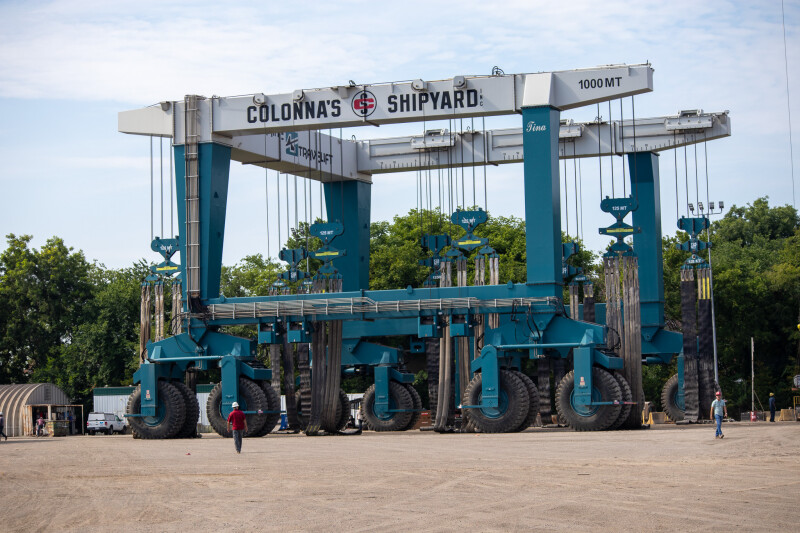
Capacity is also increasing. Marine Travelift has delivered machines rated up to 1,000 tons and is working with prospective customers on 1,200- and 1,500-ton projects, Rubens said. Where 35- to 100-ton machines once represented much of the company’s regular business, its active range is increasingly 75 to 200 tons.
GRANT SUPPORT
Marad’s Small Shipyard Grant Program is helping yards fund equipment purchases as the federal government emphasizes domestic shipbuilding capacity.
Matsuda and Erika Young, director of the Small Shipyard Grant Coalition, said the larger appropriation enabled Marad to support more capital-intensive projects capable of changing how a yard operates.
Matsuda credited the Trump administration’s proposal to fund the program at $105 million with changing the congressional discussion, even though lawmakers ultimately appropriated about one-third of that amount.
“We’d love to see them get to 105,” he said, but allowed that increasing the grants from just under $9 million to over $35 million was transformative and would show what large travel lifts can do for a shipyard. “We know that this industry can spend the money wisely,” he said.
Greater haul-out capacity is particularly important when operators need unplanned repairs, Matsuda said. A shortage of available drydock or travel-lift capacity can extend downtime and require vessels to travel farther for service.
The 2026 awards included several of the equipment projects Matsuda described. Pacific Shipyards International, Honolulu, received approximately $1.53 million toward a 120-ton truck crane, while Fincantieri Bay Shipbuilding, Sturgeon Bay, Wis., received funding for a 100-ton rough-terrain crane. Delta Marine Industries, Seattle, received an award toward the purchase of a 620-ton Marine Travelift.
“This round, we saw more of those kinds of transformational projects,” Matsuda said. “And I think at $105 million, you’ll certainly see even more of those.”
STRONG DEMAND
Marad received 172 applications requesting approximately $162.7 million during the latest funding round, according to the coalition. Matsuda and Young said even that gap understates demand because yards tend to scale their applications to the amount Congress makes available.
“Everybody likes to point to the demand as proof that there’s actual demand for these funds,” Matsuda said. “But that is so understated, because people only write for what they think they can get.”
When annual funding fell below $9 million, applicants often requested grants closer to $500,000 because they understood that larger proposals would face long odds.
“In this round, they’re writing for larger grants, because they know more money is there,” he said. “If $105 million were made available, you would see folks say, ‘We have projects in the $4 million range.’ But they’ve never really been considered for this program before, because it hasn’t been funded enough.”
“We heard from at least a handful of different yards that they sat out the last two rounds because they [said] it’s not going to be enough money to pay for this piece of equipment, even with our match,” Young said.
The program generally provides up to 75% of a project’s cost, with the recipient contributing the remaining 25%.
“So we know when the pot’s larger, we’re going to see more competition, we’re going to see better project ideas,” Young said. “We’ll see some of the holes plugged, like, sometimes a larger travel lift or drydocks are popular when people can scale them correctly for the amount of money available.”
Matsuda encouraged yards to apply even when competition is strong. An unsuccessful application can demonstrate broader demand for the program and give a yard an opportunity to receive feedback before submitting again.
“If you’ve got a project that you’re going to apply for next year, why not put in this year too?” he said. “You know, you get two bites at the apple. You can help show that there’s demand for these funds.”
The latest grants, which reached shipyards across the country, included first-time awards in Vermont and the U.S. Virgin Islands. Young said that geographic reach helps demonstrate that the program supports a national industry, even though shipbuilding and repair activity is concentrated in coastal and inland-waterway states.
“I think the distribution of projects demonstrates that it is a national program,” Young said. “And that’s the point of having Congress fund it as opposed to an individual state.” That distribution can also help sustain congressional backing for annual appropriations, Young said.
BUILDING FROM ABOVE
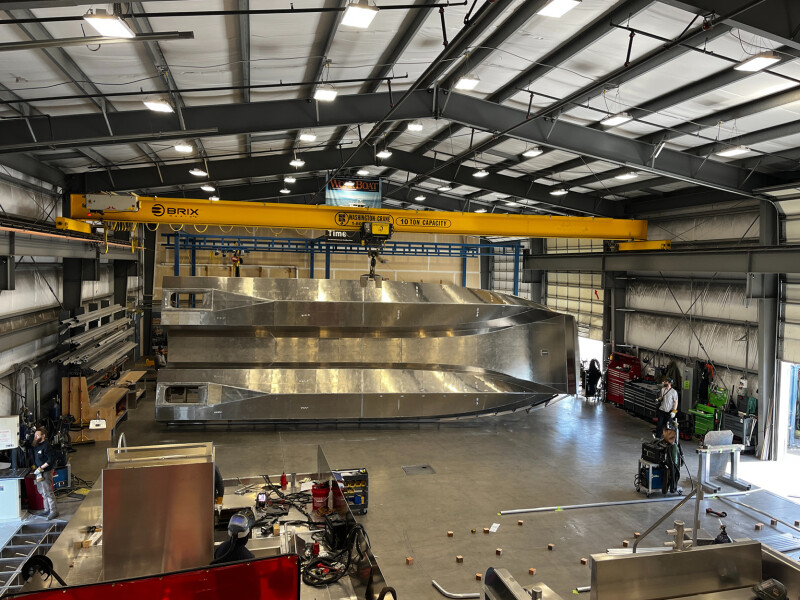
Brix Marine received fiscal year 2026 small shipyard grants for four 10-ton bridge cranes and a CNC press brake for its planned aluminum boat factory at Port Angeles, Wash.
The builder had already committed to the facility and would have pursued the equipment even if the grant program had remained near its previous funding level, said Perry Knudson, Brix Marine’s general manager.
“We would have thrown that Hail Mary no matter what,” Knudson said. “Even if it didn’t get awarded, we’d still be procuring this equipment.”
Knudson said the bridge cranes address three needs: “capacity, efficiency and safety.”
Brix’s current facility has one 10-ton overhead crane covering approximately half its production space. Elsewhere, the yard uses a carry-deck crane that must travel around vessels under construction, occupying floor space and requiring crews to repeatedly establish restricted areas.
The new facility will have two parallel production lines with two 10-ton cranes on each set of rails. Workers will have access to an overhead hook throughout the production area without maneuvering a crane between hulls, equipment, and personnel.
“That more than doubles our capacity in terms of what we can physically do,” Knudson said.
Brix is targeting the fourth quarter of 2027 to begin operating from the new factory.
Launching will be integrated into the building. A 75-ton travel lift owned by the Port of Port Angeles will have direct access to the production floor, allowing completed aluminum vessels to move from the facility to the waterfront.
The arrangement shows how lifting equipment affects the entire shipbuilding process. Crane and travel-lift capacities and travel paths influence building dimensions, production-line spacing, material flow, and assembly sequences.
For Steiner, the immediate results are an additional 200 tons of lifting capacity and access to vessels previously at the edge of what the yard could handle. At Carver, an 820-ton machine helped convert a fleet-support operation into a yard where outside customers provide most of the work. At Brix, four bridge cranes will shape two production lines before the factory opens.
