



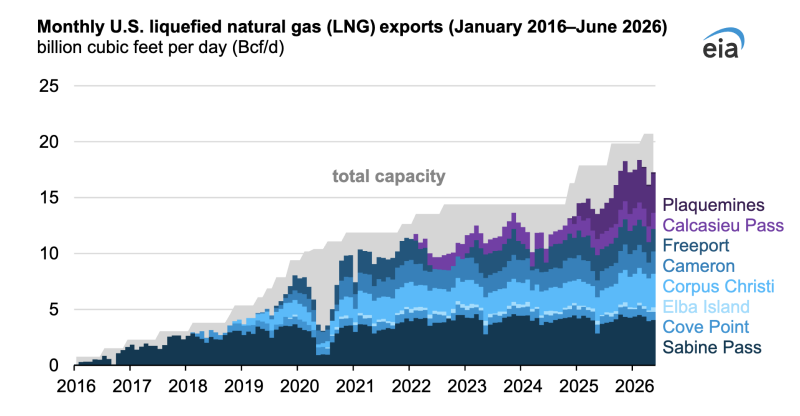
U.S. liquefied natural gas exports averaged 17.4 billion cu. ft. per day (Bcf/d) during the first six months of 2026, up 23% from the same period a year earlier, according to the U.S. Energy Information Administration (EIA).
The increase was the fastest since the U.S. began large-scale LNG exports in 2016. EIA credited new liquefaction capacity coming online, along with global prices high enough to keep terminals running near maximum output — a combination that translates directly into more vessel calls and more tug and support-boat work at Gulf Coast terminals. U.S. exports averaged 15.1 Bcf/d for all of 2025, itself a record.
Venture Global's Plaquemines LNG in Plaquemines Parish, La., is exporting at full capacity. Cheniere Energy's Corpus Christi Stage 3 in Texas, which was running six of its seven liquefaction trains through the first half, reached substantial completion Aug. 28, when contractor Bechtel Energy turned over the seventh and final train. The expansion adds more than 10 million tonnes per annum (mtpa), bringing Corpus Christi above 25 mtpa and Cheniere's total Gulf Coast capacity to roughly 56 mtpa. Together, Plaquemines and Stage 3 add a combined 4 Bcf/d of nominal export capacity.
Golden Pass LNG at Sabine Pass, Texas — a joint venture of QatarEnergy (70%) and ExxonMobil (30%) — achieved first LNG production from Train 1 on March 30 and shipped its first cargo April 22. It became the ninth operational U.S. export terminal. Output from Train 1 is expected to keep climbing through the end of the year, adding 0.7 Bcf/d of nominal capacity; the terminal exported less than 0.2 Bcf/d between April and June as it ramped up. Train 2 is due to be completed in late 2026, with Train 3 to follow, for a facility total of 2.0 Bcf/d nominal, or about 18 mtpa.
EIA's August Short-Term Energy Outlook projected exports averaging 17.3 Bcf/d in the second half of 2026 before climbing to 18.7 Bcf/d in the first half of 2027. The agency's September outlook, released Sept. 9, forecasts 17.4 Bcf/d for full-year 2026 and 18.6 Bcf/d for 2027.
More capacity is close behind. NextDecade expects first gas into Train 1 at Rio Grande LNG, at the Port of Brownsville, Texas, in the second half of this year and first LNG in the first half of 2027. Sempra Infrastructure's Port Arthur (Texas) LNG is also targeting first production in 2027, with its second train due in 2028. Venture Global has guided to second-half 2027 for CP2 in Cameron Parish, La., though some analysts see slippage risk into 2028. Cheniere is building two more trains at Corpus Christi — Midscale Trains 8 and 9, sanctioned in June 2025 under a roughly $2.9 billion Bechtel contract with a guaranteed completion date in the second half of 2028. Woodside's Louisiana LNG in Calcasieu Parish is targeting first LNG in 2029.
The U.S. has been the world's largest LNG exporter since 2023, and producers have benefited from demand for alternative supplies during both the Iran war and following Russia's invasion of Ukraine. Attacks on Qatari facilities in early March forced QatarEnergy to shut Ras Laffan and declare force majeure, and traffic through the Strait of Hormuz fell from about 100 vessels a day to an average of five after the Islamic Revolutionary Guard Corps announced the closure on March 2. Roughly 20% of global LNG trade moves through the strait, most of it Qatari. Asian buyers, who take about 80% of Qatari supply, turned to the spot market for replacements. The disruption has not resolved; vessel traffic slowed again after attacks on shipping resumed July 7, and Qatari exports were still down roughly 96% year over year as of late August, at 18 cargoes against 509 a year earlier.
Europe's benchmark Title Transfer Facility price in the Netherlands averaged $14.74 per million British thermal units (MMBtu) in the first half, up from $13.10/MMBtu a year earlier and the highest since Russia's 2022 invasion of Ukraine, when it reached $32.42/MMBtu. The Japan-Korea Marker, the East Asian benchmark, averaged $15.56/MMBtu, a four-year high and the strongest since $29.00/MMBtu in 2022. That was up $2.38/MMBtu from the first half of 2025, with hot weather in the region adding to spot demand.
U.S. shipments to Asia more than doubled, rising 2.3 Bcf/d, or 108%, from a year earlier. Volumes to Europe edged up 0.1 Bcf/d, or 1%. Exports to Latin America and the Caribbean and to the Middle East and North Africa rose a combined 0.8 Bcf/d, or 46%.
The top five destination countries were Egypt and the Netherlands at 1.7 Bcf/d each, Italy at 1.4 Bcf/d, France at 1.2 Bcf/d, and the United Kingdom at 1.1 Bcf/d.
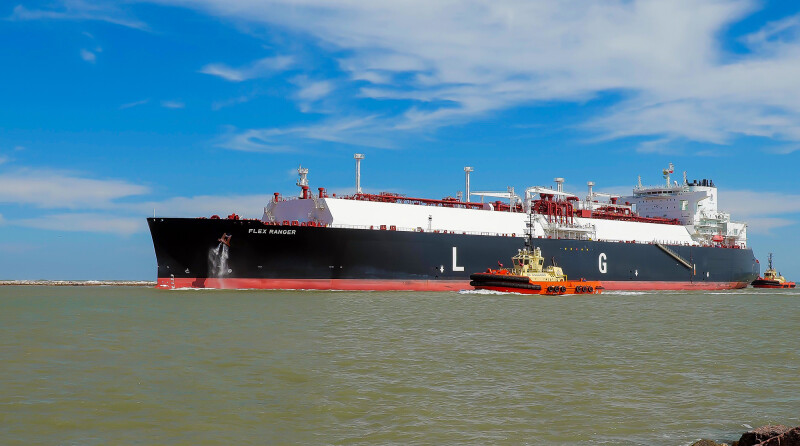
LNG cargoes leaving U.S. terminals requires ship-assist and escort tugs, line handling, pilot transfers, and bunkering support, making export capacity growth one of the more direct drivers of marine services demand on the Gulf Coast.
Several tugboat newbuild programs are already underway to support the buildout. The Gulf LNG Tugs group — a joint venture involving partners Moran Towing, Bay-Houston Towing, and Suderman & Young Towing — is contracted with its affiliates at five Gulf Coast LNG terminals, among them Port Arthur LNG and Rio Grande LNG. It has been taking delivery of a series of tugs from Master Boat Builders, Coden, Ala., and Sterling Shipyard, Port Neches, Texas.
Master Boat Builders is also turning out escort and terminal-support tugs for other operators, including a series of tugs for Maritime Partners to be operated by E.N. Bisso & Son.
In April, Woodside awarded Green Tug Towing a 20-year services contract covering the design, construction, and operation of four hybrid escort tugs for Louisiana LNG, providing berthing, unberthing, escort, standby, and emergency response. Green Tug Towing is a new joint venture of Saltchuk Marine, Seattle, and Harbor Docking & Towing, Lake Charles, La., and will operate a tug facility in Lake Charles. The tugs are being built at C&C Marine and Repair in Belle Chasse, La., for delivery starting in 2028.
