



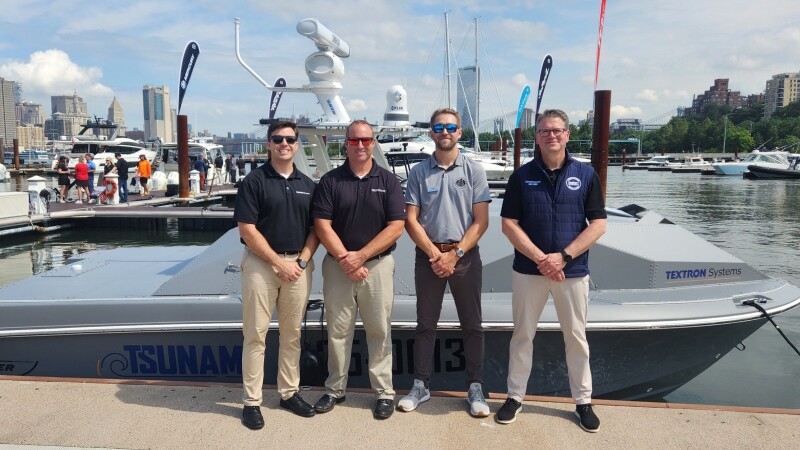
Textron Systems is using commercially produced Boston Whaler boats and Brunswick's existing manufacturing capacity as the foundation for its TSUNAMI uncrewed surface vessels, an approach the companies say can put autonomous capability on the water far faster than a traditional military acquisition program.
The model was on display Aug. 18 at Brooklyn Bridge Marina, where the gray TSUNAMI 25 stood out among a lineup of recreational boats along Pier 5. At its core was a stock Boston Whaler 250 Outrage that had been pulled from a dealer lot before Textron added its autonomy package, wave cover, additional fuel capacity, and other mission equipment.
Gary Ayers, TSUNAMI program director for Textron Systems, Hunt Valley, Md., said the approach combines autonomy developed through more than 15 years of work supporting Navy mine countermeasures with boats Brunswick already knows how to produce at commercial scale.
“We basically take something that Brunswick does and does very well,” Ayers said. “We meet those price points, we meet those turn times, and we provide capability to the fleet when we incorporate our technology on top of that.”
TSUNAMI is not tied to a single hull. Ayers said the system is the technology that makes a vessel uncrewed and autonomous, allowing Textron to apply it to different boats depending on the mission. The company's current lineup ranges from 21' to 42', using Boston Whaler Montauk, Guardian, Outrage, and Justice platforms.
The TSUNAMI 25 shown in Brooklyn is based on the Boston Whaler Outrage/Justice 250 platform. Textron lists the 25'5" craft with a 9' beam, single 400-hp gasoline engine, a top speed above 40 knots, and an approximate 275-nautical-mile range on baseline fuel. With extended fuel capacity, Textron says the configuration has been tested beyond 500 nautical miles in Sea State 4.
Ayers said the commercial-platform approach also allows Textron to move quickly when a customer needs an autonomous vessel.
“We can have a kit ready to go, and we've proven that we can have an unmanned craft, a vessel of opportunity, configured in six hours, and it can immediately support the mission set,” he said.
A more extensive conversion like the TSUNAMI 25 displayed in Brooklyn takes about four to six weeks when Textron starts with an existing boat, Ayers said. Incorporating the work into Brunswick's production process takes roughly 2½ to four months, depending on where the production line stands.
The underlying boat brings another advantage. Because the hull, propulsion, and other components come from established commercial production and supply chains, Ayers said the Navy does not need a specialized supply network to sustain the craft.
“You no longer have the luxury of time,” Ayers said, pointing to government demand for systems that can move from development to the field more quickly. “You can't take a typical acquisition process that is a seven-year development to field.”
Textron has been placing TSUNAMI craft with Navy warfare centers and using them as test platforms, Ayers said. More recently, the USVs participated in the Navy's FLEX event in Key West, leading to contractor-owned, contractor-operated deployments in several locations.
The craft can support missions including maritime domain awareness and intelligence, surveillance, and reconnaissance, along with counter-uncrewed aircraft, counter-underwater vehicle, and surface warfare applications. Ayers said maritime domain awareness and ISR currently represent the strongest demand signal, including operating multiple USVs together to extend surveillance coverage.
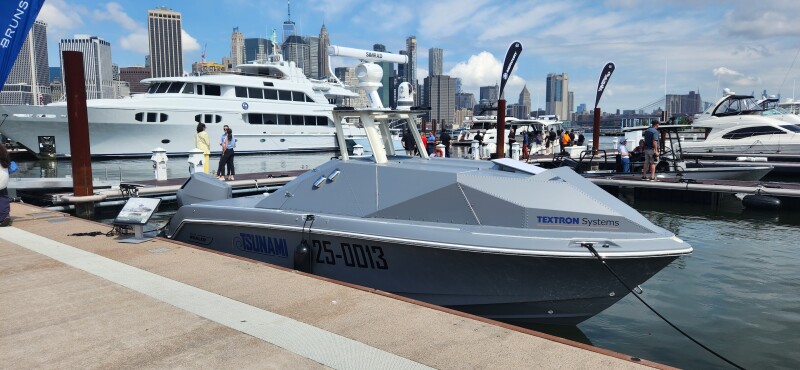
On the Brunswick side, Bryce Birmingham, senior manager of category and strategy at Boston Whaler and general manager of Brunswick Government Products, Edgewater, Fla., said Textron approached the company several years ago while looking for a commercial platform on which to install its technology.
Brunswick provides the Boston Whaler hull, Mercury Marine propulsion, Simrad radar, Lenco controls, and other commercially produced components, Birmingham said. The 250 Outrage runs through Boston Whaler's existing production line in Edgewater alongside the company's other boats.
For Birmingham, the military application also serves as an unusual test of a familiar commercial product.
“It showcases just how well engineered and how robust and durable our Boston Whaler product is, because we can take something that anybody can go buy at a dealership and put that into an extreme application that you need in military environments,” Birmingham said. “We have unsinkable construction, so we get to see all those elements that we really love and that our Boston Whaler customers love get used in an application that really tests that and really showcases that strength in our engineering.”
The TSUNAMI 25 at the Brooklyn event illustrated the point. Birmingham said the boat was pulled directly from a dealer lot as a stock 250 Outrage before Textron installed the wave cover, autonomy technology, and an auxiliary fuel tank for extended-range and long-dwell ISR missions.
Mercury Marine is part of the broader Brunswick commercial operation supporting the platform. John Buelow, president of Mercury Marine, said the company works with commercial OEMs and operators globally, including through its SeaPro engine line, which is designed for commercial applications.
“We have our SeaPro line, which is our engines which are specifically made, tailored for commercial applications,” Buelow said. “All our engines, of course, we focus on durability, reliability, but our SeaPro is designed specifically for those unique needs of commercial markets.”
For Brunswick, the TSUNAMI arrangement provides a route into defense work without establishing a separate production system for the underlying craft. The existing operation also gives the company room to absorb increased demand before additional manufacturing investment would be needed.
“We have the capability to manufacture hundreds of those boats as it is today,” Birmingham said. “If demand ever exceeded that, then you'd start considering incremental capital investment for tooling and things of that nature. But we have all the facilities, we have the production processes, and all that stuff already in place today to build a 250 Outrage.”
Ayers described the Brunswick relationship as a strategic agreement built around combining the companies' respective strengths. He did not identify additional government-vessel programs under the partnership, but said the commercial-production model fits what military customers are asking for.
“What we have with Brunswick is a strategic agreement that basically allows us to go ahead and take advantage of what we do well and what they do well,” Ayers said. “It reduces costs. It's significant reduction in lead times. And again, I've said this multiple times. It gets capability to fleet.”
