



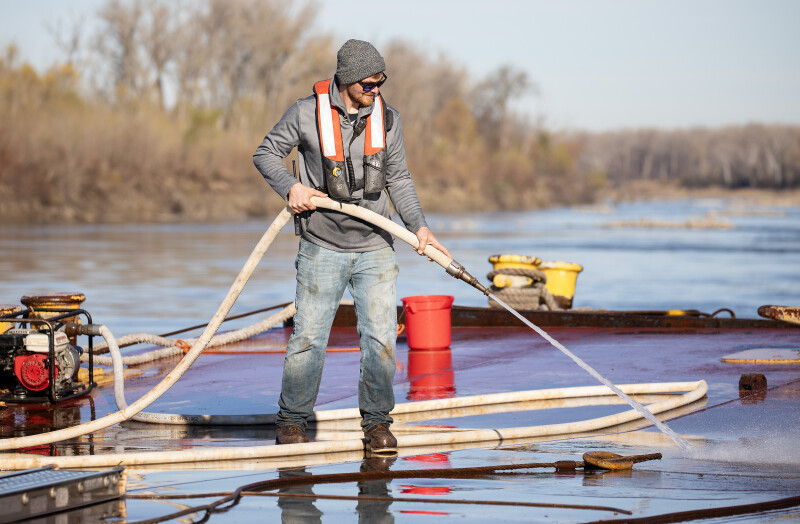
Working in the commercial barge industry has many advantages over trucking and railroad jobs, including reliable schedules, quick advancement, competitive pay, and job security, according to a new study commissioned by the National Waterways Foundation.
Conducted by the Texas Transportation Institute at Texas A&M University, the study takes a deep dive into employment conditions in the inland industry. It paints a picture of a workplace that outshines competitors by many measures, and that makes a substantial contribution to the economy through employment, taxes, and as a key player in the nation’s transportation supply chain.
“Compared to employment in the trucking and rail sectors, waterways positions require no prior experience, and offer advancement based on merit, the opportunity to acquire additional certification, and reliable scheduling of work periods,” said the study, Evaluating Employment by Inland Waterways Operators.
By contrast, the trucking sector is experiencing a critical driver shortage, high turnover rates, irregular work schedules, and health problems due to the sedentary nature of the work. Railroad jobs have similar issues, the study notes, and have experienced big reductions in the workforce recently.
Inland jobs offer good pay, work-life balance, job security, and significantly safer environments than rails and trucks. Median compensation ($73,530 in May 2024) exceeds trucking wages and is close to rail wages.
Job security is another plus, the report finds, because vessel jobs can’t be replaced by autonomous vessels or artificial intelligence, “as too many variables and factors come into play that only an experienced crew member could address.
Job growth on the waterways is projected at 3% from 2023 to 2033, and companies are actively recruiting to fill openings due to retirements.
Researchers analyzed Bureau of Labor Statistics data that included employment numbers and wages. They found that inland waterways jobs have a total economic output, including direct, indirect, and induced impacts of $36.1 billion yearly, contribute $10.2 billion in wages, and employ 127,500 people across the country. These jobs also contribute $4.2 billion in tax revenues annually.
“Our industry generates substantial national economic benefits while providing entry-level positions that can develop into skilled careers without requiring a college degree,” Cherrie Felder, chair of the foundation, said in a statement accompanying the report’s release.
A video and brochure that describe advantages of working on the water were also produced and will be provided to middle and high school guidance counselors and parents to introduce students to this promising career opportunity.
