



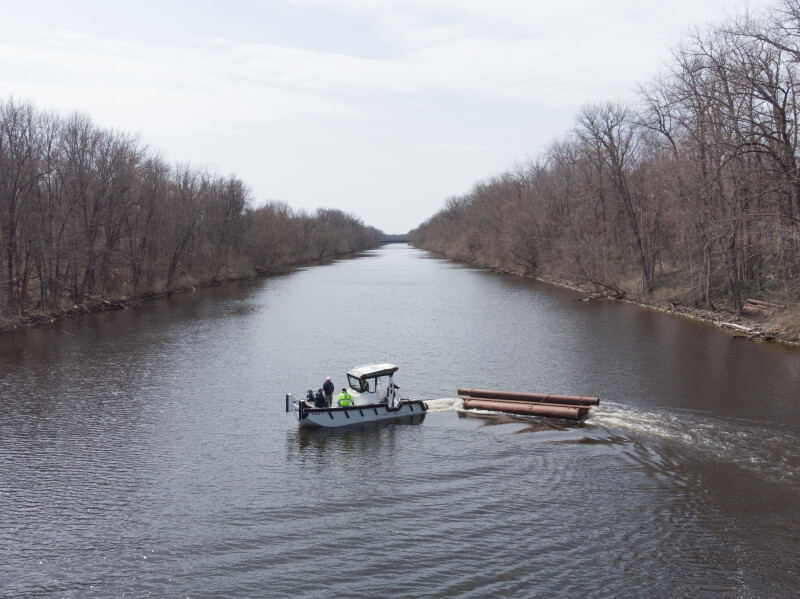
In 2025, the New York Power Authority (NYPA) and the New York State Canal Corporation wrapped up a multi-year evaluation of an electric workboat on the Erie Canal, building on three seasons of trials using a competitively procured Photon-powered 21' Silverback Marine hull to assess whether the technology can adequately support day-to-day canal operations and maintenance activities.
NYPA’s Strategic Projects Manager, Andrew Marzo, said the effort initially stemmed from New York State’s broader climate initiatives and goals. Those policies directed state agencies to increase efficiency across facilities and convert vehicles, equipment, and other assets from combustion engines to electric propulsion where practical and feasible. NYPA, the nation’s largest state-owned utility, has been expanding its electric vehicle charging network statewide. The Canal Corporation, now operated as a subsidiary of NYPA, saw an opportunity to evaluate marine electrification inside its own fleet by leveraging experts from across both organizations.
“In 2019, the New York State Climate Leadership and Community Protection Act (CLCPA) was signed into law, and set ambitious goals for reducing greenhouse gas emissions and transitioning to renewable energy in New York State” Marzo said. “A piece of that initiative includes converting state-owned vehicles and equipment from traditional combustion engines to electric. We knew immediately that there were opportunities to assess our ability to convert a portion of our vehicle fleet and other equipment to electric, but the big question was, ‘What does electrification actually look like for vessels on the canal?’”
The Canal Corporation’s first attempt dates back nearly a decade. In 2014, the Canal Corporation and NYSERDA retrofitted Tender No. 4 with 35 lead-acid batteries and an electric motor. The demonstration produced headlines but was not suitable for daily operations. Operators raised concerns about battery life, range, structural limitations of the historic hull, and the practical need for reliability during long workdays.
By 2022, as policymakers contemplated incentive programs to support commercial tour boat conversions, the Canal Corporation issued a request for information and found that a majority of respondents were interested in attempting to retrofit existing vessels to electric. Upon further research, and discussions with respondents and industry experts, the agency found that the technology, particularly for retrofits, was still cost-prohibitive and architecturally complex. New commercial tour vessels were also largely unavailable in the United States, untested in the industry, and there were very few if any marine technicians that had the knowledge to troubleshoot issues if something were to go wrong. There were also cost and other barriers to developing the charging infrastructure that would be required to practically support the electrification of larger tour vessels. That led the agency to hit the pause button on considering external incentives and instead build internal technical understanding through controlled trials.
“We said, let’s hit the brakes and instead focus on becoming an industry leader and subject matter expert on this technology as the industry continues to mature through its early growth stage,” Marzo said. “This type of project was also a great opportunity for NYPA and the Canal Corporation to come together and leverage one another’s core competencies and subject matter expertise. Both NYPA and the Canal Corporation have histories that are anchored by innovation, and it just seemed like a great fit for our collective team in so many different ways.”
Defining a use case
The first challenge was identifying a location where an electric workboat could operate without major electric infrastructure upgrades. NYPA partnered with the Electric Power Research Institute to survey existing electrical capacity along the canal. The Utica section emerged as the best candidate.
Utica is a central work zone for the Canal Corporation, handling roughly 75% of its dredging workload and managing several tributaries. The section includes maintenance facilities and other locations already equipped with 30- and 50-amp power pedestals and/or hookups, sufficient for overnight charging without the need for new fast-charging infrastructure.
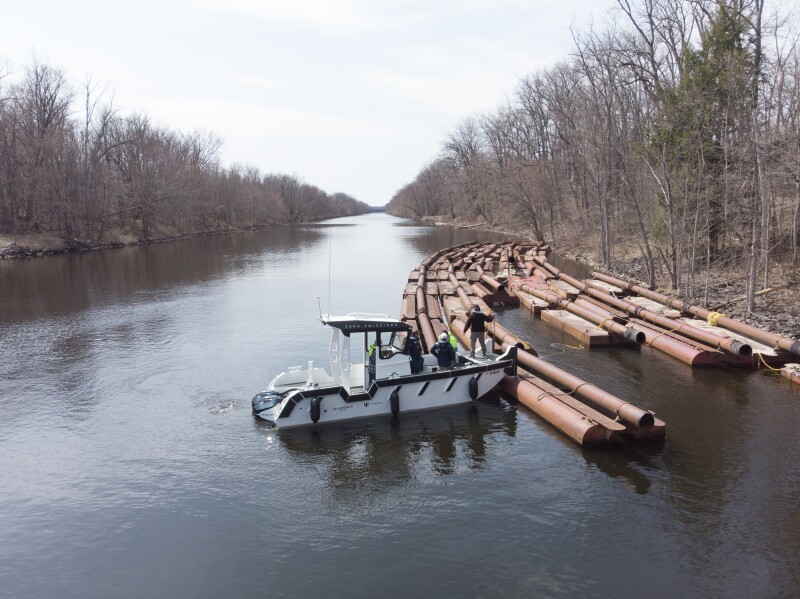
The workboat’s operational profile in this region includes supporting dredge operations, moving crews, pulling buoys, towing dredge pipe, and debris removal. Marzo noted these types of tasks offered a realistic test bed without needing long, high-speed transits.
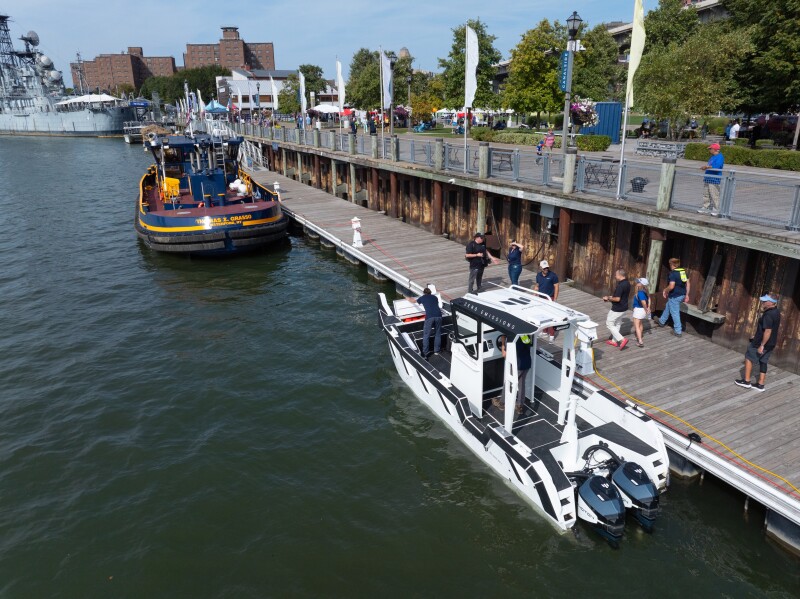
During this period, the Canal Corporation had an existing order with Silverback Marine for new gas-powered workboats. Silverback had recently partnered with Photon Marine and installed a 300-hp electric outboard on one of its 21' hulls. The Canal Corporation arranged for a four-day demonstration in 2023 and later expanded to a six-week trial in 2024.
The trial allowed crews to compare the electric Silverback directly with a nearly identical traditional gasoline model. Marzo said operators immediately noted the electric boat’s maneuverability, quiet operation, and lack of fumes, but practical considerations still shaped the evaluation.
“Crews were skeptical that the electric workboat would have the horsepower to adequately support the work they were doing, and range anxiety still existed,” he said. “There were a few intermittent charging issues as well, and the crew worried that if they showed up at 5:30 a.m. and the boat wasn’t fully charged, then they would not be able to perform their maintenance responsibilities, compared to a gas boat they could just fuel up.”
Crews also needed training in electric-safety procedures, and unlike conventional outboards, there was some hesitation since operators could not perform on-the-spot mechanical troubleshooting if a fault occurred.
Despite these limitations, the electric boat’s overall field performance was strong. The Canal Corporation also incorporated the vessel into several bicentennial events in 2025, including a long-distance operation during which Marzo ran the boat more than 200 miles from Buffalo to Syracuse over the course of a few days. The longest leg, about 50 miles, took roughly ten hours at an average of four to four-and-a-half knots.
“That day was a little nerve-racking,” he said. “For the last 20 miles or so, we were in a more remote section of the canal far away from any of our facilities or charging infrastructure. But we leveraged data and lessons learned from previous legs of the trip, and finished the journey with about 30% charge left.”
For most of the run, speed was held at displacement pace to manage battery drawdown. The team briefly brought the boat on plane during the final miles after confirming sufficient reserve power.
The Canal Corporation typically dewaters large sections of the canal during winter and does not operate workboats outside of icebreaking assets. As a result, the electric boat was not tested in freezing conditions. The vessel returned to Silverback Marine in Portland, Ore., at the end of each navigation season.
Maintenance demands during the lease periods were minimal, and Marzo said one of electrification’s advantages is reduced seasonal upkeep and simplified winterization compared with combustion engines. Photon also helped alleviate some of the crew’s concerns around range anxiety by creating an app that could be downloaded on phones to track the workboat’s battery life, and other important metrics.
What comes next
After the 2025 navigation season ended, NYPA and the Canal Corporation spent some time reflecting on lessons learned, talking to industry experts, and evaluating the vessel and technology’s performance over the past three years. Marzo said the agency has decided that it would like to move forward with its vessel electrification program, and will likely look to lease another electric workboat for the 2026 navigation season while exploring additional use cases elsewhere on the canal so it can continue to evaluate the technology and get it in the hands of more members of the Canal Corporation’s operations team.
“We’re pleased with how this innovative technology has performed,” Marzo said. Our team and vendors have been dedicated to evaluating and developing it further in a way that supports practical marine operations and maintenance applications. At the same time, there are improvements we’d like to see, and we are not looking at this technology as a total replacement for our entire workboat fleet. Instead, we see it as another tool in our toolbelt that we can utilize to perform our operations and maintenance responsibilities while also making sure we are positioning ourselves as an industry leader and champion of the state’s broader climate initiatives and goals.”
The Canal Corporation continues to operate its conventional Silverback workboats across the system.
