


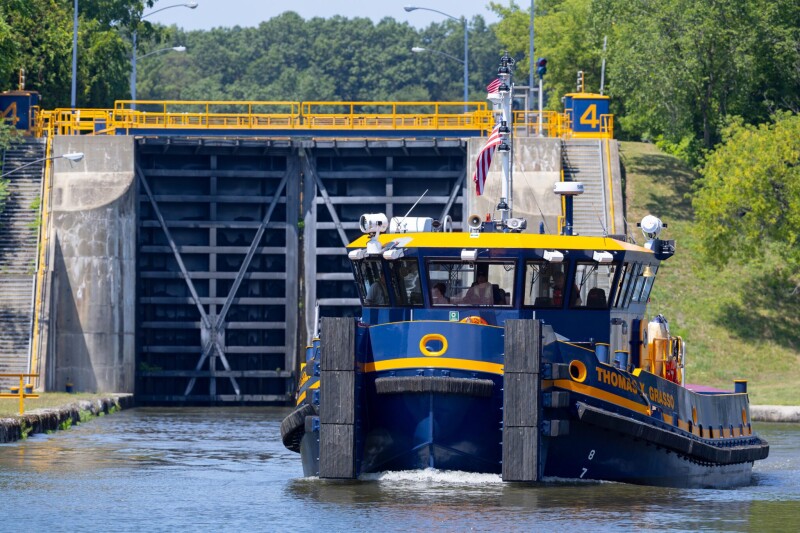
The 64’6”x22’x9’ steel inland tug Thomas X. Grasso was delivered to the New York Power Authority (NYPA) in July and entered service with its subsidiary, the New York State Canal Corporation, during the bicentennial year of the Erie Canal. The delivery marks the first of four new tugs being constructed under NYPA’s fleet renewal program for the Canal Corporation.
Designed by Bristol Harbor Group, Bristol, R.I., and built by Blount Boats, Warren, R.I., the vessels are set to operate along the 524-mile New York State Canal system to support dredging, navigation aid installation, pollution and debris control, and icebreaking operations.
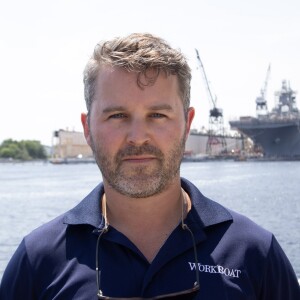
NYPA’s marine infrastructure managers Amy Hansen and Randy Fenton spoke with WorkBoat about the newbuilds. “The Thomas X. Grasso is the first of four tugboats that we’re planning to build for the Canal Corporation,” said Hansen. “All four of them are to be built at Blount. The first one was delivered in July of this year, and the second boat is currently under construction right now.” Grasso will be homeported in Waterford, N.Y., while the second vessel will be stationed in Utica. Boats three and four will head to each location, respectively, Hansen said.
Powered by twin Caterpillar C9.3 Tier 3 “B” rated diesel engines, each producing 375 hp at 1,800 rpm, the Grasso delivers a combined 750 hp through Twin Disc MGX5114SC 3:1 reduction gears to a pair of 38” Michigan Wheel stainless-steel propellers on 4.5” Aquamet 22HS shafts. The vessel’s top speed is listed at 10.5 knots, with an estimated bollard pull of 18,000 lbs. Ship’s service power comes from twin Caterpillar C2.2 Tier 3 marine generators, each rated at 25-kW, providing 208/120V three-phase power.
The vessel draws seven feet, with an air draft limited to 15’3” to allow transit under low canal bridges, aided by a remotely operated retractable main mast. The vessel carries 4,100 gals. of fuel oil, 350 gals. of fresh water, and 350 gals. of black and gray water.
The Grasso’s design was tailored for the tight confines of the Canal system according to Fenton. “They’re working in very restrained waters, and what I mean by that is width of the canal in areas that’s only 140’ wide. We did equip these tugs with flanking rudders,” he said. “Just so we have much better precise control.”
The four tugs are being built as sisterships, with minor refinements anticipated as construction progresses. “We just took delivery of the first one and just like any other first boat there are always small improvements that we’re making as we go,” Hansen said. “But overall, [it’s a] fantastic boat.”
Deck equipment includes a pair of Nabrico DF156-10-6L/R 10-ton pushing winches, two Nabrico DF-164 roller chocks, and a full complement of 10” and 8” diameter bitts for towing and mooring operations. Twin 8.5’-high push knees with a 10’ center spacing fitted with Schuyler SR114 laminated fenders provide the tug’s primary pushing interface. A Nick Jackson 500 lb. main davit and Columbia 5AFM stainless-steel portable davits offer auxiliary lifting capability.
Blount Boats noted the tug is outfitted for year-round operation, featuring ice-strengthened shell plating, reinforced scantlings, and ice knives at both the stem and rudder tubes. The hull is constructed to ABS Grade D standards with a reinforced ice belt, utilizing advanced coating applications done by RJ Forbes for durability and corrosion resistance. The vessel is certified under U.S. Coast Guard Subchapter M for towing vessels.
Heated and air-conditioned accommodations allow for a two- to three-person overnight crew, with capacity for up to eight during day operations. Interior amenities include a galley, crew head with shower, and modern communications and navigation systems supplied by Cay Electronics and Zenitel.
Fire and safety systems include Kidde Fluoro-K automatic fire suppression, Fireboy-Xintex Elite CPM detection with CO and combustible gas sensors, and a Subchapter F-compliant lifesaving package with an Elliot eight-person liferaft, portable extinguishers, PFDs, and a 3M Fibrelight man-overboard cradle.
Cooling is handled by Fernstrum Weka box coolers, with Delta T Zazz ventilation, Rheem freshwater systems, and a Reverso GP-806 lube oil transfer unit. Navigation visibility is aided by Beclawat heated windows, Exalto wipers, and twin Carlisle Finch 350W Xenon searchlights.
The new class of tugs is being introduced to replace the Canal Corporation’s aging vessels that no longer meet current safety standards, particularly around Subchapter M regulations. “We’re coming up to spec on those regulations,” Hansen said. “We’re phasing out three of our older vessels…some of which date back to the 1930s and 1950s… It was just based on the age and really the condition of the hull.”
As for the fate of the retired vessels—Governor Roosevelt, Erie, and Joncaire—Fenton said decisions are still being made. “We’re kind of in a holding pattern right now because they could be deemed state historical vessels,” he said.
